GRACE MATSIKO
Kampala
In an apparent revenge attack following military raids on their territories, suspected Lord’s Resistance Army (LRA) rebels have killed two civilians in South Sudan, a regional official has said.
The Deputy Governor of the Western Equatoria state, Joseph Ngere told Sudan Tribune, a Sudanese online daily publication on Friday, suspected LRA rebels killed two youths in an ambush at Tore, an area on the South Sudan-Democratic Republic of Congo border on Thursday.
“The deputy governor Ngere said there are growing fears in Western Equatoria state that the fighting may spill over to the state,” the Sudan Tribune quoted the governor as saying.
Uganda, DR Congo and the semi-autonomous South Sudan last Sunday launched joint military strikes in an operation codenamed ‘Lightning Thunder’ against the LRA rebels who have been holed up in north-eastern Congo’s Garamba forests since 2005.
But the statement by Governor Ngere on the attack could be a signal that, though the LRA may have been displaced from its bases as a result of last Sunday’s air strikes, the reclusive rebel leader Joseph Kony’s will to forment mischief is not yet over.
Last Sunday’s strike had the stated objective of applying pressure on Kony to sign the Final Peace Agreement negotiated with the Uganda government since 2006. The operation’s commander, Brig. Patrick Kankiriho has said they wanted to “break Kony’s back”.
However, emerging information suggests that the rebels may have been tipped-off before the attack, meaning the onslaught hit empty encampments and ultimately appears to have failed in its primary objective.
Thursday’s ambush at Tore is the one consequence of military action that political leaders in northern Uganda had warned about, saying the LRA could mount retaliatory strikes, forcing their people who have enjoyed relative peace back into the crowded internally displaced persons camps.
Meanwhile, the LRA peace delegation chairman, Mr. David Nyekorach Matsanga said by telephone yesterday, he could not confirm or deny the attack. He promised to verify the information from military commanders on the ground.
“As far we are concerned we are ready for peace not fighting,” Mr Matsanga said. “If there is ceasefire, it will enable our troops to re-assemble in Rii-kwangba, the designated assembly point,” he added.
Mr Matsanga told Sunday Monitor yesterday, they have not closed the door to peace efforts but will no longer allow South Sudan’s semi-autonomous government to chair any talks. Until last Sunday, South Sudan Vice President, Dr Riek Machar, was chief mediator to the Juba peace process.
“I have spoken to LRA and they are asking for cessation of hostilities. They are however saying future negotiations cannot take place in Sudan because the Sudan People’s Liberation Army participated in the raids,” Mr Matsanga said.
When contacted the spokesman for the UPDF troops deployed in the DRC, Capt. Chris Magezi said they have not heard of the attack.
“We are not aware of that,” Capt. Magezi said via satellite telephone link from Dungu yesterday.
Sunday Monitor has separately learnt that the army has stepped up its vigilance in West Nile. Before Operation Lightning Thunder, the army had repeatedly said they have secured Uganda’s borders against possible infiltration by the LRA, a terror group that for years has used panga’s, among other weapons, to kill and maim their victims.
Up to two million Ugandans were at one time internally displaced in northern Uganda as result of the insurgency.
The Governor of Central Equatoria state, which covers the provincial capital of Juba, Major General Clement Wani Konga, on Monday warned of imminent attacks by the LRA rebels in the region.
The UPDF said military strikes on Kony’s bases were necessary to force the elusive rebel leader to sign a peace deal. Kony has thrice failed to show up at the signing venue since at various since the beginning of this year.
Meanwhile, Sunday Monitor has established that the UPDF have established their second tactical headquarters at Camp Swahili, the former LRA headquarters, inside the Garamba forests that were occupied by the troops this week.
Between September 17 and October 4, sources in Monuc, the UN mission in DR Congo, say the LRA attacked 10 villages and abducted of between 100 and 200 people, as well as killing up to a 100 others. The attacks displaced over 70,000 people.
Sunday, December 21, 2008


Mugabe vows not to reverse Zimbabwe farm seizures
Sun 21 Dec 2008, 8:31 GMT
By MacDonald Dzirutwe
BINDURA, Zimbabwe (Reuters) - Zimbabwean President Robert Mugabe said on Saturday he would not allow a unity government to reverse his controversial policy of seizing white-owned farmland and giving it to blacks.
Speaking at his ZANU-PF party's annual conference, Mugabe said that while he hoped the opposition would agree to form a coalition government, he would not compromise on policies such as land seizures, which critics say wrecked Zimbabwe's economy.
"We don't want a unity which is retrogressive," Mugabe told about 6,000 ruling party supporters at this town about 80 km (50 miles) north of the capital Harare.
"The biggest issue is of land ... the land has already been given to the people, it will not be returned to whites."
Mugabe and opposition leader Morgan Tsvangirai agreed three months ago to form a coalition government after disputed elections, but the pact has stalled as they fight over who should control key ministries.
Meanwhile, Zimbabwe has sunk deeper into crisis: hyperinflation means prices double every day and a cholera epidemic has killed more than 1,100 people.
Mugabe has threatened to form a government with or without the MDC, which complains the president is trying to relegate it to a junior role.
Investors hope a unity government would wrest enough control from Mugabe to reverse the policies they blame for the meltdown, and avert total collapse in Zimbabwe. Mugabe blames Western sanctions for the crisis.
UNTILLED FARMLAND
Under the September 15 deal, land that was seized from white farmers and now lies dormant would not be returned, but would be redistributed to black farmers with the resources and skills to cultivate it.
In a sign of Zimbabwe's collapse -- and its potential -- the conference took place in a town that once relied on mining for its economic lifeblood. Those mines have recently been shut.
ZANU-PF officials earlier said the party was likely to vote on a resolution on Saturday urging Mugabe urgently to form a government unilaterally -- a move that would probably finish off the power-sharing pact.
Resolutions were being discussed behind closed doors and it was not immediately clear whether the motion had been passed.
In elections last March, ZANU-PF lost its parliamentary majority for the first time since independence in 1980. Tsvangirai boycotted a run-off presidential vote in June, citing violence against his supporters.
Western countries and some African leaders have renewed calls in recent weeks for Mugabe, 84, to step down.
But, a day after vowing never to "surrender", Mugabe railed against his foes, saying the West wanted to topple him.
"Mugabe must go before Bush is going?" he said, referring to U.S. President George W. Bush, who leaves office in January. "Is it a ritual now that Bush with his political death must be accompanied by some African from
By MacDonald Dzirutwe
BINDURA, Zimbabwe (Reuters) - Zimbabwean President Robert Mugabe said on Saturday he would not allow a unity government to reverse his controversial policy of seizing white-owned farmland and giving it to blacks.
Speaking at his ZANU-PF party's annual conference, Mugabe said that while he hoped the opposition would agree to form a coalition government, he would not compromise on policies such as land seizures, which critics say wrecked Zimbabwe's economy.
"We don't want a unity which is retrogressive," Mugabe told about 6,000 ruling party supporters at this town about 80 km (50 miles) north of the capital Harare.
"The biggest issue is of land ... the land has already been given to the people, it will not be returned to whites."
Mugabe and opposition leader Morgan Tsvangirai agreed three months ago to form a coalition government after disputed elections, but the pact has stalled as they fight over who should control key ministries.
Meanwhile, Zimbabwe has sunk deeper into crisis: hyperinflation means prices double every day and a cholera epidemic has killed more than 1,100 people.
Mugabe has threatened to form a government with or without the MDC, which complains the president is trying to relegate it to a junior role.
Investors hope a unity government would wrest enough control from Mugabe to reverse the policies they blame for the meltdown, and avert total collapse in Zimbabwe. Mugabe blames Western sanctions for the crisis.
UNTILLED FARMLAND
Under the September 15 deal, land that was seized from white farmers and now lies dormant would not be returned, but would be redistributed to black farmers with the resources and skills to cultivate it.
In a sign of Zimbabwe's collapse -- and its potential -- the conference took place in a town that once relied on mining for its economic lifeblood. Those mines have recently been shut.
ZANU-PF officials earlier said the party was likely to vote on a resolution on Saturday urging Mugabe urgently to form a government unilaterally -- a move that would probably finish off the power-sharing pact.
Resolutions were being discussed behind closed doors and it was not immediately clear whether the motion had been passed.
In elections last March, ZANU-PF lost its parliamentary majority for the first time since independence in 1980. Tsvangirai boycotted a run-off presidential vote in June, citing violence against his supporters.
Western countries and some African leaders have renewed calls in recent weeks for Mugabe, 84, to step down.
But, a day after vowing never to "surrender", Mugabe railed against his foes, saying the West wanted to topple him.
"Mugabe must go before Bush is going?" he said, referring to U.S. President George W. Bush, who leaves office in January. "Is it a ritual now that Bush with his political death must be accompanied by some African from
Mugabe vows not to reverse Zimbabwe farm seizures
Sun 21 Dec 2008, 8:31 GMT
By MacDonald Dzirutwe
BINDURA, Zimbabwe (Reuters) - Zimbabwean President Robert Mugabe said on Saturday he would not allow a unity government to reverse his controversial policy of seizing white-owned farmland and giving it to blacks.
Speaking at his ZANU-PF party's annual conference, Mugabe said that while he hoped the opposition would agree to form a coalition government, he would not compromise on policies such as land seizures, which critics say wrecked Zimbabwe's economy.
"We don't want a unity which is retrogressive," Mugabe told about 6,000 ruling party supporters at this town about 80 km (50 miles) north of the capital Harare.
"The biggest issue is of land ... the land has already been given to the people, it will not be returned to whites."
Mugabe and opposition leader Morgan Tsvangirai agreed three months ago to form a coalition government after disputed elections, but the pact has stalled as they fight over who should control key ministries.
Meanwhile, Zimbabwe has sunk deeper into crisis: hyperinflation means prices double every day and a cholera epidemic has killed more than 1,100 people.
Mugabe has threatened to form a government with or without the MDC, which complains the president is trying to relegate it to a junior role.
Investors hope a unity government would wrest enough control from Mugabe to reverse the policies they blame for the meltdown, and avert total collapse in Zimbabwe. Mugabe blames Western sanctions for the crisis.
UNTILLED FARMLAND
Under the September 15 deal, land that was seized from white farmers and now lies dormant would not be returned, but would be redistributed to black farmers with the resources and skills to cultivate it.
In a sign of Zimbabwe's collapse -- and its potential -- the conference took place in a town that once relied on mining for its economic lifeblood. Those mines have recently been shut.
ZANU-PF officials earlier said the party was likely to vote on a resolution on Saturday urging Mugabe urgently to form a government unilaterally -- a move that would probably finish off the power-sharing pact.
Resolutions were being discussed behind closed doors and it was not immediately clear whether the motion had been passed.
In elections last March, ZANU-PF lost its parliamentary majority for the first time since independence in 1980. Tsvangirai boycotted a run-off presidential vote in June, citing violence against his supporters.
Western countries and some African leaders have renewed calls in recent weeks for Mugabe, 84, to step down.
But, a day after vowing never to "surrender", Mugabe railed against his foes, saying the West wanted to topple him.
"Mugabe must go before Bush is going?" he said, referring to U.S. President George W. Bush, who leaves office in January. "Is it a ritual now that Bush with his political death must be accompanied by some African from
By MacDonald Dzirutwe
BINDURA, Zimbabwe (Reuters) - Zimbabwean President Robert Mugabe said on Saturday he would not allow a unity government to reverse his controversial policy of seizing white-owned farmland and giving it to blacks.
Speaking at his ZANU-PF party's annual conference, Mugabe said that while he hoped the opposition would agree to form a coalition government, he would not compromise on policies such as land seizures, which critics say wrecked Zimbabwe's economy.
"We don't want a unity which is retrogressive," Mugabe told about 6,000 ruling party supporters at this town about 80 km (50 miles) north of the capital Harare.
"The biggest issue is of land ... the land has already been given to the people, it will not be returned to whites."
Mugabe and opposition leader Morgan Tsvangirai agreed three months ago to form a coalition government after disputed elections, but the pact has stalled as they fight over who should control key ministries.
Meanwhile, Zimbabwe has sunk deeper into crisis: hyperinflation means prices double every day and a cholera epidemic has killed more than 1,100 people.
Mugabe has threatened to form a government with or without the MDC, which complains the president is trying to relegate it to a junior role.
Investors hope a unity government would wrest enough control from Mugabe to reverse the policies they blame for the meltdown, and avert total collapse in Zimbabwe. Mugabe blames Western sanctions for the crisis.
UNTILLED FARMLAND
Under the September 15 deal, land that was seized from white farmers and now lies dormant would not be returned, but would be redistributed to black farmers with the resources and skills to cultivate it.
In a sign of Zimbabwe's collapse -- and its potential -- the conference took place in a town that once relied on mining for its economic lifeblood. Those mines have recently been shut.
ZANU-PF officials earlier said the party was likely to vote on a resolution on Saturday urging Mugabe urgently to form a government unilaterally -- a move that would probably finish off the power-sharing pact.
Resolutions were being discussed behind closed doors and it was not immediately clear whether the motion had been passed.
In elections last March, ZANU-PF lost its parliamentary majority for the first time since independence in 1980. Tsvangirai boycotted a run-off presidential vote in June, citing violence against his supporters.
Western countries and some African leaders have renewed calls in recent weeks for Mugabe, 84, to step down.
But, a day after vowing never to "surrender", Mugabe railed against his foes, saying the West wanted to topple him.
"Mugabe must go before Bush is going?" he said, referring to U.S. President George W. Bush, who leaves office in January. "Is it a ritual now that Bush with his political death must be accompanied by some African from
Friday, December 19, 2008
Trio found guilty of Rwandan genocide
(CNN) -- The International Criminal Tribunal for Rwanda on Thursday convicted the "mastermind" of the Rwandan genocide and sentenced him to life in prison for genocide, crimes against humanity, and war crimes.
It is the first time the tribunal has convicted high-level officials for the 100-day genocide in 1994 which left an estimated 800,000 people dead.
Theoneste Bagosora, 67, a colonel in the Rwandan army, was found guilty along with two other men -- Major Aloys Ntabakuze and Lieutenant Colonel Anatole Nsengiyumva. All were sentenced to life in prison.
The tribunal -- located in Arusha, Tanzania -- acquitted General Gratien Kabiligi, the former head of military operations, and ordered his immediate release.
CNN Chief International Correspondent Christiane Amanpour -- who covered the story -- called the verdicts "a real turning point and a milestone in justice."
"It sends a message that right up the chain of command, you cannot hide," Amanpour said.
The court said Bagosora was a key figure in drawing up plans for the genocide. A Hutu, Bagosora was convicted of ordering Hutu militia to slaughter rival Tutsis.
The massacres began after a plane crash on April 6, 1994 that killed the presidents of Rwanda and neighboring Burundi. The court said the plane was brought down by a surface-to-air missile fired from the airport in Kigali, the Rwandan capital.
Bagosora decided the military should take over and he refused to involve the prime minister, Agathe Uwilingiyimana, in any discussions, the court found.
April 7, while Bagosora held a crisis meeting with top military officials, the prime minister was arrested, sexually assaulted and killed by top members of the Rwandan Army, the court found.
That made Bagosora the head of all political and military affairs in Rwanda, and in that capacity, he was at the top of the chain of command.
The same day the prime minister was killed, the court said, army personnel confined and killed four important opposition leaders -- including the president of the constitutional court and government ministers -- and murdered 10 Belgian peacekeepers who had been dispatched to the prime minister's residence.
The court found Bagosora bore responsibility for those and other killings because he commanded those who carried out the crimes.
"Bagosora was the highest authority in the Ministry of Defense and exercised effective control of the Rwandan army and gendarmerie," said Presiding Judge Erik Mose. "He's therefore responsible for the murder of the prime minister, the four opposition politicians, the 10 Belgian peacekeepers, as well as the extensive military involvement in the killing of civilians during this period."
ICTR Prosecutor Hassan Bubacar Jallow said the convicted men "prepared, planned, ordered, directed, incited, encouraged and approved the murder of innocent civilian Tutsis."
The killings were carried out by military personnel on the orders of Rwandan authorities including Bagosora, the court said.
The court found that from April to July 1994, Bagosora exercised authority over members of the Rwandan Army and their militiamen, who committed massacres throughout Rwanda with Bagosora's knowledge.
"In all the regions of the country, members of the Tutsi population who were fleeing from the massacres on their hills sought refuge in locations they thought would be safe, often on the recommendation of the local civil and military authorities," the indictment said. "In many of these places, despite the promise that they would be protected by the local civil and military authorities, the refugees were attacked, abducted and massacred, often on the orders or with the complicity of those same authorities."
The indictment against Bagosora alleged he had been opposed to concessions made by his government to Tutsi rebels at 1993 peace talks in Tanzania, and had left the negotiations saying he was returning to Rwanda to "prepare the apocalypse."
The U.N. established the tribunal in late 1994. The trial began in April 2002 and has been deliberating since June 1, 2007.
During the trial, the court heard 242 witnesses -- 82 for the prosecution and 160 for the defense.
The three convicted men will be held in the tribunal's custody until a state can be found to house them.
The genocide's impact is still be felt today, with recent fighting in neighbouring Congo blamed on lingering tensions from the slaughter.
Rebel leader Laurent Nkunda says his forces are fighting to defend Congolese Tutsis from Hutu militants who escaped to Congo.
It is the first time the tribunal has convicted high-level officials for the 100-day genocide in 1994 which left an estimated 800,000 people dead.
Theoneste Bagosora, 67, a colonel in the Rwandan army, was found guilty along with two other men -- Major Aloys Ntabakuze and Lieutenant Colonel Anatole Nsengiyumva. All were sentenced to life in prison.
The tribunal -- located in Arusha, Tanzania -- acquitted General Gratien Kabiligi, the former head of military operations, and ordered his immediate release.
CNN Chief International Correspondent Christiane Amanpour -- who covered the story -- called the verdicts "a real turning point and a milestone in justice."
"It sends a message that right up the chain of command, you cannot hide," Amanpour said.
The court said Bagosora was a key figure in drawing up plans for the genocide. A Hutu, Bagosora was convicted of ordering Hutu militia to slaughter rival Tutsis.
The massacres began after a plane crash on April 6, 1994 that killed the presidents of Rwanda and neighboring Burundi. The court said the plane was brought down by a surface-to-air missile fired from the airport in Kigali, the Rwandan capital.
Bagosora decided the military should take over and he refused to involve the prime minister, Agathe Uwilingiyimana, in any discussions, the court found.
April 7, while Bagosora held a crisis meeting with top military officials, the prime minister was arrested, sexually assaulted and killed by top members of the Rwandan Army, the court found.
That made Bagosora the head of all political and military affairs in Rwanda, and in that capacity, he was at the top of the chain of command.
The same day the prime minister was killed, the court said, army personnel confined and killed four important opposition leaders -- including the president of the constitutional court and government ministers -- and murdered 10 Belgian peacekeepers who had been dispatched to the prime minister's residence.
The court found Bagosora bore responsibility for those and other killings because he commanded those who carried out the crimes.
"Bagosora was the highest authority in the Ministry of Defense and exercised effective control of the Rwandan army and gendarmerie," said Presiding Judge Erik Mose. "He's therefore responsible for the murder of the prime minister, the four opposition politicians, the 10 Belgian peacekeepers, as well as the extensive military involvement in the killing of civilians during this period."
ICTR Prosecutor Hassan Bubacar Jallow said the convicted men "prepared, planned, ordered, directed, incited, encouraged and approved the murder of innocent civilian Tutsis."
The killings were carried out by military personnel on the orders of Rwandan authorities including Bagosora, the court said.
The court found that from April to July 1994, Bagosora exercised authority over members of the Rwandan Army and their militiamen, who committed massacres throughout Rwanda with Bagosora's knowledge.
"In all the regions of the country, members of the Tutsi population who were fleeing from the massacres on their hills sought refuge in locations they thought would be safe, often on the recommendation of the local civil and military authorities," the indictment said. "In many of these places, despite the promise that they would be protected by the local civil and military authorities, the refugees were attacked, abducted and massacred, often on the orders or with the complicity of those same authorities."
The indictment against Bagosora alleged he had been opposed to concessions made by his government to Tutsi rebels at 1993 peace talks in Tanzania, and had left the negotiations saying he was returning to Rwanda to "prepare the apocalypse."
The U.N. established the tribunal in late 1994. The trial began in April 2002 and has been deliberating since June 1, 2007.
During the trial, the court heard 242 witnesses -- 82 for the prosecution and 160 for the defense.
The three convicted men will be held in the tribunal's custody until a state can be found to house them.
The genocide's impact is still be felt today, with recent fighting in neighbouring Congo blamed on lingering tensions from the slaughter.
Rebel leader Laurent Nkunda says his forces are fighting to defend Congolese Tutsis from Hutu militants who escaped to Congo.
Sunday, December 14, 2008
UN SECURITY COUNCIL REPORT
NOVEMBER 2008
DEMOCRATIC REPUBLIC OF THE CONGO
Expected Council Action
The dramatic developments in eastern Democratic Republic of the Congo (DRC) suggest that the Council will continue to watch the situation closely. It remains to be seen, however, whether the Council will agree to include the issue in the Council’s November programme of work. (Further discussions seem to be warranted especially in view of the regional implications and the grave risks for civilians in the light of the history of genocide in the region and the regional/ethnic roots of the problem.) It also remains to be seen how DRC issues will be featured by members in their statements in the thematic debate on protection of civilians in November.
The DRC Sanctions Committee expects to receive the final report of the Group of Experts monitoring the sanctions regime in late November. (The report had been originally expected on 15 November, in line with resolution 1807 of 31 March.)
Key Recent Developments
Initial armed clashes in the eastern DRC have escalated into all-out war. Several towns and camps for internally displaced persons (IDPs) were overrun and the provincial capital of Goma was under imminent threat with the armed forces of the DRC (Forces armées de la République Démocratique du Congo, or FARDC) fleeing the city in disarray. At press time, rebel general Laurent Nkunda who heads the National Congress for the Defence of the People (Congrès National pour la Défense du Peuple, or CNDP) declared a unilateral ceasefire. There are reports of direct involvement in the fighting by UN peacekeepers.
Tensions between the DRC and Rwanda have grown since early October and seem to have escalated into direct exchanges and fire across the border. The DRC government alleges that Rwandan government forces have lent their support to the CNDP. The Rwandan government alleges government support of “forces of genocide” comprising the former Armed Forces of Rwanda (ex-FAR) and the extremist militia Hutu forces (Interahamwe) and the rebel Democratic Forces for the Liberation of Rwanda (Forces démocratiques de Libération du Rwanda, or the FDLR). (The ex-FAR was the army of the ethnic Hutu-dominated Rwandan regime during the genocide in 1994. The Interahamwe was the civilian militia force that carried out much of the killing during the genocide.) In 2000 the FDLR was formed as a successor to the Hutu exiles’ driven Army for the Liberation of Rwanda (ALIR) which was made up of ex-FAR and Interahamwe members.
Nkunda’s CNDP was formed in 2004 originally to protect Congolese Tutsis residing in eastern DRC from attacks by ex-FAR/Interahamwe/FDLR, although Nkunda has in recent times called for a national insurrection against the incumbent Congolese government. (For recent background details on these issues please see our 14 October Update Report.) In a letter to the president of the Council on 14 October, the Rwandan ambassador to the UN conveyed his government’s allegations of collaboration between the FARDC and the ex-FAR/Interahamwe and the FDLR. On 15 October the ambassador requested the Council to condemn the alleged collaboration between the Armed Forces of the DRC and the ex-FAR Interahamwe/FDLR, sanction five FARDC commanders “directly involved in the most recent collaboration with the forces of genocide”, and suspend the UN Mission in the DRC (MONUC) support to the FARDC “until there is a verified end to the FARDC/FDLR co-location and collaboration.”
On 21 October the Council adopted a presidential statement which:
expressed concern about the resurgence of violence in the eastern parts of the DRC and its humanitarian consequences;
welcomed the intention of MONUC to reconfigure its forces to optimise their deployment within the current troop ceiling and mandate; noted (but did not approve) the reinforcements requested in early October by Special Representative of the Secretary-General and head of MONUC, Alan Doss;requested a comprehensive analysis of the situation from the Secretary-General and recommendations for the renewal of MONUC’s mandate in the next report for the Council’s consideration;
condemned recent calls by Nkunda for a national insurrection;urged the Congolese government to take effective steps to ensure that there is no cooperation between elements of the FARDC and the FDLR.
called on the governments in the region to cease all support to the armed groups in the eastern DRC;
encouraged the Secretary-General to step up his efforts to facilitate dialogue between the DRC and Rwanda;
urged the governments of the DRC and Rwanda to engage in efforts to settle their differences; and condemned the recent attacks by the LRA and made reference to the International Criminal Court’s indictments against the LRA leadership.
Over the weekend of 25 October Nkunda’s forces captured a major Congolese army base at Rumangabo and the headquarters of Virunga National Park. On 26 October the UN accused Nkunda’s soldiers of firing rockets at two UN vehicles, injuring several peacekeepers. The accusation was denied by a spokesman for Nkunda.
On 27 and 28 October Congolese protesters attacked the UN's headquarters in Goma over what they saw as insufficient protection for them and support to Congolese government forces against the offensive by Nkunda’s forces. Thousands of refugees displaced by the fighting have reportedly moved into Goma. UN peacekeepers were reported to have deployed to battle the rebels, using UN helicopter gunships and ground forces against the rebels in Rumangabo. The rationale for this action may have been to protect IDPs in the area—but that remains unclear. Nkunda’s army seems to have forced the national army to withdraw from Kimbumba and was reported to be advancing on Goma.
On 27 October Lieutenant General Vicente Diaz de Villegas y Herrería of Spain indicated that he would relinquish his post citing personal reasons (he had been appointed as force commander for MONUC seven weeks before). Brigadier General Ishmeel Ben Quartey of Ghana was named to serve as Acting Force Commander until a successor to Diaz was appointed.
On 28 October the Security Council was briefed in private consultations by the Under Secretary-General for Peacekeeping Operations Alain Le Roy on the security situation in the eastern provinces of the DRC. He reportedly informed the Council that the situation on the ground was very critical, with Nkunda’s forces having advanced within a few kilometres of Goma. Le Roy emphasised the request that had been made in early October by Doss for reinforcements for MONUC. He suggested that a political solution involving all the parties was critical. Apparently there was some discussion of the Secretary-General appointing a special envoy to directly engage the DRC and Rwanda. Le Roy also discussed possible options for a multinational force being deployed to assist in securing Goma.
Speaking to the media on 28 October, the president of the Council indicated that during the meeting Council members:
expressed grave concern at the resurgence of violence in eastern DRC and strongly condemned the “offensive operations”;
urged all parties to immediately observe a ceasefire and to implement the disengagement plan;
expressed deep concern over the humanitarian consequences of the recent fighting and its negative implications for regional peace and stability; reiterated the need for all parties to the Goma and Nairobi agreements to implement them effectively; and
expressed support for the peacemaking efforts of the Secretary-General and MONUC in the DRC, and called on the relevant parties to cooperate with MONUC to achieve peace and stability in the country and the Great Lakes region.
On 29 October 2008, Council adopted a presidential statement which:
condemned the CNDP offensive in the eastern DRC and demanded that it bring its operations to an end. The Council welcomed the announcement by Laurent Nkunda of an immediate ceasefire and anticipated that he would ensure its effective and durable implementation, and the CNDP’s reengagement in the Goma process; expressed its grave concern about the dramatic humanitarian consequences of the fighting and urged all parties to respect fully their obligations under international law to protect civilians; urged all the signatories to the Goma and Nairobi processes to implement their commitments effectively and in good faith and called on the DRC and Rwandan authorities to take concrete steps to defuse tensions and to restore stability in the region; supported the efforts of the Secretary General to facilitate dialogue between the leaders of the DRC and Rwanda and encouraged him to send a special envoy tasked with this mission as soon as possible;
urged the Government of the DRC to take effective steps to ensure that there is no cooperation between elements of the FARDC and the FDLR and called upon the Governments of the region to cease all support to the armed groups in the eastern region of the DRC; expressed its concern at the reports of heavy weapons fire across the DRC-Rwanda border and reiterates its determination to continue to monitor closely the implementation of the arms embargo and other measures as set out in its resolution 1807; expressed its full support for MONUC and condemned all attacks launched against MONUC and called on MONUC to continue to implement fully its mandate, in all its aspects, especailly “by robust actions to protect civilians at risk and to deter any attempt to threaten the political process by any armed group”; and noted the request by the UN Secretariat for reinforcement of the MONUC and indicated that Council would “study expeditiously that request in view of the developments of the situation on the ground.”
Key Issues
The key issue for the Council is the dangerous situation in the DRC, with its worrying humanitarian implications, and the related issues for the Great Lakes region as a whole. Related issues include urgent protection of civilians requirements and the concerns and role of Rwanda.
The underlying problem is that, despite the agreements which have led to relative stability in western DRC, in the east the Tutsi minority still feels extremely insecure due to lack of accommodations of their concerns by Kinshasa and the presence in the region of the illegal Hutu elements from Rwanda who had perpetrated the genocide against their Tutsi cousins in that country. This situation has fueled the Nkunda rebellion. Equally serious is the problem of relocating Hutu back to Rwanda because of the unwillingness there to make some political accommodations.
Options
Options for the Council members include:
agree to include either DRC or the Great Lakes as an item in the programme of work as a signal of its seriousness on the issue and determination to take further action;
use their interventions in the November debate on protection of civilians to highlight the problem in eastern DRC;
initiate discussions immediately on the request made by Doss for reinforcements for MONUC and on elements for a draft resolution authorising a multinational force, should that become a more feasible immediate option;
develop an initiative to produce a comprehensive political solution to the regional tension involving not only the good offices of the Secretary-General but also more active leadership from the Council and close cooperation with the AU (this might include pressing Kinshasa to accept the need for a formal ceasefire and a negotiated solution with Nkunda followed by a real solution to the ex-FAR/FDLR problem—thereby removing justifications cited by Nkunda and the Rwandan government for their positions). Pressure on Kigali to use its influence with Nkunda to get a reasonable ceasefire is also critical along with pressure for some reforms to improve the comfort level of moderate Hutu; in view of the situation confronting civilians and the history of genocide in the area to encourage the Secretary-General to use his Special Advisor on the Prevention of Genocide as a part of any high-level team sent to the region; and in their capacities as members of the Sanctions Committee to explore possible measures against individuals responsible for attacks on civilians and creating lists of individuals to be targeted with sanctions for recruiting and using child soldiers, and targeting women or children for violence, including sexual crimes, in line with its resolutions 1698 of July 2006 and 1807 of March 2008 respectively.
Council Dynamics
Council members’ caution in early October about Doss’ request for temporary additional troops for MONUC is now coming back to haunt them. It seems that only France was really sympathetic to Doss’ request.
The willingness to discount the Special Representative’s warnings seems to have been related to the general hesitancy among Council members about the feasibility of obtaining requisite funding and additional troops to meet such requests. The escalation of the conflict in eastern DRC and the mounting tension between Kinshasa and Kigali now seems likely to make some sort of intervention inevitable and probably at much greater financial cost than would have been the case.
Council members also refrained in their 21 October presidential statement from directly addressing the underlying political issues. They seemed to prefer to address the problem indirectly.
The DRC Sanctions Committee members (comprising all 15 Council members) seem to accept the request from the Group of Experts for a delay in its next report, especially since this could result in receiving a much more comprehensive document and also because the request was dictated by practical (and not political) considerations. Agreement to the delay is also, reportedly, due in part to an understanding that the Group of Experts’ report would be submitted before intensive consideration begins on the review of the DRC sanctions regime in December, as stipulated in resolution 1807.
Underlying Problems
The continued presence of illegal armed groups, especially those originating in Rwanda and responsible for 1994 genocide remain a key problem which exacerbates the insecurity felt by the Tutsi community which is protected by Nkunda forces. Weak state institutions, the illicit flow of arms and formidable socioeconomic challenges also continue to impede efforts at peacebuilding in the DRC.
UN Documents
Selected Security Council Resolutions
S/RES/1820 (19 June 2008) on women, peace and security indicated the Council’s intention to consider the “appropriateness of targeted and graduated measures” against parties who committed acts of violence towards women and girls in situations of conflict.
S/RES/1807 (31 March 2008) lifted the arms embargo for government forces, strengthened measures related to aviation and customs, renewed until 31 December 2008 the sanctions regime on the DRC and extended the mandate of the Group of Experts for the same period.
S/RES/1698 (31 July 2006), 1649 (21 December 2005) and 1596 (18 April 2005) strengthened sanctions, including, in resolution 1698, provisions against actors recruiting and using children in armed conflict in the DRC.
S/RES/1533 (12 March 2004) established the Sanctions Committee and the Group of Experts.
Latest Presidential Statement
S/PRST/2008/40 (29 October 2008) condemned the rebel CNDP offensive in the eastern region of the DRC and demanded that it ends its operations, welcomed the announcement by Nkunda of an immediate ceasefire, noted the request for reinforcement of the MONUC made by the UN Secretariat and indicated that it would “study expeditiously that request in view of the developments of the situation on the ground.”
S/PRST/2008/38 (21 October 2008) expressed concern about the resurgence of violence in the eastern parts of the DRC, requested a comprehensive analysis of the situation from the Secretary-General and recommendations for the renewal of MONUC’s mandate in the next report for the Council’s consideration.
Latest Secretary-General’s Report
S/2008/433 (3 July 2008) was the latest (twenty-sixth) report on the DRC.
Selected Sanctions Committee Document
S/2008/43 (11 February 2008) was the latest report of the Group of Experts for the DRC.
Other
S/2008/652 (15 October 2008) was a letter from the Rwandan ambassador to the UN to the president of the Council conveying the Rwanda government’s request to the Council to condemn the collaboration between the Armed Forces of the DRC and the Ex-FAR Interahamwe/FDLR, sanction implicated FARDC commanders and suspend MONUC support to the FARDC.
S/2008/649 (14 October 2008) was a letter from the Rwandan ambassador to the UN to the president of the Council conveying the Rwanda governments’ allegations of collaboration between the Armed Forces of the DRC and the Ex-FAR Interahamwe/FDLR.
S/2008/526 (6 August 2008) was the letter from the Secretary-General informing the president of the Council about his appointment of two people to replace the arms and aviation experts of the Group of Experts on the DRC for the remainder of the Group’s current mandate.
S/2008/312 (9 May 2008) was the letter from the Secretary-General informing the president of the Council about his appointment of six persons to serve on the Group of Experts.
SC/9312 (28 April 2008) was the press release on the DRC Sanctions Committee delisting of Kisoni Kambale from its consolidated list on assets freezes and travel bans.
S/AC.51/2008/4 (14 January 2008) was the letter from the president of the Council to the Chair of the DRC Sanctions Committee following up on the recommendations of the Working Group on Children and Armed Conflict.
Other Relevant Facts
Chairman of the DRC Sanctions Committee
Ambassador R.M. Marty M. Natalegawa (Indonesia)
Group of Experts
Sergio Finardi (Italy, aviation expert)
Jason Stearns (USA, regional expert and Coordinator of the Group)
Mouctar Kokouma Diallo (Guinea, customs expert)
Peter Danssaert (Belgium, arms expert)
Dinesh Mahtani (UK, finance expert)
Special Representative of the Secretary-General and Head of Mission
Alan Doss (UK)
MONUC Acting Force Commander
Brigadier General Ishmeel Ben Quartey (Ghana)
Size, Composition and Cost of Mission
Strength as of 30 August: 16,668 troops, 670 military observers, 1,051 police, 937 international civilian personnel and 2,120 local civilian staff.
Approved budget (1 July 2008-30 June 2009): $1,242.73 million
Duration
30 November 1999 to present; mandate expires on 31 December 2008
DEMOCRATIC REPUBLIC OF THE CONGO
Expected Council Action
The dramatic developments in eastern Democratic Republic of the Congo (DRC) suggest that the Council will continue to watch the situation closely. It remains to be seen, however, whether the Council will agree to include the issue in the Council’s November programme of work. (Further discussions seem to be warranted especially in view of the regional implications and the grave risks for civilians in the light of the history of genocide in the region and the regional/ethnic roots of the problem.) It also remains to be seen how DRC issues will be featured by members in their statements in the thematic debate on protection of civilians in November.
The DRC Sanctions Committee expects to receive the final report of the Group of Experts monitoring the sanctions regime in late November. (The report had been originally expected on 15 November, in line with resolution 1807 of 31 March.)
Key Recent Developments
Initial armed clashes in the eastern DRC have escalated into all-out war. Several towns and camps for internally displaced persons (IDPs) were overrun and the provincial capital of Goma was under imminent threat with the armed forces of the DRC (Forces armées de la République Démocratique du Congo, or FARDC) fleeing the city in disarray. At press time, rebel general Laurent Nkunda who heads the National Congress for the Defence of the People (Congrès National pour la Défense du Peuple, or CNDP) declared a unilateral ceasefire. There are reports of direct involvement in the fighting by UN peacekeepers.
Tensions between the DRC and Rwanda have grown since early October and seem to have escalated into direct exchanges and fire across the border. The DRC government alleges that Rwandan government forces have lent their support to the CNDP. The Rwandan government alleges government support of “forces of genocide” comprising the former Armed Forces of Rwanda (ex-FAR) and the extremist militia Hutu forces (Interahamwe) and the rebel Democratic Forces for the Liberation of Rwanda (Forces démocratiques de Libération du Rwanda, or the FDLR). (The ex-FAR was the army of the ethnic Hutu-dominated Rwandan regime during the genocide in 1994. The Interahamwe was the civilian militia force that carried out much of the killing during the genocide.) In 2000 the FDLR was formed as a successor to the Hutu exiles’ driven Army for the Liberation of Rwanda (ALIR) which was made up of ex-FAR and Interahamwe members.
Nkunda’s CNDP was formed in 2004 originally to protect Congolese Tutsis residing in eastern DRC from attacks by ex-FAR/Interahamwe/FDLR, although Nkunda has in recent times called for a national insurrection against the incumbent Congolese government. (For recent background details on these issues please see our 14 October Update Report.) In a letter to the president of the Council on 14 October, the Rwandan ambassador to the UN conveyed his government’s allegations of collaboration between the FARDC and the ex-FAR/Interahamwe and the FDLR. On 15 October the ambassador requested the Council to condemn the alleged collaboration between the Armed Forces of the DRC and the ex-FAR Interahamwe/FDLR, sanction five FARDC commanders “directly involved in the most recent collaboration with the forces of genocide”, and suspend the UN Mission in the DRC (MONUC) support to the FARDC “until there is a verified end to the FARDC/FDLR co-location and collaboration.”
On 21 October the Council adopted a presidential statement which:
expressed concern about the resurgence of violence in the eastern parts of the DRC and its humanitarian consequences;
welcomed the intention of MONUC to reconfigure its forces to optimise their deployment within the current troop ceiling and mandate; noted (but did not approve) the reinforcements requested in early October by Special Representative of the Secretary-General and head of MONUC, Alan Doss;requested a comprehensive analysis of the situation from the Secretary-General and recommendations for the renewal of MONUC’s mandate in the next report for the Council’s consideration;
condemned recent calls by Nkunda for a national insurrection;urged the Congolese government to take effective steps to ensure that there is no cooperation between elements of the FARDC and the FDLR.
called on the governments in the region to cease all support to the armed groups in the eastern DRC;
encouraged the Secretary-General to step up his efforts to facilitate dialogue between the DRC and Rwanda;
urged the governments of the DRC and Rwanda to engage in efforts to settle their differences; and condemned the recent attacks by the LRA and made reference to the International Criminal Court’s indictments against the LRA leadership.
Over the weekend of 25 October Nkunda’s forces captured a major Congolese army base at Rumangabo and the headquarters of Virunga National Park. On 26 October the UN accused Nkunda’s soldiers of firing rockets at two UN vehicles, injuring several peacekeepers. The accusation was denied by a spokesman for Nkunda.
On 27 and 28 October Congolese protesters attacked the UN's headquarters in Goma over what they saw as insufficient protection for them and support to Congolese government forces against the offensive by Nkunda’s forces. Thousands of refugees displaced by the fighting have reportedly moved into Goma. UN peacekeepers were reported to have deployed to battle the rebels, using UN helicopter gunships and ground forces against the rebels in Rumangabo. The rationale for this action may have been to protect IDPs in the area—but that remains unclear. Nkunda’s army seems to have forced the national army to withdraw from Kimbumba and was reported to be advancing on Goma.
On 27 October Lieutenant General Vicente Diaz de Villegas y Herrería of Spain indicated that he would relinquish his post citing personal reasons (he had been appointed as force commander for MONUC seven weeks before). Brigadier General Ishmeel Ben Quartey of Ghana was named to serve as Acting Force Commander until a successor to Diaz was appointed.
On 28 October the Security Council was briefed in private consultations by the Under Secretary-General for Peacekeeping Operations Alain Le Roy on the security situation in the eastern provinces of the DRC. He reportedly informed the Council that the situation on the ground was very critical, with Nkunda’s forces having advanced within a few kilometres of Goma. Le Roy emphasised the request that had been made in early October by Doss for reinforcements for MONUC. He suggested that a political solution involving all the parties was critical. Apparently there was some discussion of the Secretary-General appointing a special envoy to directly engage the DRC and Rwanda. Le Roy also discussed possible options for a multinational force being deployed to assist in securing Goma.
Speaking to the media on 28 October, the president of the Council indicated that during the meeting Council members:
expressed grave concern at the resurgence of violence in eastern DRC and strongly condemned the “offensive operations”;
urged all parties to immediately observe a ceasefire and to implement the disengagement plan;
expressed deep concern over the humanitarian consequences of the recent fighting and its negative implications for regional peace and stability; reiterated the need for all parties to the Goma and Nairobi agreements to implement them effectively; and
expressed support for the peacemaking efforts of the Secretary-General and MONUC in the DRC, and called on the relevant parties to cooperate with MONUC to achieve peace and stability in the country and the Great Lakes region.
On 29 October 2008, Council adopted a presidential statement which:
condemned the CNDP offensive in the eastern DRC and demanded that it bring its operations to an end. The Council welcomed the announcement by Laurent Nkunda of an immediate ceasefire and anticipated that he would ensure its effective and durable implementation, and the CNDP’s reengagement in the Goma process; expressed its grave concern about the dramatic humanitarian consequences of the fighting and urged all parties to respect fully their obligations under international law to protect civilians; urged all the signatories to the Goma and Nairobi processes to implement their commitments effectively and in good faith and called on the DRC and Rwandan authorities to take concrete steps to defuse tensions and to restore stability in the region; supported the efforts of the Secretary General to facilitate dialogue between the leaders of the DRC and Rwanda and encouraged him to send a special envoy tasked with this mission as soon as possible;
urged the Government of the DRC to take effective steps to ensure that there is no cooperation between elements of the FARDC and the FDLR and called upon the Governments of the region to cease all support to the armed groups in the eastern region of the DRC; expressed its concern at the reports of heavy weapons fire across the DRC-Rwanda border and reiterates its determination to continue to monitor closely the implementation of the arms embargo and other measures as set out in its resolution 1807; expressed its full support for MONUC and condemned all attacks launched against MONUC and called on MONUC to continue to implement fully its mandate, in all its aspects, especailly “by robust actions to protect civilians at risk and to deter any attempt to threaten the political process by any armed group”; and noted the request by the UN Secretariat for reinforcement of the MONUC and indicated that Council would “study expeditiously that request in view of the developments of the situation on the ground.”
Key Issues
The key issue for the Council is the dangerous situation in the DRC, with its worrying humanitarian implications, and the related issues for the Great Lakes region as a whole. Related issues include urgent protection of civilians requirements and the concerns and role of Rwanda.
The underlying problem is that, despite the agreements which have led to relative stability in western DRC, in the east the Tutsi minority still feels extremely insecure due to lack of accommodations of their concerns by Kinshasa and the presence in the region of the illegal Hutu elements from Rwanda who had perpetrated the genocide against their Tutsi cousins in that country. This situation has fueled the Nkunda rebellion. Equally serious is the problem of relocating Hutu back to Rwanda because of the unwillingness there to make some political accommodations.
Options
Options for the Council members include:
agree to include either DRC or the Great Lakes as an item in the programme of work as a signal of its seriousness on the issue and determination to take further action;
use their interventions in the November debate on protection of civilians to highlight the problem in eastern DRC;
initiate discussions immediately on the request made by Doss for reinforcements for MONUC and on elements for a draft resolution authorising a multinational force, should that become a more feasible immediate option;
develop an initiative to produce a comprehensive political solution to the regional tension involving not only the good offices of the Secretary-General but also more active leadership from the Council and close cooperation with the AU (this might include pressing Kinshasa to accept the need for a formal ceasefire and a negotiated solution with Nkunda followed by a real solution to the ex-FAR/FDLR problem—thereby removing justifications cited by Nkunda and the Rwandan government for their positions). Pressure on Kigali to use its influence with Nkunda to get a reasonable ceasefire is also critical along with pressure for some reforms to improve the comfort level of moderate Hutu; in view of the situation confronting civilians and the history of genocide in the area to encourage the Secretary-General to use his Special Advisor on the Prevention of Genocide as a part of any high-level team sent to the region; and in their capacities as members of the Sanctions Committee to explore possible measures against individuals responsible for attacks on civilians and creating lists of individuals to be targeted with sanctions for recruiting and using child soldiers, and targeting women or children for violence, including sexual crimes, in line with its resolutions 1698 of July 2006 and 1807 of March 2008 respectively.
Council Dynamics
Council members’ caution in early October about Doss’ request for temporary additional troops for MONUC is now coming back to haunt them. It seems that only France was really sympathetic to Doss’ request.
The willingness to discount the Special Representative’s warnings seems to have been related to the general hesitancy among Council members about the feasibility of obtaining requisite funding and additional troops to meet such requests. The escalation of the conflict in eastern DRC and the mounting tension between Kinshasa and Kigali now seems likely to make some sort of intervention inevitable and probably at much greater financial cost than would have been the case.
Council members also refrained in their 21 October presidential statement from directly addressing the underlying political issues. They seemed to prefer to address the problem indirectly.
The DRC Sanctions Committee members (comprising all 15 Council members) seem to accept the request from the Group of Experts for a delay in its next report, especially since this could result in receiving a much more comprehensive document and also because the request was dictated by practical (and not political) considerations. Agreement to the delay is also, reportedly, due in part to an understanding that the Group of Experts’ report would be submitted before intensive consideration begins on the review of the DRC sanctions regime in December, as stipulated in resolution 1807.
Underlying Problems
The continued presence of illegal armed groups, especially those originating in Rwanda and responsible for 1994 genocide remain a key problem which exacerbates the insecurity felt by the Tutsi community which is protected by Nkunda forces. Weak state institutions, the illicit flow of arms and formidable socioeconomic challenges also continue to impede efforts at peacebuilding in the DRC.
UN Documents
Selected Security Council Resolutions
S/RES/1820 (19 June 2008) on women, peace and security indicated the Council’s intention to consider the “appropriateness of targeted and graduated measures” against parties who committed acts of violence towards women and girls in situations of conflict.
S/RES/1807 (31 March 2008) lifted the arms embargo for government forces, strengthened measures related to aviation and customs, renewed until 31 December 2008 the sanctions regime on the DRC and extended the mandate of the Group of Experts for the same period.
S/RES/1698 (31 July 2006), 1649 (21 December 2005) and 1596 (18 April 2005) strengthened sanctions, including, in resolution 1698, provisions against actors recruiting and using children in armed conflict in the DRC.
S/RES/1533 (12 March 2004) established the Sanctions Committee and the Group of Experts.
Latest Presidential Statement
S/PRST/2008/40 (29 October 2008) condemned the rebel CNDP offensive in the eastern region of the DRC and demanded that it ends its operations, welcomed the announcement by Nkunda of an immediate ceasefire, noted the request for reinforcement of the MONUC made by the UN Secretariat and indicated that it would “study expeditiously that request in view of the developments of the situation on the ground.”
S/PRST/2008/38 (21 October 2008) expressed concern about the resurgence of violence in the eastern parts of the DRC, requested a comprehensive analysis of the situation from the Secretary-General and recommendations for the renewal of MONUC’s mandate in the next report for the Council’s consideration.
Latest Secretary-General’s Report
S/2008/433 (3 July 2008) was the latest (twenty-sixth) report on the DRC.
Selected Sanctions Committee Document
S/2008/43 (11 February 2008) was the latest report of the Group of Experts for the DRC.
Other
S/2008/652 (15 October 2008) was a letter from the Rwandan ambassador to the UN to the president of the Council conveying the Rwanda government’s request to the Council to condemn the collaboration between the Armed Forces of the DRC and the Ex-FAR Interahamwe/FDLR, sanction implicated FARDC commanders and suspend MONUC support to the FARDC.
S/2008/649 (14 October 2008) was a letter from the Rwandan ambassador to the UN to the president of the Council conveying the Rwanda governments’ allegations of collaboration between the Armed Forces of the DRC and the Ex-FAR Interahamwe/FDLR.
S/2008/526 (6 August 2008) was the letter from the Secretary-General informing the president of the Council about his appointment of two people to replace the arms and aviation experts of the Group of Experts on the DRC for the remainder of the Group’s current mandate.
S/2008/312 (9 May 2008) was the letter from the Secretary-General informing the president of the Council about his appointment of six persons to serve on the Group of Experts.
SC/9312 (28 April 2008) was the press release on the DRC Sanctions Committee delisting of Kisoni Kambale from its consolidated list on assets freezes and travel bans.
S/AC.51/2008/4 (14 January 2008) was the letter from the president of the Council to the Chair of the DRC Sanctions Committee following up on the recommendations of the Working Group on Children and Armed Conflict.
Other Relevant Facts
Chairman of the DRC Sanctions Committee
Ambassador R.M. Marty M. Natalegawa (Indonesia)
Group of Experts
Sergio Finardi (Italy, aviation expert)
Jason Stearns (USA, regional expert and Coordinator of the Group)
Mouctar Kokouma Diallo (Guinea, customs expert)
Peter Danssaert (Belgium, arms expert)
Dinesh Mahtani (UK, finance expert)
Special Representative of the Secretary-General and Head of Mission
Alan Doss (UK)
MONUC Acting Force Commander
Brigadier General Ishmeel Ben Quartey (Ghana)
Size, Composition and Cost of Mission
Strength as of 30 August: 16,668 troops, 670 military observers, 1,051 police, 937 international civilian personnel and 2,120 local civilian staff.
Approved budget (1 July 2008-30 June 2009): $1,242.73 million
Duration
30 November 1999 to present; mandate expires on 31 December 2008
A place where tears are dried.....
Overview
If the Rwandan genocide represents the failure of the global community to act, then the ASYV represents the power of people from around the world coming together to create a solution to a serious challenge.
The ASYV will not only provide the basic human needs of food, shelter, and protection in order to meet the needs of traumatized youth still struggling with the aftereffects of genocide, but also prepare these youth to take on leadership roles in their society and enable them to move towards the mending of the world beyond them. ASYV will integrate two central elements – the living environment and the learning environment:
Living Environment
A rich, communal living environment will provide the security, structure, and unconditional support which are vital to rehabilitating orphans who otherwise would not experience any form of normative ‘family’ life. This will enable them to feel nurtured, so that they may begin the healing process, and also cultivate a strong sense of self and of social justice. The living environment will also tend to the physical needs of the youth, many of whom suffer from psychological conditions such as trauma, as well as medical conditions that include HIV/AIDS. Village buildings will be environmentally friendly to the extent possible; the Village will engage in sustainable agriculture; attention will be paid to landscaping and trees at the Village. A core element will be an on-site medical clinic, which will be a considerable asset to the Village's orphans, and also provide an important resource to others as it will be linked to the local community health clinic.
Learning Environment
The learning environment of the ASYV will focus on two complementary areas - formal and informal education. The core principles of the informal education curriculum are healing and enrichment. In addition to the therapeutic living environment, ASYV will provide individualized therapies to assist in the healing of each student. Outreach and community service programs will be an integral part of the informal curriculum, as focusing on and being engaged in helping others is a proven methodology for personal healing and leadership development. The formal education at the ASYV school, which incorporates the philosophy of the Village, will provide access to an education – and thus a future – for many who would not otherwise be able to receive it. Students will benefit from on-site computer and arts centers. They will have the opportunity to pursue vocational training, and to be awarded university scholarships.
Impact beyond the village
A strong educational system is vital to rehabilitating the younger generation. ASYV will give its students the skills they need to realize their potential as individuals and to become contributing members of society, helping to build a stronger Rwanda.
ASYV graduates will not only be able to care for themselves and their families, but will form a cadre of individuals with a strong commitment to improving their community and the world, utilizing the tools that ASYV has given them to take action and contribute towards the future of a country recovering from complete devastation.
The potential significance of ASYV reaches far beyond Rwanda, as this project has immense capacity for replication and profound impact. The comprehensive and innovative response to the trauma of the orphan and genocide experience will serve as a model for the successful integration of orphans into civil society, wherever they may be.
The Philosophy
Repairing the individual
The philosophy behind the ASYV is based heavily on the Yemin Orde Youth Village. We believe that there is a timeline in every life, so each one of the traumatized youth that comes through the ASYV has a past, a present and a future. They are in the village because there was a break between their past and their present, some traumatic event that they need to repair in order for them to live in the present and even dream about having a future.
At the village, each child will deal with that break on two levels. One is called tikkun halev, which is repairing the heart. These include individual therapies that range from music, art, or animal therapy, to seeing a psychologist or psychiatrist. Then there’s another level of therapies called tikkun olam, which is repairing the world. The notion is that the way that you heal yourself is by going out and doing for others, because whoever you are there are others less fortunate than you, and you heal yourself through doing for them.
Building on a successful model
ASYV will work in partnership with Yemin Orde and follow its successful model to further the treatment and growth of abandoned children and youth by placing them in a safe, structured environment with a rich community life, while minimizing threats and exposing them to elements of parental wholeness. Additionally, it will provide them with quality education while adequately preparing them for their future roles in society. Ethiopian Israelis, many of them graduates of Yemin Orde, are helping to bring the model to Rwanda, sharing their own personal experiences.
Focus on learning
ASYV will focus on developing students both cognitively and socially. Schooling will be geared towards university and also provide students with choices for vocational tracks. The curriculum will focus on communal participation, and encourage the spirit of volunteerism as a means for sustainable development and community enrichment. It will also seek to expand each student’s talents, skills, and capacity to become not only functioning members of society but leaders of their communities.
The History
The spark of an idea
In November of 2005, ASYV founder Anne Heyman and her husband Seth Merrin heard a talk about the Rwanda genocide by Paul Rusesabagina, the subject of the movie Hotel Rwanda. At a dinner after the talk, Seth asked Paul to identify the biggest problem facing Rwanda today. Paul replied that in a country with 1.2 million orphans – 15% of the population – there is no future for that country unless you can figure out how to help those children.
Immediately, Anne, a South African-born lawyer and mother of three living in New York City, connected the challenge of the Rwandan orphan population to the similar challenge that Israel faced after the Second World War, when there had been a large influx of orphans from the Holocaust. To care for these traumatized youth, Israel built residential living communities called youth villages. Anne was inspired to bring this model to Rwanda.
Making connections
Anne began reaching out to people in Rwanda, Israel and the United States, to share her idea and learn how to realize her vision. She met with officials at the American Jewish Joint Distribution Committee (JDC), an international humanitarian organization, which agreed to offer logistical support for the project. The ASYV is now a special project of JDC’s non-sectarian international development program.
It takes a village
The JDC connected Anne to Dr. Chaim Peri, who runs Yemin Orde, one of the Israel youth villages on which the ASYV would come to be modeled. Established in 1953, Yemin Orde originally cared for orphans from the Holocaust, but since then has come to serve many other traumatized youth, including from South America, the former Soviet Union, and Ethiopia. Several Ethiopian Israeli graduates of Yemin Orde are now helping with the ASYV.
Wednesday, December 10, 2008
La Déclaration universelle des droits de l'Homme a soixante ans
mercredi, 10 decembre, 08h00
AFP Cécile FEUILLATRE
Il y a soixante ans, le 10 décembre 1948, l'Assemblée générale de l'Onu adoptait à Paris la Déclaration universelle des droits de l'Homme, texte fondateur qui a inspiré le droit international d'après-guerre, mais dont l'idéal proclamé reste lointain et contesté.
Plusieurs manifestations sont organisées à cette occasion, essentiellement en France, où doit avoir lieu ce mercredi une cérémonie en présence de représentants de l'Onu, de la Commission européenne, et d'ONG au Palais de Chaillot, à Paris, où fut adopté le texte.
Inspirée par la déclaration française des droits de l'homme et du citoyen de 1789 et la déclaration d'indépendance américaine de 1776, la Déclaration universelle des droits de l'Homme (DUDH) a pour première origine le traumatisme engendré par la seconde guerre mondiale et le génocide des juifs par les nazis.
"Tous les êtres humains naissent libres et égaux en dignité et en droits", proclame le premier article de la déclaration, qui en trente points énumère des droits humains, civils, économiques, sociaux et culturels, "inaliénables" et "indivisibles".
Le texte fut adopté par les 58 Etats alors membres de l'assemblée générale de l'Onu, à l'exception de l'URSS, des pays d'Europe orientale, de l'Arabie saoudite et de l'Afrique du Sud, qui s'abstinrent. Car la déclaration est le fruit de débats complexes, et a été élaborée dans un climat de début de Guerre froide. L'URSS et ses satellites insistaient notamment sur les "droits réels", économiques et sociaux, contre les "droits bourgeois" civils et culturels défendus par les démocraties occidentales.
Ces dernières, de leur côté, résistaient à l'idée de traduire la déclaration en instrument juridique contraignant, craignant qu'il ne fût utilisé contre elles par les pays colonisés. De fait, ce n'est qu'en 1966 que furent adoptés par l'Onu deux pactes contraignants qui constituent, avec la DUDH, la charte des droits de l'Homme de l'Onu.
Mais malgré ses ambiguités et les arrière-pensées qui ont présidé à sa création, le texte de 1948 reste, selon le mot du juriste français René Cassin, qui participa à son élaboration, "le premier manifeste que l'humanité organisée ait jamais adopté".
Sans valeur contraignante, la DUDH a inspiré tous les traités internationaux de l'après-guerre, et est généralement reconnue comme le fondement du droit international relatif aux droits de l'Homme. Les conventions internationales de 1979 contre la discrimination envers les femmes, de 1984 contre la torture, de 1990 sur les droits de l'enfant, la création de la Cour Pénale internationale (CPI) en 1998 découlent directement de la DUDH.
Elle a également inspiré "le droit d'ingérence" et d'assistance humanitaire chers au chef de la diplomatie française Bernard Kouchner. Pour autant, elle n'a pas empêché un nouveau génocide, au Rwanda en 1994, ni la violation quotidienne des droits les plus élémentaires à travers le monde.
En outre, les droits de l'homme restent une "idéologie", selon le terme de l'ancien ministre français de la Justice Robert Badinter, idéologie contestée par des Etats qui dénoncent une vision purement occidentale et qui remettent en cause son universalisme. "Il y a un courant souverainiste --chacun est maître chez soi--, représenté notamment par la Chine, le Venezuela, Cuba ou la Birmanie, et un courant islamiste, qui estime que les droits de l'Homme sont le produit d'une pensée religieuse révélée", estimait M. Badinter lors d'une récente conférence à Paris.
Pour ce militant farouche de l'universalisme des droits de l'Homme, le monde est entré "en régression" dans ce domaine, depuis les attentats du 11 septembre et la politique "désastreuse" menée par les Etats-Unis puis par les démocraties européennes sous couvert de lutte contre le terrorisme.
"Nous avons renié ce que nous prétendons défendre, et nous en supporterons longtemps les conséquences", prévoit-il.
AFP Cécile FEUILLATRE
Il y a soixante ans, le 10 décembre 1948, l'Assemblée générale de l'Onu adoptait à Paris la Déclaration universelle des droits de l'Homme, texte fondateur qui a inspiré le droit international d'après-guerre, mais dont l'idéal proclamé reste lointain et contesté.
Plusieurs manifestations sont organisées à cette occasion, essentiellement en France, où doit avoir lieu ce mercredi une cérémonie en présence de représentants de l'Onu, de la Commission européenne, et d'ONG au Palais de Chaillot, à Paris, où fut adopté le texte.
Inspirée par la déclaration française des droits de l'homme et du citoyen de 1789 et la déclaration d'indépendance américaine de 1776, la Déclaration universelle des droits de l'Homme (DUDH) a pour première origine le traumatisme engendré par la seconde guerre mondiale et le génocide des juifs par les nazis.
"Tous les êtres humains naissent libres et égaux en dignité et en droits", proclame le premier article de la déclaration, qui en trente points énumère des droits humains, civils, économiques, sociaux et culturels, "inaliénables" et "indivisibles".
Le texte fut adopté par les 58 Etats alors membres de l'assemblée générale de l'Onu, à l'exception de l'URSS, des pays d'Europe orientale, de l'Arabie saoudite et de l'Afrique du Sud, qui s'abstinrent. Car la déclaration est le fruit de débats complexes, et a été élaborée dans un climat de début de Guerre froide. L'URSS et ses satellites insistaient notamment sur les "droits réels", économiques et sociaux, contre les "droits bourgeois" civils et culturels défendus par les démocraties occidentales.
Ces dernières, de leur côté, résistaient à l'idée de traduire la déclaration en instrument juridique contraignant, craignant qu'il ne fût utilisé contre elles par les pays colonisés. De fait, ce n'est qu'en 1966 que furent adoptés par l'Onu deux pactes contraignants qui constituent, avec la DUDH, la charte des droits de l'Homme de l'Onu.
Mais malgré ses ambiguités et les arrière-pensées qui ont présidé à sa création, le texte de 1948 reste, selon le mot du juriste français René Cassin, qui participa à son élaboration, "le premier manifeste que l'humanité organisée ait jamais adopté".
Sans valeur contraignante, la DUDH a inspiré tous les traités internationaux de l'après-guerre, et est généralement reconnue comme le fondement du droit international relatif aux droits de l'Homme. Les conventions internationales de 1979 contre la discrimination envers les femmes, de 1984 contre la torture, de 1990 sur les droits de l'enfant, la création de la Cour Pénale internationale (CPI) en 1998 découlent directement de la DUDH.
Elle a également inspiré "le droit d'ingérence" et d'assistance humanitaire chers au chef de la diplomatie française Bernard Kouchner. Pour autant, elle n'a pas empêché un nouveau génocide, au Rwanda en 1994, ni la violation quotidienne des droits les plus élémentaires à travers le monde.
En outre, les droits de l'homme restent une "idéologie", selon le terme de l'ancien ministre français de la Justice Robert Badinter, idéologie contestée par des Etats qui dénoncent une vision purement occidentale et qui remettent en cause son universalisme. "Il y a un courant souverainiste --chacun est maître chez soi--, représenté notamment par la Chine, le Venezuela, Cuba ou la Birmanie, et un courant islamiste, qui estime que les droits de l'Homme sont le produit d'une pensée religieuse révélée", estimait M. Badinter lors d'une récente conférence à Paris.
Pour ce militant farouche de l'universalisme des droits de l'Homme, le monde est entré "en régression" dans ce domaine, depuis les attentats du 11 septembre et la politique "désastreuse" menée par les Etats-Unis puis par les démocraties européennes sous couvert de lutte contre le terrorisme.
"Nous avons renié ce que nous prétendons défendre, et nous en supporterons longtemps les conséquences", prévoit-il.
RDC: première rencontre directe à Nairobi entre rebelles et gouvernement
Lundi 8 décembre, 16h57
Lucie PEYTERMANN
La rébellion congolaise de Laurent Nkunda et le gouvernement de République démocratique du Congo (RDC), qui s'affrontent depuis fin août dans l'est du pays, s'entretenaient directement pour la première fois lundi à Nairobi, un rendez-vous crucial pour l'issue du conflit.
La rencontre a commencé lundi après-midi à huis clos entre la délégation du gouvernement de Kinshasa et celle du Congrès national pour la défense du peuple (CNDP) de Laurent Nkunda au siège des Nations unies à Nairobi. Ces discussions pourraient se prolonger jusque mercredi selon les participants.
"C'est une occasion qui ne devrait être ni perdue, ni gâchée", a déclaré en préambule le médiateur de l'ONU dans la crise et ex-président nigérian Olusegun Obasanjo.
"J'espère que vous serez capables de mettre de côté vos divergences et que vous réaliserez qu'il n'y a qu'un seul Congo et que la communauté internationale est là pour vous encourager et vous aider", a pour sa part estimé le ministre kényan des Affaires étrangères Moses Wetangula
La délégation du CNDP est composée de cinq personnes, dont le porte-parole Bertrand Bisimwa, le secrétaire exécutif adjoint du CNDP, Serge Kambasu Ngeve et le commissaire en charge des Relations extérieures du mouvement, René Abandi.
La délégation gouvernementale est conduite par le ministre de la Coopération internationale et régionale, Raymond Tshibanda.
La RDC est confrontée à une reprise des combats dans la province du Nord-Kivu (est) entre l'armée et la rébellion du général déchu tutsi congolais Laurent Nkunda, qui campe depuis fin octobre aux portes de Goma, capitale du Nord-Kivu.
Ces combats ont jeté sur les routes plus de 250.000 personnes, survivant dans des conditions catastrophiques.
Le CNDP a toutefois adopté unilatéralement un cessez-le-feu fin octobre, qui a permis le maintien d'un calme précaire. Mais des affrontements sporadiques se poursuivent entre d'un côté le CNDP, et de l'autre des groupes armés pro-gouvernementaux et des rebelles hutus rwandais.
Le gouvernement congolais, qui a longtemps refusé de discuter avec Laurent Nkunda, avait annoncé vendredi la tenue de cette réunion à Nairobi avec des représentants de la rébellion, sous les auspices de M. Obasanjo. Pour Kinshasa, la réunion doit servir à "formaliser" le cessez-le-feu.
Mais selon M. Bisimwa, "certains points" de la discussion doivent encore être clarifiés, notamment le "cadre" et les "participants".
Des doutes demeuraient selon lui sur la possible volonté de Kinshasa d'inclure d'autres groupes armés actifs au Nord-Kivu et participant au programme Amani.
Ce programme, lancé en janvier pour tenter d'imposer un cessez-le feu dans l'est de la RDC, inclut tous les mouvements armés congolais actifs dans les provinces du Sud et du Nord-Kivu.
La rébellion a dénoncé ce programme et exige des négociations directes avec Kinshasa. Dimanche, M. Bisimwa a encore menacé de quitter Nairobi si le gouvernement persistait à inclure d'autres groupes armés dans les pourparlers.
"Nous avons un problème de leadership. Le régime actuel a échoué", a affirmé lundi à l'AFP M. Bisimwa. "Il faut refonder l'Etat et la nation congolaise. Nous pensons que cela doit passer par un gouvernement d'union nationale auquel nous participerions".
Parallèlement, un diplomate européen a indiqué lundi que l'UE allait étudier toutes les options possibles avant de répondre à la demande des Nations unies d'envoyer une "force relais" en attendant l'arrivée en RDC des 3.000 Casques bleus prévus pour renforcer les 17.000 hommes de la force de l'ONU en RDC.
Lucie PEYTERMANN
La rébellion congolaise de Laurent Nkunda et le gouvernement de République démocratique du Congo (RDC), qui s'affrontent depuis fin août dans l'est du pays, s'entretenaient directement pour la première fois lundi à Nairobi, un rendez-vous crucial pour l'issue du conflit.
La rencontre a commencé lundi après-midi à huis clos entre la délégation du gouvernement de Kinshasa et celle du Congrès national pour la défense du peuple (CNDP) de Laurent Nkunda au siège des Nations unies à Nairobi. Ces discussions pourraient se prolonger jusque mercredi selon les participants.
"C'est une occasion qui ne devrait être ni perdue, ni gâchée", a déclaré en préambule le médiateur de l'ONU dans la crise et ex-président nigérian Olusegun Obasanjo.
"J'espère que vous serez capables de mettre de côté vos divergences et que vous réaliserez qu'il n'y a qu'un seul Congo et que la communauté internationale est là pour vous encourager et vous aider", a pour sa part estimé le ministre kényan des Affaires étrangères Moses Wetangula
La délégation du CNDP est composée de cinq personnes, dont le porte-parole Bertrand Bisimwa, le secrétaire exécutif adjoint du CNDP, Serge Kambasu Ngeve et le commissaire en charge des Relations extérieures du mouvement, René Abandi.
La délégation gouvernementale est conduite par le ministre de la Coopération internationale et régionale, Raymond Tshibanda.
La RDC est confrontée à une reprise des combats dans la province du Nord-Kivu (est) entre l'armée et la rébellion du général déchu tutsi congolais Laurent Nkunda, qui campe depuis fin octobre aux portes de Goma, capitale du Nord-Kivu.
Ces combats ont jeté sur les routes plus de 250.000 personnes, survivant dans des conditions catastrophiques.
Le CNDP a toutefois adopté unilatéralement un cessez-le-feu fin octobre, qui a permis le maintien d'un calme précaire. Mais des affrontements sporadiques se poursuivent entre d'un côté le CNDP, et de l'autre des groupes armés pro-gouvernementaux et des rebelles hutus rwandais.
Le gouvernement congolais, qui a longtemps refusé de discuter avec Laurent Nkunda, avait annoncé vendredi la tenue de cette réunion à Nairobi avec des représentants de la rébellion, sous les auspices de M. Obasanjo. Pour Kinshasa, la réunion doit servir à "formaliser" le cessez-le-feu.
Mais selon M. Bisimwa, "certains points" de la discussion doivent encore être clarifiés, notamment le "cadre" et les "participants".
Des doutes demeuraient selon lui sur la possible volonté de Kinshasa d'inclure d'autres groupes armés actifs au Nord-Kivu et participant au programme Amani.
Ce programme, lancé en janvier pour tenter d'imposer un cessez-le feu dans l'est de la RDC, inclut tous les mouvements armés congolais actifs dans les provinces du Sud et du Nord-Kivu.
La rébellion a dénoncé ce programme et exige des négociations directes avec Kinshasa. Dimanche, M. Bisimwa a encore menacé de quitter Nairobi si le gouvernement persistait à inclure d'autres groupes armés dans les pourparlers.
"Nous avons un problème de leadership. Le régime actuel a échoué", a affirmé lundi à l'AFP M. Bisimwa. "Il faut refonder l'Etat et la nation congolaise. Nous pensons que cela doit passer par un gouvernement d'union nationale auquel nous participerions".
Parallèlement, un diplomate européen a indiqué lundi que l'UE allait étudier toutes les options possibles avant de répondre à la demande des Nations unies d'envoyer une "force relais" en attendant l'arrivée en RDC des 3.000 Casques bleus prévus pour renforcer les 17.000 hommes de la force de l'ONU en RDC.
RDC: première rencontre directe à Nairobi entre rebelles et gouvernement
Lundi 8 décembre, 16h57
Lucie PEYTERMANN
La rébellion congolaise de Laurent Nkunda et le gouvernement de République démocratique du Congo (RDC), qui s'affrontent depuis fin août dans l'est du pays, s'entretenaient directement pour la première fois lundi à Nairobi, un rendez-vous crucial pour l'issue du conflit.
La rencontre a commencé lundi après-midi à huis clos entre la délégation du gouvernement de Kinshasa et celle du Congrès national pour la défense du peuple (CNDP) de Laurent Nkunda au siège des Nations unies à Nairobi. Ces discussions pourraient se prolonger jusque mercredi selon les participants.
"C'est une occasion qui ne devrait être ni perdue, ni gâchée", a déclaré en préambule le médiateur de l'ONU dans la crise et ex-président nigérian Olusegun Obasanjo.
"J'espère que vous serez capables de mettre de côté vos divergences et que vous réaliserez qu'il n'y a qu'un seul Congo et que la communauté internationale est là pour vous encourager et vous aider", a pour sa part estimé le ministre kényan des Affaires étrangères Moses Wetangula
La délégation du CNDP est composée de cinq personnes, dont le porte-parole Bertrand Bisimwa, le secrétaire exécutif adjoint du CNDP, Serge Kambasu Ngeve et le commissaire en charge des Relations extérieures du mouvement, René Abandi.
La délégation gouvernementale est conduite par le ministre de la Coopération internationale et régionale, Raymond Tshibanda.
La RDC est confrontée à une reprise des combats dans la province du Nord-Kivu (est) entre l'armée et la rébellion du général déchu tutsi congolais Laurent Nkunda, qui campe depuis fin octobre aux portes de Goma, capitale du Nord-Kivu.
Ces combats ont jeté sur les routes plus de 250.000 personnes, survivant dans des conditions catastrophiques.
Le CNDP a toutefois adopté unilatéralement un cessez-le-feu fin octobre, qui a permis le maintien d'un calme précaire. Mais des affrontements sporadiques se poursuivent entre d'un côté le CNDP, et de l'autre des groupes armés pro-gouvernementaux et des rebelles hutus rwandais.
Le gouvernement congolais, qui a longtemps refusé de discuter avec Laurent Nkunda, avait annoncé vendredi la tenue de cette réunion à Nairobi avec des représentants de la rébellion, sous les auspices de M. Obasanjo. Pour Kinshasa, la réunion doit servir à "formaliser" le cessez-le-feu.
Mais selon M. Bisimwa, "certains points" de la discussion doivent encore être clarifiés, notamment le "cadre" et les "participants".
Des doutes demeuraient selon lui sur la possible volonté de Kinshasa d'inclure d'autres groupes armés actifs au Nord-Kivu et participant au programme Amani.
Ce programme, lancé en janvier pour tenter d'imposer un cessez-le feu dans l'est de la RDC, inclut tous les mouvements armés congolais actifs dans les provinces du Sud et du Nord-Kivu.
La rébellion a dénoncé ce programme et exige des négociations directes avec Kinshasa. Dimanche, M. Bisimwa a encore menacé de quitter Nairobi si le gouvernement persistait à inclure d'autres groupes armés dans les pourparlers.
"Nous avons un problème de leadership. Le régime actuel a échoué", a affirmé lundi à l'AFP M. Bisimwa. "Il faut refonder l'Etat et la nation congolaise. Nous pensons que cela doit passer par un gouvernement d'union nationale auquel nous participerions".
Parallèlement, un diplomate européen a indiqué lundi que l'UE allait étudier toutes les options possibles avant de répondre à la demande des Nations unies d'envoyer une "force relais" en attendant l'arrivée en RDC des 3.000 Casques bleus prévus pour renforcer les 17.000 hommes de la force de l'ONU en RDC.
Lucie PEYTERMANN
La rébellion congolaise de Laurent Nkunda et le gouvernement de République démocratique du Congo (RDC), qui s'affrontent depuis fin août dans l'est du pays, s'entretenaient directement pour la première fois lundi à Nairobi, un rendez-vous crucial pour l'issue du conflit.
La rencontre a commencé lundi après-midi à huis clos entre la délégation du gouvernement de Kinshasa et celle du Congrès national pour la défense du peuple (CNDP) de Laurent Nkunda au siège des Nations unies à Nairobi. Ces discussions pourraient se prolonger jusque mercredi selon les participants.
"C'est une occasion qui ne devrait être ni perdue, ni gâchée", a déclaré en préambule le médiateur de l'ONU dans la crise et ex-président nigérian Olusegun Obasanjo.
"J'espère que vous serez capables de mettre de côté vos divergences et que vous réaliserez qu'il n'y a qu'un seul Congo et que la communauté internationale est là pour vous encourager et vous aider", a pour sa part estimé le ministre kényan des Affaires étrangères Moses Wetangula
La délégation du CNDP est composée de cinq personnes, dont le porte-parole Bertrand Bisimwa, le secrétaire exécutif adjoint du CNDP, Serge Kambasu Ngeve et le commissaire en charge des Relations extérieures du mouvement, René Abandi.
La délégation gouvernementale est conduite par le ministre de la Coopération internationale et régionale, Raymond Tshibanda.
La RDC est confrontée à une reprise des combats dans la province du Nord-Kivu (est) entre l'armée et la rébellion du général déchu tutsi congolais Laurent Nkunda, qui campe depuis fin octobre aux portes de Goma, capitale du Nord-Kivu.
Ces combats ont jeté sur les routes plus de 250.000 personnes, survivant dans des conditions catastrophiques.
Le CNDP a toutefois adopté unilatéralement un cessez-le-feu fin octobre, qui a permis le maintien d'un calme précaire. Mais des affrontements sporadiques se poursuivent entre d'un côté le CNDP, et de l'autre des groupes armés pro-gouvernementaux et des rebelles hutus rwandais.
Le gouvernement congolais, qui a longtemps refusé de discuter avec Laurent Nkunda, avait annoncé vendredi la tenue de cette réunion à Nairobi avec des représentants de la rébellion, sous les auspices de M. Obasanjo. Pour Kinshasa, la réunion doit servir à "formaliser" le cessez-le-feu.
Mais selon M. Bisimwa, "certains points" de la discussion doivent encore être clarifiés, notamment le "cadre" et les "participants".
Des doutes demeuraient selon lui sur la possible volonté de Kinshasa d'inclure d'autres groupes armés actifs au Nord-Kivu et participant au programme Amani.
Ce programme, lancé en janvier pour tenter d'imposer un cessez-le feu dans l'est de la RDC, inclut tous les mouvements armés congolais actifs dans les provinces du Sud et du Nord-Kivu.
La rébellion a dénoncé ce programme et exige des négociations directes avec Kinshasa. Dimanche, M. Bisimwa a encore menacé de quitter Nairobi si le gouvernement persistait à inclure d'autres groupes armés dans les pourparlers.
"Nous avons un problème de leadership. Le régime actuel a échoué", a affirmé lundi à l'AFP M. Bisimwa. "Il faut refonder l'Etat et la nation congolaise. Nous pensons que cela doit passer par un gouvernement d'union nationale auquel nous participerions".
Parallèlement, un diplomate européen a indiqué lundi que l'UE allait étudier toutes les options possibles avant de répondre à la demande des Nations unies d'envoyer une "force relais" en attendant l'arrivée en RDC des 3.000 Casques bleus prévus pour renforcer les 17.000 hommes de la force de l'ONU en RDC.
Nord-Kivu: des pourparlers de paix s'ouvrent au Kenya, sans Nkunda ni Kabila
Lundi 8 décembre, 15h45
Katharine Houreld
Des représentants du gouvernement congolais et des forces rebelles ont entamé lundi à Nairobi des pourparlers de paix sous l'égide des Nations unies pour tenter de mettre fin aux violences au Nord-Kivu, dans l'est de la République démocratique du Congo (RDC), qui ont fait plus de 250.000 déplacés depuis le mois d'août.
"C'est une opportunité qui ne doit pas être perdue ni gâchée", a déclaré lundi l'émissaire spécial de l'ONU, l'ancien président nigérian Olusegun Obasanjo, dans la capitale kenyane. Il a précisé que les pourparlers avaient pour objectif d'établir un cessez-le-feu durable et permettre l'acheminement d'aide humanitaire dans cette région de l'est du Congo-Kinshasa.
Mais ni le chef des insurgés Laurent Nkunda, ni le président congolais Joseph Kabila ne participaient à ces discussions. Joseph Kabila a jusqu'ici refusé de rencontrer Laurent Nkunda, arguant qu'une telle rencontre constituerait une reconnaissance des rebelles.
Au total, plus de 250.000 personnes ont été forcées d'abandonner leurs maisons depuis le début de l'offensive des forces de Laurent Nkunda le 28 août dernier.
Et plus de 30.000 réfugiés de République démocratique du Congo (RDC) ont gagné l'Ouganda voisin depuis le mois d'août, fuyant les combats au Nord-Kivu, a précisé lundi le Haut commissariat pour les réfugiés des Nations unies (HCR) en Ouganda. AP
Katharine Houreld
Des représentants du gouvernement congolais et des forces rebelles ont entamé lundi à Nairobi des pourparlers de paix sous l'égide des Nations unies pour tenter de mettre fin aux violences au Nord-Kivu, dans l'est de la République démocratique du Congo (RDC), qui ont fait plus de 250.000 déplacés depuis le mois d'août.
"C'est une opportunité qui ne doit pas être perdue ni gâchée", a déclaré lundi l'émissaire spécial de l'ONU, l'ancien président nigérian Olusegun Obasanjo, dans la capitale kenyane. Il a précisé que les pourparlers avaient pour objectif d'établir un cessez-le-feu durable et permettre l'acheminement d'aide humanitaire dans cette région de l'est du Congo-Kinshasa.
Mais ni le chef des insurgés Laurent Nkunda, ni le président congolais Joseph Kabila ne participaient à ces discussions. Joseph Kabila a jusqu'ici refusé de rencontrer Laurent Nkunda, arguant qu'une telle rencontre constituerait une reconnaissance des rebelles.
Au total, plus de 250.000 personnes ont été forcées d'abandonner leurs maisons depuis le début de l'offensive des forces de Laurent Nkunda le 28 août dernier.
Et plus de 30.000 réfugiés de République démocratique du Congo (RDC) ont gagné l'Ouganda voisin depuis le mois d'août, fuyant les combats au Nord-Kivu, a précisé lundi le Haut commissariat pour les réfugiés des Nations unies (HCR) en Ouganda. AP
Les réfugiés congolais de Masisi s'estiment abandonnés
Hier, 16h08
Joe Bavier
Alors que les autorités de Kinshasa et les rebelles tutsis du Nord-Kivu ont engagé lundi des pourparlers de paix au Kenya, les conséquences humanitaires des derniers mois d'affrontements dans l'est de la République démocratique du Congo (RDC) commencent à se faire lourdement sentir.
Discussion: Kenya
"Rukundo: parents inconnus; sexe féminin; âge: cinq ans; maladie inconnue. "Dusingamana: parents inconnus; sexe féminin; âge: neuf ans, diarrhée." "Uwahiszemo: parents inconnus; sexe masculin; âge: 17 mois; maladie inconnue."
La liste des décès au camp de Kilimani, à Masisi, dans la province orientale du Nord-Kivu, ne cesse de s'allonger, alourdissant encore le bilan d'une crise qui a fait, directement ou non, plus de cinq millions de morts en dix ans.
Plus de 250.000 personnes ont encore été déplacées ces dernières semaines dans cette région par des combats aux motivations politico-ethniques.
De combats sporadiques en initiatives de paix éphémères, la situation humanitaire n'a cessé de s'aggraver.
Josephine Foraha s'est enfuie vers Kilimani en mai 2007, lorsque les rebelles tutsis du général déchu Laurent Nkunda ont fait irruption dans son village.
Avec son mari et ses neuf enfants, elle est restée dans le camp après la conclusion, en janvier 2008, d'un accord de paix censé mettre fin aux affrontements dans la région entre, d'une part, les forces gouvernementales et milices locales et, d'autre part, les rebelles de Nkunda, soutenus par le Rwanda voisin.
PISTES À RISQUES
Mal lui en a pris. "Mon mari a été le premier à mourir", raconte-t-elle, tapie dans un abri de fortune fait de feuilles de bananier qui fait office de foyer familial.
"Son coeur a cédé. Il ne mangeait plus. Le premier de mes enfants est mort en septembre, le deuxième en octobre", explique-t-elle, son plus jeune enfant accroché à son dos.
Trois milices rivales, l'armée nationale et les rebelles occupent des positions sur les collines qui surplombent Masisi.
Ces groupes, parmi lesquels figurent des rebelles hutus qui ont participé au génocide des Tutsis en 1994 au Rwanda, se disputent le contrôle des pistes boueuses qui serpentent à travers ces collines.
Des éléments armés écument ces lacets de latérite, stratégiques pour l'acheminement de l'aide médicale de l'ONG Médecins sans frontières aux dispensaires locaux, fréquemment pillés.
"Chaque fois qu'il prennent la route, les gens prennent un risque", souligne Emma Zoratti, responsable de l'antenne de MSF à Masisi.
Les personnels médicaux ont évacué de nombreuses zones d'affrontements au Nord-Kivu, où chaque mouvement de réfugiés accroît les risques d'épidémies mortelles.
Mais parfois les civils déplacés ont trop peur pour venir se faire soigner. "Ils ne viennent pas. Même quand leurs enfants sont très malades, ils ne viennent tout simplement pas", explique Emma Zoratti.
"Ceux qui arrivent finalement sont souvent en trop mauvais état pour être sauvés", déplore-t-elle.
PLUS LA FORCE DE PLEURER
Le conflit dans l'ex-Congo-belge, nourri par des haines ethniques et la convoitise de ses richesses minérales, est considéré comme le plus sanglant depuis la Seconde Guerre mondiale.
La plupart des morts sont des victimes indirectes des combats. Elles succombent à des maladies soignables comme le paludisme, la diarrhée ou le choléra, qui sont aggravées par de mauvaises conditions sanitaires et la malnutrition, autant de 'produits dérivés' du conflit.
"Ce qui a tué mon mari, ce qui a tué mes filles, est encore là. C'est la guerre", affirme Joséphine Foraha.
Dans une aile de l'hôpital de Masisi, les enfants d'un village voisin frappé par une épidémie de rougeole sont en quarantaine. Le personnel estime que ceux qui souffraient déjà de malnutrition ne survivront pas à la maladie. Les autres risquent la cécité. La plupart n'ont plus la force de pleurer.
Chaque nouvelle vague de combats inonde les salles d'opérations de l'hôpital.
Les médecins ont lutté durant des semaines pour sauver la jambe de Bananiye Hakiza, un enfant de 12 ans atteint par les balles de miliciens pro-gouvernementaux. Il les a finalement implorés de l'amputer et repose aujourd'hui sur son lit, une couverture dissimulant son moignon.
"Tant qu'il n'y aura pas de sécurité, nous ne pourrons pas regagner nos foyers. La communauté internationale nous a abandonnés", résume un résident du camp de Masisis, Gabardine Rwarakabije.
Joe Bavier
Alors que les autorités de Kinshasa et les rebelles tutsis du Nord-Kivu ont engagé lundi des pourparlers de paix au Kenya, les conséquences humanitaires des derniers mois d'affrontements dans l'est de la République démocratique du Congo (RDC) commencent à se faire lourdement sentir.
Discussion: Kenya
"Rukundo: parents inconnus; sexe féminin; âge: cinq ans; maladie inconnue. "Dusingamana: parents inconnus; sexe féminin; âge: neuf ans, diarrhée." "Uwahiszemo: parents inconnus; sexe masculin; âge: 17 mois; maladie inconnue."
La liste des décès au camp de Kilimani, à Masisi, dans la province orientale du Nord-Kivu, ne cesse de s'allonger, alourdissant encore le bilan d'une crise qui a fait, directement ou non, plus de cinq millions de morts en dix ans.
Plus de 250.000 personnes ont encore été déplacées ces dernières semaines dans cette région par des combats aux motivations politico-ethniques.
De combats sporadiques en initiatives de paix éphémères, la situation humanitaire n'a cessé de s'aggraver.
Josephine Foraha s'est enfuie vers Kilimani en mai 2007, lorsque les rebelles tutsis du général déchu Laurent Nkunda ont fait irruption dans son village.
Avec son mari et ses neuf enfants, elle est restée dans le camp après la conclusion, en janvier 2008, d'un accord de paix censé mettre fin aux affrontements dans la région entre, d'une part, les forces gouvernementales et milices locales et, d'autre part, les rebelles de Nkunda, soutenus par le Rwanda voisin.
PISTES À RISQUES
Mal lui en a pris. "Mon mari a été le premier à mourir", raconte-t-elle, tapie dans un abri de fortune fait de feuilles de bananier qui fait office de foyer familial.
"Son coeur a cédé. Il ne mangeait plus. Le premier de mes enfants est mort en septembre, le deuxième en octobre", explique-t-elle, son plus jeune enfant accroché à son dos.
Trois milices rivales, l'armée nationale et les rebelles occupent des positions sur les collines qui surplombent Masisi.
Ces groupes, parmi lesquels figurent des rebelles hutus qui ont participé au génocide des Tutsis en 1994 au Rwanda, se disputent le contrôle des pistes boueuses qui serpentent à travers ces collines.
Des éléments armés écument ces lacets de latérite, stratégiques pour l'acheminement de l'aide médicale de l'ONG Médecins sans frontières aux dispensaires locaux, fréquemment pillés.
"Chaque fois qu'il prennent la route, les gens prennent un risque", souligne Emma Zoratti, responsable de l'antenne de MSF à Masisi.
Les personnels médicaux ont évacué de nombreuses zones d'affrontements au Nord-Kivu, où chaque mouvement de réfugiés accroît les risques d'épidémies mortelles.
Mais parfois les civils déplacés ont trop peur pour venir se faire soigner. "Ils ne viennent pas. Même quand leurs enfants sont très malades, ils ne viennent tout simplement pas", explique Emma Zoratti.
"Ceux qui arrivent finalement sont souvent en trop mauvais état pour être sauvés", déplore-t-elle.
PLUS LA FORCE DE PLEURER
Le conflit dans l'ex-Congo-belge, nourri par des haines ethniques et la convoitise de ses richesses minérales, est considéré comme le plus sanglant depuis la Seconde Guerre mondiale.
La plupart des morts sont des victimes indirectes des combats. Elles succombent à des maladies soignables comme le paludisme, la diarrhée ou le choléra, qui sont aggravées par de mauvaises conditions sanitaires et la malnutrition, autant de 'produits dérivés' du conflit.
"Ce qui a tué mon mari, ce qui a tué mes filles, est encore là. C'est la guerre", affirme Joséphine Foraha.
Dans une aile de l'hôpital de Masisi, les enfants d'un village voisin frappé par une épidémie de rougeole sont en quarantaine. Le personnel estime que ceux qui souffraient déjà de malnutrition ne survivront pas à la maladie. Les autres risquent la cécité. La plupart n'ont plus la force de pleurer.
Chaque nouvelle vague de combats inonde les salles d'opérations de l'hôpital.
Les médecins ont lutté durant des semaines pour sauver la jambe de Bananiye Hakiza, un enfant de 12 ans atteint par les balles de miliciens pro-gouvernementaux. Il les a finalement implorés de l'amputer et repose aujourd'hui sur son lit, une couverture dissimulant son moignon.
"Tant qu'il n'y aura pas de sécurité, nous ne pourrons pas regagner nos foyers. La communauté internationale nous a abandonnés", résume un résident du camp de Masisis, Gabardine Rwarakabije.
Saturday, December 6, 2008
Staline, le retour d'une icône
Publié le 03 décembre 2008
Image
Dans une petite église orthodoxe de la banlieue de Saint-Pétersbourg,
une icône pas comme les autres a trouvé sa place, sous le regard
bienveillant des fidèles : elle représente Staline, imposant, aux
côtés d'une sainte.
L'icône a été commandée par un homme d'affaires, Alexandre Evseev, qui
l'a offerte en septembre à l'église de la Sainte Princesse Olga à
Strelna, à quelques encablures de la résidence d'été du tsar
Pierre-le-Grand dans le golfe de Finlande.
Elle représente une rencontre de Joseph Staline avec la bienheureuse
Matrona de Moscou, qui aurait eu lieu dans la capitale soviétique à
l'automne 1941 quelques mois après le début de l'offensive allemande
contre l'URSS.
Selon la légende, la sainte (1881-1952) aurait alors conseillé à
Staline de ne pas quitter Moscou, alors que la Wehrmacht était aux
portes de la ville, et lui aurait promis la victoire du peuple russe
sur l'Allemagne nazie.
Sur cette icône, "le petit père des Peuples", vêtu d'un pardessus
militaire, se tient debout devant la sainte, assise près de la
fenêtre. Aveugle de naissance, Matrona Nikonova, à qui l'on attribue
des miracles, fut canonisée par l'Eglise orthodoxe après sa mort.
"J'ai commandé cette icône parce que pour moi, Staline est un grand
homme politique qui a gagné la guerre contre les nazis et créé l'Union
soviétique", confie à l'AFP Alexandre Evseev.
Il affirme avoir offert l'icône à l'église de la Sainte Princesse Olga
à Strelna en raison "de l'amour et du respect" qu'il porte à ce lieu
de culte et à son prêtre Evstafi.
Cette petite église, à laquelle on ne peut accéder qu'après un
kilomètre de sentier à pied à travers un vieux parc, est très
fréquentée. Des dizaines de personnes y affluent le samedi et le
dimanche, attirées par la personnalité du père Evstafi Jakov, 67 ans,
qui officie là depuis huit ans.
"Je ne connais aucun prêtre qui soit aussi bon, simple, sensible et
pur que le père Evstafi", affirme Lidia Nikolaïeva, 55 ans. "S'il a
accepté cette icône, il sait pourquoi", dit-elle, tout en assurant ne
pas être "du tout staliniste".
Viatcheslav, un homme d'affaire d'une trentaine années, affirme lui
aussi être loin d'admirer Staline mais se refuse néanmoins à tout
jugement négatif sur l'icône.
"Pour moi c'est la représentation d'un épisode historique de la vie de
la sainte Matrona de Moscou", dit-t-il. "Je ne peux pas juger le credo
politique du père Evstafi, c'est une personnalité unique,
exceptionnelle, qui fait beaucoup de bien", conclut Viatcheslav.
"Si cela pose problème à batiouchka (père) Evstafi, je retirerai mon
icône", ajoute Alexandre Evseev dans une allusion à plusieurs articles
sur le sujet dans la presse.
Le père Evstafi, un homme grand et maigre à la longue barbe grise, ne
cache pas pour sa part sa sympathie envers Staline et sa surprise
devant "tant de bruit autour de cette icône".
"Il y a deux types d'icônes : celles représentant des saints et celles
sur des événements liés à la vie des saints", explique-t-il à l'AFP.
'Ce n'est pas une icône de Staline, c'est une icône de la bienheureuse
Matrona", dit-il.
"En ce qui concerne Staline, pour moi c'est un vrai père du peuple,
qui a créé un Etat fort et une société morale. Après sa mort, la
Nation a perdu son père et est devenu orpheline. Je voudrais que
Staline revienne", lance le père Evstafi.
Pour nombre de Russes, Staline reste avant tout l'artisan de la
victoire sur les nazis, source d'une immense fierté nationale, et de
l'empire soviétique, de Berlin-Est à Vladivostok, aujourd'hui défunt.
Près de la moitié des Russes (47%) ont une perception positive de
Staline, contre moins d'un tiers (29%) d'avis négatifs, selon un des
derniers sondages sur la question publié en février 2006 par
l'institut d'opinion russe FOM.
Source : http://fr.news.yahoo.com
Image
Dans une petite église orthodoxe de la banlieue de Saint-Pétersbourg,
une icône pas comme les autres a trouvé sa place, sous le regard
bienveillant des fidèles : elle représente Staline, imposant, aux
côtés d'une sainte.
L'icône a été commandée par un homme d'affaires, Alexandre Evseev, qui
l'a offerte en septembre à l'église de la Sainte Princesse Olga à
Strelna, à quelques encablures de la résidence d'été du tsar
Pierre-le-Grand dans le golfe de Finlande.
Elle représente une rencontre de Joseph Staline avec la bienheureuse
Matrona de Moscou, qui aurait eu lieu dans la capitale soviétique à
l'automne 1941 quelques mois après le début de l'offensive allemande
contre l'URSS.
Selon la légende, la sainte (1881-1952) aurait alors conseillé à
Staline de ne pas quitter Moscou, alors que la Wehrmacht était aux
portes de la ville, et lui aurait promis la victoire du peuple russe
sur l'Allemagne nazie.
Sur cette icône, "le petit père des Peuples", vêtu d'un pardessus
militaire, se tient debout devant la sainte, assise près de la
fenêtre. Aveugle de naissance, Matrona Nikonova, à qui l'on attribue
des miracles, fut canonisée par l'Eglise orthodoxe après sa mort.
"J'ai commandé cette icône parce que pour moi, Staline est un grand
homme politique qui a gagné la guerre contre les nazis et créé l'Union
soviétique", confie à l'AFP Alexandre Evseev.
Il affirme avoir offert l'icône à l'église de la Sainte Princesse Olga
à Strelna en raison "de l'amour et du respect" qu'il porte à ce lieu
de culte et à son prêtre Evstafi.
Cette petite église, à laquelle on ne peut accéder qu'après un
kilomètre de sentier à pied à travers un vieux parc, est très
fréquentée. Des dizaines de personnes y affluent le samedi et le
dimanche, attirées par la personnalité du père Evstafi Jakov, 67 ans,
qui officie là depuis huit ans.
"Je ne connais aucun prêtre qui soit aussi bon, simple, sensible et
pur que le père Evstafi", affirme Lidia Nikolaïeva, 55 ans. "S'il a
accepté cette icône, il sait pourquoi", dit-elle, tout en assurant ne
pas être "du tout staliniste".
Viatcheslav, un homme d'affaire d'une trentaine années, affirme lui
aussi être loin d'admirer Staline mais se refuse néanmoins à tout
jugement négatif sur l'icône.
"Pour moi c'est la représentation d'un épisode historique de la vie de
la sainte Matrona de Moscou", dit-t-il. "Je ne peux pas juger le credo
politique du père Evstafi, c'est une personnalité unique,
exceptionnelle, qui fait beaucoup de bien", conclut Viatcheslav.
"Si cela pose problème à batiouchka (père) Evstafi, je retirerai mon
icône", ajoute Alexandre Evseev dans une allusion à plusieurs articles
sur le sujet dans la presse.
Le père Evstafi, un homme grand et maigre à la longue barbe grise, ne
cache pas pour sa part sa sympathie envers Staline et sa surprise
devant "tant de bruit autour de cette icône".
"Il y a deux types d'icônes : celles représentant des saints et celles
sur des événements liés à la vie des saints", explique-t-il à l'AFP.
'Ce n'est pas une icône de Staline, c'est une icône de la bienheureuse
Matrona", dit-il.
"En ce qui concerne Staline, pour moi c'est un vrai père du peuple,
qui a créé un Etat fort et une société morale. Après sa mort, la
Nation a perdu son père et est devenu orpheline. Je voudrais que
Staline revienne", lance le père Evstafi.
Pour nombre de Russes, Staline reste avant tout l'artisan de la
victoire sur les nazis, source d'une immense fierté nationale, et de
l'empire soviétique, de Berlin-Est à Vladivostok, aujourd'hui défunt.
Près de la moitié des Russes (47%) ont une perception positive de
Staline, contre moins d'un tiers (29%) d'avis négatifs, selon un des
derniers sondages sur la question publié en février 2006 par
l'institut d'opinion russe FOM.
Source : http://fr.news.yahoo.com
RDCongo: Hutu rwandais et congolais réunis contre "l'envahisseur tutsi"
NYAMILIMA — On les appelle les "F". Sur ce bout de route perdue de la province du Nord-Kivu, dans l'est de la République démocratique du Congo (RDC), les paysans, toujours prudents, hésitent à désigner les rebelles hutu rwandais par leur nom.
A la faveur d'un retrait des rebelles congolais du Tutsi Laurent Nkunda, les Forces démocratiques de libération du Rwanda (FDLR) ont repris cette semaine le contrôle d'une route menant à la frontière ougandaise.
Bottes de caoutchouc, armement conséquent et la plupart en treillis vert olive, les FDLR patrouillent entre les localités de Kiwanja et Nyamilima (80 et 120 km au nord de Goma).
Presqu'aucun véhicule ne circule dans cette zone contestée, abandonnée par l'armée régulière et où pullulent les groupes armés plus ou moins identifiés. Pas de Casques bleus non plus à l'horizon.
"C'est sécurisé!", assure un milicien qui se proclame fièrement "FDLR", occupé, à l'ombre d'un manguier, à regarder les paysannes en pagnes revenant des champs.
Après avoir fui par milliers jusqu'en Ouganda l'avancée des hommes de Nkunda, la population miséreuse -- majoritairement hutu congolaise mais d'expression rwandophone -- vaque de nouveau à ses occupations.
Les FDLR, dont certains ont participé au génocide de 1994 au Rwanda, sont installés dans la région depuis des années, avec pour éternel projet de rentrer chez eux combattre le régime de Paul Kagame.
Les villageois les connaissent. Comme cette femme pliée sous un lourd sac de bois qui, sans hésitation, désigne un groupe de miliciens assis devant une casemate de boue séchée: "là: c'est FDLR".
Les rebelles rwandais se partagent le contrôle de cette partie du Nord-Kivu avec un autre groupe armé, frère jumeau et acteur local incontournable, les Patriotes résistants congolais (Pareco).
Disciplinés, bien équipés, vêtus d'uniformes impeccables et semblables eux aussi à ceux de l'armée congolaise, les Pareco contrôlaient jeudi le bourg de Nyamilima.
En majorité Hutu, anciens membres des forces gouvernementales, les Pareco se disent alliés à Kinshasa. "Nous avons pour objectif de défendre les populations menacées par les envahisseurs tutsi venus du Rwanda", explique le colonel James Nzita Kanyana, commandant de la "7e brigade" du territoire de Rutshuru.
Protégé par une dizaine d'hommes en armes lui obéissant au doigt et à l'oeil, ce quadragénaire reçoit dans les locaux de la paroisse de Nyamilima après en avoir aimablement demandé l'autorisation au curé. "Nous sommes Congolais", affirme-t-il, rejetant tout amalgame avec les FDLR.
"Chaque groupe a son organisation, mais nous collaborons parfois: nous pouvons intervenir en renfort pour soutenir l'un ou l'autre, car nous combattons le même ennemi".
En apparence, presque rien ne distingue les Pareco de leurs compagnons d'armes rwandais, si ce n'est peut-être leur béret vert. Comme pour alimenter un peu plus la confusion, certains Pareco, interrogés en kinyarwanda, reconnaissent être membres des FDLR et s'expriment avec un fort accent rwandais.
Pour le colonel Kanyana, ce sont ses éléments Pareco qui contrôlent la route jusqu'à Kiwanja. Alors pourquoi s'y présentent-ils comme FDLR ? Les rebelles hutu rwandais "sont présents dans la zone", concède-t-il avec une certaine gêne.
Sous couvert d'anonymat, un notable local avoue s'y perdre un peu lui même. "Tous ces groupes changent souvent d'étiquette en fonction des opérations ou de leurs interlocuteurs. Les FDLR ont mauvaise réputation, ils veulent se camoufler".
Mais une chose est sûre: à côté des miliciens Maï-Maï réputés pour leur indiscipline, et autres "bandits" qui se promènent dans la brousse, "les FDLR et leur doubles des Pareco sont de vrais militaires, disciplinés et efficaces".
Vendredi à Goma, les gouvernements congolais et rwandais ont approuvé un plan militaire conjoint contre les FDLR. Ce plan ne prévoit pas d'actions contre les Parecos. Mais, en prévision de cette opération, les Parecos ont été clairement sommés par Kinshasa de se désolidariser des rebelles rwandais, selon un haut responsable congolais. Emmanuel Mungwarakarama
A la faveur d'un retrait des rebelles congolais du Tutsi Laurent Nkunda, les Forces démocratiques de libération du Rwanda (FDLR) ont repris cette semaine le contrôle d'une route menant à la frontière ougandaise.
Bottes de caoutchouc, armement conséquent et la plupart en treillis vert olive, les FDLR patrouillent entre les localités de Kiwanja et Nyamilima (80 et 120 km au nord de Goma).
Presqu'aucun véhicule ne circule dans cette zone contestée, abandonnée par l'armée régulière et où pullulent les groupes armés plus ou moins identifiés. Pas de Casques bleus non plus à l'horizon.
"C'est sécurisé!", assure un milicien qui se proclame fièrement "FDLR", occupé, à l'ombre d'un manguier, à regarder les paysannes en pagnes revenant des champs.
Après avoir fui par milliers jusqu'en Ouganda l'avancée des hommes de Nkunda, la population miséreuse -- majoritairement hutu congolaise mais d'expression rwandophone -- vaque de nouveau à ses occupations.
Les FDLR, dont certains ont participé au génocide de 1994 au Rwanda, sont installés dans la région depuis des années, avec pour éternel projet de rentrer chez eux combattre le régime de Paul Kagame.
Les villageois les connaissent. Comme cette femme pliée sous un lourd sac de bois qui, sans hésitation, désigne un groupe de miliciens assis devant une casemate de boue séchée: "là: c'est FDLR".
Les rebelles rwandais se partagent le contrôle de cette partie du Nord-Kivu avec un autre groupe armé, frère jumeau et acteur local incontournable, les Patriotes résistants congolais (Pareco).
Disciplinés, bien équipés, vêtus d'uniformes impeccables et semblables eux aussi à ceux de l'armée congolaise, les Pareco contrôlaient jeudi le bourg de Nyamilima.
En majorité Hutu, anciens membres des forces gouvernementales, les Pareco se disent alliés à Kinshasa. "Nous avons pour objectif de défendre les populations menacées par les envahisseurs tutsi venus du Rwanda", explique le colonel James Nzita Kanyana, commandant de la "7e brigade" du territoire de Rutshuru.
Protégé par une dizaine d'hommes en armes lui obéissant au doigt et à l'oeil, ce quadragénaire reçoit dans les locaux de la paroisse de Nyamilima après en avoir aimablement demandé l'autorisation au curé. "Nous sommes Congolais", affirme-t-il, rejetant tout amalgame avec les FDLR.
"Chaque groupe a son organisation, mais nous collaborons parfois: nous pouvons intervenir en renfort pour soutenir l'un ou l'autre, car nous combattons le même ennemi".
En apparence, presque rien ne distingue les Pareco de leurs compagnons d'armes rwandais, si ce n'est peut-être leur béret vert. Comme pour alimenter un peu plus la confusion, certains Pareco, interrogés en kinyarwanda, reconnaissent être membres des FDLR et s'expriment avec un fort accent rwandais.
Pour le colonel Kanyana, ce sont ses éléments Pareco qui contrôlent la route jusqu'à Kiwanja. Alors pourquoi s'y présentent-ils comme FDLR ? Les rebelles hutu rwandais "sont présents dans la zone", concède-t-il avec une certaine gêne.
Sous couvert d'anonymat, un notable local avoue s'y perdre un peu lui même. "Tous ces groupes changent souvent d'étiquette en fonction des opérations ou de leurs interlocuteurs. Les FDLR ont mauvaise réputation, ils veulent se camoufler".
Mais une chose est sûre: à côté des miliciens Maï-Maï réputés pour leur indiscipline, et autres "bandits" qui se promènent dans la brousse, "les FDLR et leur doubles des Pareco sont de vrais militaires, disciplinés et efficaces".
Vendredi à Goma, les gouvernements congolais et rwandais ont approuvé un plan militaire conjoint contre les FDLR. Ce plan ne prévoit pas d'actions contre les Parecos. Mais, en prévision de cette opération, les Parecos ont été clairement sommés par Kinshasa de se désolidariser des rebelles rwandais, selon un haut responsable congolais. Emmanuel Mungwarakarama
Thursday, November 20, 2008
Rose Kabuye arrives in France
BY JAMES KARUHANGA AND FELLY KIMENYI
PARIS - The Director of State Protocol Rose Kabuye, who was recently arrested in Germany, was yesterday transferred to France. Members of the Rwandan Community in France standing outside the Palais de Justice in Paris, France confirmed this, moments after she was reportedly secretly and swiftly whisked into court by French police.
“We were not able to see her as she was hurriedly and secretly rushed into court on arrival here,” Nido Uwera, one of the Rwandans outside the Palais de Justice told The New Times on phone.
Uwera said that they were waiting anxiously to hear the outcome of Kabuye’s first court appearance. She also revealed that the Rwandans in France had earlier been given the go ahead to demonstrate against Kabuye’s arrest.
“We were given permission by the authorities here to protest come this Saturday. We are now planning for the rally.”
Immaculée Rahmatali, another Rwandan waiting outside the court building, also emphatically stated that they would wait till they heard what came out of her first court appearance.
“She is ours and she is innocent and we will wait here until we hear whatever comes out,” she said.
“This is a sad day in the history of international justice, a sad time for diplomacy and the International Justice is in jeopardy,” declared Justice Minister Tharcisse Karugarama during a live media debate on Kabuye’s arrest yesterday.
“This is about Rose, it’s about Rwanda and it’s about Africa but there is a light at the end of the tunnel because this case is going to unearth many things that have been hidden,” said Foreign Affairs Minister, Rosemary Museminali, who also attended the debate.
Kabuye’s transfer to France coincided with massive protests in Kigali and all over the country and hundreds of thousands converged before the German Embassy condemning the country for what they called an illegitimate arrest.
“The government and the people of Rwanda would like to reiterate their unequivocal demand to have Kabuye unconditionally released as she is an innocent political hostage and we call upon the Federal Republic of Germany and France to cease the judicial harassment of Rwandan officials,” said a government statement read by Mushikiwabo.
Government also reemphasised the request a few months ago by the African Union calling for an imposition of a moratorium on all the indictments against Rwandan officials which officials say, were politically motivated.
From a legal point of view, international law doesn’t permit any foreign judge to indict someone from a different country unless the criminal is an international terrorist…downing of that plane, as unfortunate as it was, could not in any way qualify for an international terror attack,” said Karugarama, who is also the country’s Attorney General.
He added: “Actually, Bruguiere’s method of work was more of terrorist in nature because his report is a political statement full of hate and racist language…it’s like a social research not a judicial document.”
Following the arrest, Rwanda decided to send home Christian Clages, the German Ambassador to Rwanda and recalled Rwanda’s ambassador from Berlin.
Reacting on the next step the government plans to take regarding the diplomatic impasse, Museminali said that this would depend on how Berlin reacts to the arrest.
Immediately after her arrest on November 9, Kabuye opted for her trial to be held in France from where the indictments leading to her illegal arrest were issued.
Kabuye’s arrest in Germany was on the basis of an arrest warrant stemming from controversial and widely condemned indictments by French Judge, Jean Louis Bruguière. He falsely claims that she played a role in the downing of former Rwandan President Juvenal Habyarimana’s plane.
PARIS - The Director of State Protocol Rose Kabuye, who was recently arrested in Germany, was yesterday transferred to France. Members of the Rwandan Community in France standing outside the Palais de Justice in Paris, France confirmed this, moments after she was reportedly secretly and swiftly whisked into court by French police.
“We were not able to see her as she was hurriedly and secretly rushed into court on arrival here,” Nido Uwera, one of the Rwandans outside the Palais de Justice told The New Times on phone.
Uwera said that they were waiting anxiously to hear the outcome of Kabuye’s first court appearance. She also revealed that the Rwandans in France had earlier been given the go ahead to demonstrate against Kabuye’s arrest.
“We were given permission by the authorities here to protest come this Saturday. We are now planning for the rally.”
Immaculée Rahmatali, another Rwandan waiting outside the court building, also emphatically stated that they would wait till they heard what came out of her first court appearance.
“She is ours and she is innocent and we will wait here until we hear whatever comes out,” she said.
“This is a sad day in the history of international justice, a sad time for diplomacy and the International Justice is in jeopardy,” declared Justice Minister Tharcisse Karugarama during a live media debate on Kabuye’s arrest yesterday.
“This is about Rose, it’s about Rwanda and it’s about Africa but there is a light at the end of the tunnel because this case is going to unearth many things that have been hidden,” said Foreign Affairs Minister, Rosemary Museminali, who also attended the debate.
Kabuye’s transfer to France coincided with massive protests in Kigali and all over the country and hundreds of thousands converged before the German Embassy condemning the country for what they called an illegitimate arrest.
“The government and the people of Rwanda would like to reiterate their unequivocal demand to have Kabuye unconditionally released as she is an innocent political hostage and we call upon the Federal Republic of Germany and France to cease the judicial harassment of Rwandan officials,” said a government statement read by Mushikiwabo.
Government also reemphasised the request a few months ago by the African Union calling for an imposition of a moratorium on all the indictments against Rwandan officials which officials say, were politically motivated.
From a legal point of view, international law doesn’t permit any foreign judge to indict someone from a different country unless the criminal is an international terrorist…downing of that plane, as unfortunate as it was, could not in any way qualify for an international terror attack,” said Karugarama, who is also the country’s Attorney General.
He added: “Actually, Bruguiere’s method of work was more of terrorist in nature because his report is a political statement full of hate and racist language…it’s like a social research not a judicial document.”
Following the arrest, Rwanda decided to send home Christian Clages, the German Ambassador to Rwanda and recalled Rwanda’s ambassador from Berlin.
Reacting on the next step the government plans to take regarding the diplomatic impasse, Museminali said that this would depend on how Berlin reacts to the arrest.
Immediately after her arrest on November 9, Kabuye opted for her trial to be held in France from where the indictments leading to her illegal arrest were issued.
Kabuye’s arrest in Germany was on the basis of an arrest warrant stemming from controversial and widely condemned indictments by French Judge, Jean Louis Bruguière. He falsely claims that she played a role in the downing of former Rwandan President Juvenal Habyarimana’s plane.
Rwandans walk with Kabuye to France
BY SAM NKURUNZIZA
The mood in Rwanda was sombre as Rose Kabuye, Director of State Protocol was transferred to France yesterday. There, she is expected to answer charges of an alleged role in the shooting down of the plane carrying former president of Rwanda Juvenal Habyarimana in 1994. She was arrested on Sunday while on official state duty.
People from all over Kigali endured the rain that washed the city and stormed the streets in peaceful demonstrations that climaxed at different points in the city.
The demonstrations were a simultaneous undertaking all over the country denouncing the widely condemned arrest that has also attracted attention from the wider international community.
Carrying banners bearing different messages attacking the arrest, the people were visibly angry with Germany and France for what they called a tactic to blur the role of the French in the 1994 Tutsi Genocide.
“Rose Kabuye is innocent and ready to prove it,” read a banner carried along by workers of Banque Populaire.
“We want justice for Rwandan people. Perpetrators of the Genocide should not live freely in Europe as you arrest our heroes,” read another banner carried by residents of Kicukiro district who also converged at the German embassy.
The demonstrations that lasted over six hours were also joined by children shouting and chanting slogans demanding for the immediate release of Kabuye.
“We want our Rose back, we want our Rose back,” they chanted.
Gary Geddes, a Canadian writer and poet was overwhelmed at how peaceful but meaningful the walk was.
“It was a good demonstration but I would have preferred if people were holding political talks and dialogue to see how to resolve the Kabuye saga,” she said.
Geddes, however, noted that if you talk and people do not respond, it is normal for Rwandans to react the way they are. Shops, restaurants, supermarkets and all public places were closed down to show solidarity against the heavily contested arrest.
Geddes who is researching for a book he is writing about Sub-Saharan Africa emphasised that such actions by Africans were necessary in order to command respect from the western world.
Ends
The mood in Rwanda was sombre as Rose Kabuye, Director of State Protocol was transferred to France yesterday. There, she is expected to answer charges of an alleged role in the shooting down of the plane carrying former president of Rwanda Juvenal Habyarimana in 1994. She was arrested on Sunday while on official state duty.
People from all over Kigali endured the rain that washed the city and stormed the streets in peaceful demonstrations that climaxed at different points in the city.
The demonstrations were a simultaneous undertaking all over the country denouncing the widely condemned arrest that has also attracted attention from the wider international community.
Carrying banners bearing different messages attacking the arrest, the people were visibly angry with Germany and France for what they called a tactic to blur the role of the French in the 1994 Tutsi Genocide.
“Rose Kabuye is innocent and ready to prove it,” read a banner carried along by workers of Banque Populaire.
“We want justice for Rwandan people. Perpetrators of the Genocide should not live freely in Europe as you arrest our heroes,” read another banner carried by residents of Kicukiro district who also converged at the German embassy.
The demonstrations that lasted over six hours were also joined by children shouting and chanting slogans demanding for the immediate release of Kabuye.
“We want our Rose back, we want our Rose back,” they chanted.
Gary Geddes, a Canadian writer and poet was overwhelmed at how peaceful but meaningful the walk was.
“It was a good demonstration but I would have preferred if people were holding political talks and dialogue to see how to resolve the Kabuye saga,” she said.
Geddes, however, noted that if you talk and people do not respond, it is normal for Rwandans to react the way they are. Shops, restaurants, supermarkets and all public places were closed down to show solidarity against the heavily contested arrest.
Geddes who is researching for a book he is writing about Sub-Saharan Africa emphasised that such actions by Africans were necessary in order to command respect from the western world.
Ends
Rwanda aide questioned in France
A senior Rwandan presidential aide has been placed under formal investigation in Paris over the killing of a former Rwandan president.
Rose Kabuye was extradited to France from Germany. She was detained in Frankfurt last week.
She is one of nine officials accused of involvement in the shooting down of Juvenal Habyarimana's plane in 1994, which helped trigger Rwanda's genocide.
She has denied any involvement and her arrest has led to protests in Rwanda.
Ms Kabuye is a popular figure in Rwanda and, on Wednesday, thousands of people turned out for what appeared to be highly organised demonstrations against her extradition in Rwanda's capital, Kigali.
"People of Rwanda have come together once again to appeal to the international community to join us in denouncing this political manipulation of international justice by certain Western countries," said one protester.
French officials took charge of Ms Kabuye in Frankfurt, and she was flown to Charles de Gaulle airport in Paris aboard an Air France jet.
From there she was transferred to the main law courts in Paris to appear before anti-terrorist judge Marc Trevidic, Ms Kabuye's lawyer Bernard Maingain told the AFP news agency.
Judicial officials confirmed she had been put under judicial investigation - in effect, charged - with "complicity in murder in relation to terrorism".
'Illegal and flawed'
Correspondents say Ms Kabuye, a former guerrilla fighter with the Rwandan Patriotic Front (RPF), now Rwanda's ruling party, has heroic status in Rwanda.
People demonstrate in support of Rose Kabuye, in Kigali, Rwanda (19/11/2008)
Correspondents said the Kigali protests did not appear spontaneous
She has served as an MP and mayor of Kigali, and is one of President Paul Kagame's closest aides.
Mr Kagame has condemned the arrest, claiming Ms Kabuye held diplomatic immunity.
Rwandan Foreign Minister Rosemary Museminali has described the arrest of Ms Kabuye as "illegal and flawed".
She told the BBC on Monday that the arrest had been "based on politically motivated information".
The plane carrying President Habyarimana, a Hutu, was shot down on 6 April 1994, as Mr Kagame's Tutsi rebels were advancing on Kigali.
The two French pilots and the president of Burundi, Cyprien Ntaryamira, were also killed.
The Hutu extremist government accused the RPF of the assassination. Within hours, militias set up roadblocks and started to systematically murder any Tutsis or moderate Hutus they could find.
The RPF has always accused the Hutu extremists of shooting down the plane, to provide a pretext for carrying out their genocidal plans.
Some 800,000 people were slaughtered in just 100 days before Mr Kagame's forces ousted the Hutu government.
Rose Kabuye was extradited to France from Germany. She was detained in Frankfurt last week.
She is one of nine officials accused of involvement in the shooting down of Juvenal Habyarimana's plane in 1994, which helped trigger Rwanda's genocide.
She has denied any involvement and her arrest has led to protests in Rwanda.
Ms Kabuye is a popular figure in Rwanda and, on Wednesday, thousands of people turned out for what appeared to be highly organised demonstrations against her extradition in Rwanda's capital, Kigali.
"People of Rwanda have come together once again to appeal to the international community to join us in denouncing this political manipulation of international justice by certain Western countries," said one protester.
French officials took charge of Ms Kabuye in Frankfurt, and she was flown to Charles de Gaulle airport in Paris aboard an Air France jet.
From there she was transferred to the main law courts in Paris to appear before anti-terrorist judge Marc Trevidic, Ms Kabuye's lawyer Bernard Maingain told the AFP news agency.
Judicial officials confirmed she had been put under judicial investigation - in effect, charged - with "complicity in murder in relation to terrorism".
'Illegal and flawed'
Correspondents say Ms Kabuye, a former guerrilla fighter with the Rwandan Patriotic Front (RPF), now Rwanda's ruling party, has heroic status in Rwanda.
People demonstrate in support of Rose Kabuye, in Kigali, Rwanda (19/11/2008)
Correspondents said the Kigali protests did not appear spontaneous
She has served as an MP and mayor of Kigali, and is one of President Paul Kagame's closest aides.
Mr Kagame has condemned the arrest, claiming Ms Kabuye held diplomatic immunity.
Rwandan Foreign Minister Rosemary Museminali has described the arrest of Ms Kabuye as "illegal and flawed".
She told the BBC on Monday that the arrest had been "based on politically motivated information".
The plane carrying President Habyarimana, a Hutu, was shot down on 6 April 1994, as Mr Kagame's Tutsi rebels were advancing on Kigali.
The two French pilots and the president of Burundi, Cyprien Ntaryamira, were also killed.
The Hutu extremist government accused the RPF of the assassination. Within hours, militias set up roadblocks and started to systematically murder any Tutsis or moderate Hutus they could find.
The RPF has always accused the Hutu extremists of shooting down the plane, to provide a pretext for carrying out their genocidal plans.
Some 800,000 people were slaughtered in just 100 days before Mr Kagame's forces ousted the Hutu government.
Obama: Oratory and originality
By Stephanie Holmes
BBC News
US President-elect Barack Obama's rhetorical skill, his ability to captivate and inspire audiences with his powerful speeches, has led some writers to describe him as the greatest orator of his generation.
Barack Obama makes a speech
The power of the word: Mr Obama is inspired by earlier orators
What is the secret of his success - the words themselves, the way he delivers them, or the historical change he represents?
"I believe Barack Obama embodies, more than any other politician, the ideals of American eloquence," says Ekaterina Haskins, professor of rhetoric at the University of Iowa.
His speeches, she argues, are shaded with subtle echoes of great speeches past, consciously creating a sense of history, purpose and continuity.
Past ghosts
"He has certainly studied all of his predecessors, he is quite aware of the rhetorical heritage that he draws on," Ms Haskins explains. "He clearly sees himself as a descendant of Abraham Lincoln and Martin Luther King."
"He is summoning the ghosts of previous leaders and presidents who Americans have learnt to revere."
ECHOES OF THE PAST
MARTIN LUTHER KING: I may not get there with you but I want you to know tonight that we as a people will get to the promised land
BARACK OBAMA: The road ahead will be long. Our climb will be steep. We may not get there in one year or even one term. But, America, I have never been more hopeful than I am tonight that we will get there. I promise you, we as a people will get there
On winning the election, his Chicago address echoed two of the most famous speeches in US history - Abraham Lincoln's 1863 Gettysburg address and the words spoken by assassinated civil rights campaigner Martin Luther King the day before his death.
Philip Collins, a speech-writer for former UK Prime Minister Tony Blair, is in no doubt that Mr Obama owes his success to his oratorical gifts.
"He has shown the power of brilliant rhetorical force," says Mr Collins, a leader writer for the UK's Times newspaper.
Initially, Mr Obama's speeches, peppered with references to lofty ideals like "change", "promise" and "belief" prompted criticism that they were devoid of content and policy.
He began to add policy detail as the campaign progressed but his speech at the Democratic Convention was regarded as less engaging by some observers, precisely because of the number of concrete proposals it contained.
Peopled by personalities
Ms Haskins argues that Mr Obama has other techniques for avoiding the charge of pure rhetoric, adding weight and depth to the abstract with solid illustrations.
Barack Obama tells supporters 'This is our moment'
"Rhetoric always has the connotations of being about appearances rather than reality but he doesn't sound false. He plays with the patriotic abstractions that allow for a certain kind of rhetorical manoeuvring and fills them with specific concrete examples," she says.
His victory speech, delivered in Chicago, channelled broad ideas of the struggle of a generation through the eyes of 106-year-old Ann Nixon Cooper, who has become a celebrity in her own right.
But does the poetry of his campaign risk stumbling when it faces the more prosaic role of holding office?
RACE SPEECH IN FULL
Barack Obama: A More Perfect Union [55KB]
Most computers will open this document automatically, but you may need Adobe Reader
Download the reader here
Many commentators pinpoint the "A More Perfect Union" speech, made in March 2008 in the aftermath of a scandal about his former pastor, Reverend Jeremiah Wright, as one of Mr Obama's finest.
Evidence of Rev Wright's inflammatory sermons risked irrevocably damaging Mr Obama's candidacy but his response managed to tackle the question of race in US society with delicacy.
It was a speech which wrapped the experience of different races together, expressing understanding for the deep-seated, lingering resentments of each and presenting himself as the embodiment of unity.
His style of delivery is basically churchy, it's religious: the way he slides down some words and hits others
Philip Collins
Journalist and speech-writer
For Mr Collins, it remains the only speech, so far, that will not fade. Rousing campaigning speeches, however perfectly pitched and presented, he says, do not test the true mettle of a politician. What does is a speech that attempts to change the opinions of those who disagree with you.
"The weakness of Obama's rhetoric so far is that it is so agreeable. There is almost nothing he says with which you can disagree. We need to wait for the big moments, the foreign policy challenges, for the great Obama speeches."
'It's about the tune'
Yet print out and read a transcript of a speech by Mr Obama and you may be disappointed. Virginia Sapiro, professor of political science at Boston University, suggests this is because the way Mr Obama delivers his speeches is as important as his words.
"He looks at all times in possession of himself - he is very calm, with an inner peace in his delivery which, in a time of crisis, is very important."
Ms Haskins agrees: "I've been going through his speeches textually. The text alone cannot tell us why they are so powerful, it is about delivery."
He may have calmness, notes Mr Collins, but the range of his delivery - the way he alters his pace, tone and rhythm - is closer to song.
"His style of delivery is basically churchy, it's religious: the way he slides down some words and hits others - the intonation, the emphasis, the pauses and the silences," he explains.
"He is close to singing, just as preaching is close to singing. All writing is a rhythm of kinds and he brings it out, hits the tune. It's about the tune, not the lyrics, with Obama."
BBC News
US President-elect Barack Obama's rhetorical skill, his ability to captivate and inspire audiences with his powerful speeches, has led some writers to describe him as the greatest orator of his generation.
Barack Obama makes a speech
The power of the word: Mr Obama is inspired by earlier orators
What is the secret of his success - the words themselves, the way he delivers them, or the historical change he represents?
"I believe Barack Obama embodies, more than any other politician, the ideals of American eloquence," says Ekaterina Haskins, professor of rhetoric at the University of Iowa.
His speeches, she argues, are shaded with subtle echoes of great speeches past, consciously creating a sense of history, purpose and continuity.
Past ghosts
"He has certainly studied all of his predecessors, he is quite aware of the rhetorical heritage that he draws on," Ms Haskins explains. "He clearly sees himself as a descendant of Abraham Lincoln and Martin Luther King."
"He is summoning the ghosts of previous leaders and presidents who Americans have learnt to revere."
ECHOES OF THE PAST
MARTIN LUTHER KING: I may not get there with you but I want you to know tonight that we as a people will get to the promised land
BARACK OBAMA: The road ahead will be long. Our climb will be steep. We may not get there in one year or even one term. But, America, I have never been more hopeful than I am tonight that we will get there. I promise you, we as a people will get there
On winning the election, his Chicago address echoed two of the most famous speeches in US history - Abraham Lincoln's 1863 Gettysburg address and the words spoken by assassinated civil rights campaigner Martin Luther King the day before his death.
Philip Collins, a speech-writer for former UK Prime Minister Tony Blair, is in no doubt that Mr Obama owes his success to his oratorical gifts.
"He has shown the power of brilliant rhetorical force," says Mr Collins, a leader writer for the UK's Times newspaper.
Initially, Mr Obama's speeches, peppered with references to lofty ideals like "change", "promise" and "belief" prompted criticism that they were devoid of content and policy.
He began to add policy detail as the campaign progressed but his speech at the Democratic Convention was regarded as less engaging by some observers, precisely because of the number of concrete proposals it contained.
Peopled by personalities
Ms Haskins argues that Mr Obama has other techniques for avoiding the charge of pure rhetoric, adding weight and depth to the abstract with solid illustrations.
Barack Obama tells supporters 'This is our moment'
"Rhetoric always has the connotations of being about appearances rather than reality but he doesn't sound false. He plays with the patriotic abstractions that allow for a certain kind of rhetorical manoeuvring and fills them with specific concrete examples," she says.
His victory speech, delivered in Chicago, channelled broad ideas of the struggle of a generation through the eyes of 106-year-old Ann Nixon Cooper, who has become a celebrity in her own right.
But does the poetry of his campaign risk stumbling when it faces the more prosaic role of holding office?
RACE SPEECH IN FULL
Barack Obama: A More Perfect Union [55KB]
Most computers will open this document automatically, but you may need Adobe Reader
Download the reader here
Many commentators pinpoint the "A More Perfect Union" speech, made in March 2008 in the aftermath of a scandal about his former pastor, Reverend Jeremiah Wright, as one of Mr Obama's finest.
Evidence of Rev Wright's inflammatory sermons risked irrevocably damaging Mr Obama's candidacy but his response managed to tackle the question of race in US society with delicacy.
It was a speech which wrapped the experience of different races together, expressing understanding for the deep-seated, lingering resentments of each and presenting himself as the embodiment of unity.
His style of delivery is basically churchy, it's religious: the way he slides down some words and hits others
Philip Collins
Journalist and speech-writer
For Mr Collins, it remains the only speech, so far, that will not fade. Rousing campaigning speeches, however perfectly pitched and presented, he says, do not test the true mettle of a politician. What does is a speech that attempts to change the opinions of those who disagree with you.
"The weakness of Obama's rhetoric so far is that it is so agreeable. There is almost nothing he says with which you can disagree. We need to wait for the big moments, the foreign policy challenges, for the great Obama speeches."
'It's about the tune'
Yet print out and read a transcript of a speech by Mr Obama and you may be disappointed. Virginia Sapiro, professor of political science at Boston University, suggests this is because the way Mr Obama delivers his speeches is as important as his words.
"He looks at all times in possession of himself - he is very calm, with an inner peace in his delivery which, in a time of crisis, is very important."
Ms Haskins agrees: "I've been going through his speeches textually. The text alone cannot tell us why they are so powerful, it is about delivery."
He may have calmness, notes Mr Collins, but the range of his delivery - the way he alters his pace, tone and rhythm - is closer to song.
"His style of delivery is basically churchy, it's religious: the way he slides down some words and hits others - the intonation, the emphasis, the pauses and the silences," he explains.
"He is close to singing, just as preaching is close to singing. All writing is a rhythm of kinds and he brings it out, hits the tune. It's about the tune, not the lyrics, with Obama."
Le numéro 2 d'Al-Qaïda traite Obama d'"esclave noir" au service des Blancs
Le numéro 2 d'Al-Qaïda, Ayman Zawahiri, a traité le président élu des Etats-Unis, Barack Obama, d'"esclave noir" au service des Blancs, dans un message diffusé mercredi sur l'internet.
Dans sa première intervention depuis la victoire électorale de M. Obama au début du mois, l'adjoint d'Oussama ben Laden, cité par le centre américain de surveillance de sites islamistes SITE, dénonce également l'envoi de renforts américains en Afghanistan, promis par le prochain président.
L'enregistrement intitulé "le départ de Bush et l'arrivée d'Obama" qualifie le premier Noir à accéder à la présidence et d'autres Noirs occupant ou ayant occupé d'importantes fonctions aux Etats-Unis "d'esclaves noirs domestiques", qui vivaient dans la maison de leurs maîtres blancs.
"Ce que Malcolm X disait au sujet des esclaves employés de maison s'applique à vous et à des gens comme vous", a dit Zawahiri mentionnant l'ancien secrétaire d'Etat Colin Powell et son successeur Condoleezza Rice.
Le message est accompagné d'une photo de Malcolm X, un militant musulman noir américain qui fut assassiné en 1965.
"Vous représentez l'opposé de Noirs américains honorables comme Malcolm X", ajoute Zawahiri, alors que l'on entend en fond sonore des discours du militant noir sur les droits de l'Homme et l'égalité.
L'équipe de transition du président élu n'a pas voulu commenter ces déclarations. Mais le département d'Etat a déclaré que "ce n'étaient que des commentaires abjects de plus de la part d'un terroriste".
"Si quiconque avait besoin de faire la différence entre les valeurs démocratiques de l'Occident et des Etats-Unis et les valeurs des terroristes, il n'a pas besoin d'aller beaucoup plus loin", a dit le porte-parole Sean McCormack.
Le message est aussi illustré d'un portrait de Zawahiri portant un turban blanc à côté d'une photo de M. Obama priant au mur des Lamentations lors d'une visite en Israël cette année, avant son élection.
Le numéro deux d'Al-Qaïda reproche au prochain président américain d'"avoir choisi d'être un ennemi de l'islam et des musulmans", déclarant que la communauté musulmane "avait réagi avec amertume" à la promesse de M. Obama de soutenir Israël.
"Vous avez choisi de rejoindre les rangs des ennemis des musulmans et de dire la prière des juifs, bien que vous affirmiez que votre mère était chrétienne", a-t-il dit.
Sur la guerre d'Afghanistan, un dossier auquel M. Obama a dit vouloir donner la priorité, le No2 d'Al-Qaïda avertit: "Ce que vous avez annoncé... que vous retirerez des soldats (américains) d'Irak (pour les envoyer) en Afghanistan est une politique vouée à l'échec".
"Si vous continuez à vous entêter dans l'échec américain en Afghanistan, souvenez-vous du sort du (président américain George W.) Bush, de (l'ancien président pakistanais) Pervez Musharraf et du sort des Soviétiques et des Britanniques avant eux", en Afghanistan, a-t-il ajouté.
"Méfiez-vous, les chiens (errants) d'Afghanistan ont goûté la chair de vos soldats, alors envoyez-les par milliers", dit-il, ajoutant que M. Obama allait "hériter d'un lourd passé d'échecs".
Quelque 150.000 militaires américains sont encore en Irak, contre 32.000 en Afghanistan, où le conflit avec les insurgés talibans fait rage.
Commentant l'élection du 4 novembre, Zawahiri estime qu'"en votant Obama, le peuple américain a manifesté sa peur du sort qui pourrait lui valoir des politique comme celles de Bush."
"Ils ont décidé de soutenir celui qui appelait à un retrait d'Irak", a-t-il dit.
Selon un responsable américain du contre-terrorisme, "le message contient peu de surprise, sinon aucune. S'il faut vraiment le commenter, il montre combien Al-Qaïda est déconnectée du reste du monde. Mais ne nous y trompons pas, c'est toujours un groupe qui peut infliger de sérieux dégâts".
Dans sa première intervention depuis la victoire électorale de M. Obama au début du mois, l'adjoint d'Oussama ben Laden, cité par le centre américain de surveillance de sites islamistes SITE, dénonce également l'envoi de renforts américains en Afghanistan, promis par le prochain président.
L'enregistrement intitulé "le départ de Bush et l'arrivée d'Obama" qualifie le premier Noir à accéder à la présidence et d'autres Noirs occupant ou ayant occupé d'importantes fonctions aux Etats-Unis "d'esclaves noirs domestiques", qui vivaient dans la maison de leurs maîtres blancs.
"Ce que Malcolm X disait au sujet des esclaves employés de maison s'applique à vous et à des gens comme vous", a dit Zawahiri mentionnant l'ancien secrétaire d'Etat Colin Powell et son successeur Condoleezza Rice.
Le message est accompagné d'une photo de Malcolm X, un militant musulman noir américain qui fut assassiné en 1965.
"Vous représentez l'opposé de Noirs américains honorables comme Malcolm X", ajoute Zawahiri, alors que l'on entend en fond sonore des discours du militant noir sur les droits de l'Homme et l'égalité.
L'équipe de transition du président élu n'a pas voulu commenter ces déclarations. Mais le département d'Etat a déclaré que "ce n'étaient que des commentaires abjects de plus de la part d'un terroriste".
"Si quiconque avait besoin de faire la différence entre les valeurs démocratiques de l'Occident et des Etats-Unis et les valeurs des terroristes, il n'a pas besoin d'aller beaucoup plus loin", a dit le porte-parole Sean McCormack.
Le message est aussi illustré d'un portrait de Zawahiri portant un turban blanc à côté d'une photo de M. Obama priant au mur des Lamentations lors d'une visite en Israël cette année, avant son élection.
Le numéro deux d'Al-Qaïda reproche au prochain président américain d'"avoir choisi d'être un ennemi de l'islam et des musulmans", déclarant que la communauté musulmane "avait réagi avec amertume" à la promesse de M. Obama de soutenir Israël.
"Vous avez choisi de rejoindre les rangs des ennemis des musulmans et de dire la prière des juifs, bien que vous affirmiez que votre mère était chrétienne", a-t-il dit.
Sur la guerre d'Afghanistan, un dossier auquel M. Obama a dit vouloir donner la priorité, le No2 d'Al-Qaïda avertit: "Ce que vous avez annoncé... que vous retirerez des soldats (américains) d'Irak (pour les envoyer) en Afghanistan est une politique vouée à l'échec".
"Si vous continuez à vous entêter dans l'échec américain en Afghanistan, souvenez-vous du sort du (président américain George W.) Bush, de (l'ancien président pakistanais) Pervez Musharraf et du sort des Soviétiques et des Britanniques avant eux", en Afghanistan, a-t-il ajouté.
"Méfiez-vous, les chiens (errants) d'Afghanistan ont goûté la chair de vos soldats, alors envoyez-les par milliers", dit-il, ajoutant que M. Obama allait "hériter d'un lourd passé d'échecs".
Quelque 150.000 militaires américains sont encore en Irak, contre 32.000 en Afghanistan, où le conflit avec les insurgés talibans fait rage.
Commentant l'élection du 4 novembre, Zawahiri estime qu'"en votant Obama, le peuple américain a manifesté sa peur du sort qui pourrait lui valoir des politique comme celles de Bush."
"Ils ont décidé de soutenir celui qui appelait à un retrait d'Irak", a-t-il dit.
Selon un responsable américain du contre-terrorisme, "le message contient peu de surprise, sinon aucune. S'il faut vraiment le commenter, il montre combien Al-Qaïda est déconnectée du reste du monde. Mais ne nous y trompons pas, c'est toujours un groupe qui peut infliger de sérieux dégâts".
Kabuye: 'I'm not scared because I'm innocent'
France - Rwanda - trial
Thursday 20 November 2008
Rwandan official Rose Kabuye was granted bail after a French court charged her for complicity to murder over the killing of President Juvenal Habyarimana in 1994. In an exclusive interview with F24 Kabuye said she will prove her innocence.
French judicial officials on Wednesday charged a longtime comrade-in-arms of Rwanda's president over an assassination in the run-up to the 1994 genocide, as anti-European protests unfolded in Kigali.
Germany extradited Rose Kabuye, a former guerrilla leader who now serves as chief of protocol to President Paul Kagame, 10 days after police acting on a French warrant arrested her as she arrived at Frankfurt airport.
French officials took charge of her in Frankfurt, and she was flown to Charles de Gaulle airport in Paris aboard an Air France jet.
From there she was transferred to the main law courts in Paris to appear before anti-terrorism investigating magistrate Marc Trevidic, Kabuye's lawyer Bernard Maingain told AFP.
Judicial officials later confirmed Kabuye was put under judicial investigation -- in effect, charged -- with "complicity in murder in relation to terrorism".
She was later released on condition she not leave France without permission and appear when requested by magistrates, her lawyers said.
"I'm not so scared because I am very innocent," Kabuye said on the France24 television news channel after being released.
"I know that when I get a chance to explain what happened everything will be okay, so I am not scared," she added.
French investigators suspect Kabuye, 47, of involvement in the downing of an executive jet that killed presidents Juvenal Habyarimana of Rwanda and Cyprien Ntaryamira of Burundi and two French pilots on April 6, 1994.
Habyarimana's ethnic Hutu supporters went on the rampage following the attack, slaughtering 800,000 ethnic Tutsi and moderate Hutu men, women and children in a 100-day orgy of bloodletting.
French investigators accuse Kagame's Tutsi rebels of attacking the Falcon 500 jet, although other observers have speculated that Hutu hardliners killed their own president to serve as a pretext for the subsequent killings.
Kabuye was a senior military leader during Kagame's successful war to drive out the genocidal Hutu militias, and the arrest of his trusted lieutenant has cast a fresh chill on already frosty ties with France.
Rwanda severed diplomatic relations with Paris in 2006 after a French anti-terrorism judge issued their first arrest warrants over the case.
Kagame accuses France of having actively supported the Hutu militias, and the legal dispute has stymied attempts by both governments to re-establish friendly ties 14 years after the massacre.
He has accused Europe of persecuting the genocide's survivors instead of hunting its perpetrators, some of whom are said to be living in Europe.
Large numbers are also believed to be involved in unrest currently shaking neighbouring Democratic Republic of Congo.
"It is not only Rose who is in the dock, it is Rwanda that is in the dock," Kagame said on Monday.
Her arrest led to three days of demonstrations in Rwanda and on Wednesday tens of thousands of people again took to the streets of Kigali to vent their anger.
Large numbers were seen by an AFP correspondent converging on the German embassy -- Rwanda expelled the German ambassador after Kabuye's arrest -- and the local offices of German broadcaster Deutsche Welle.
Kigali, however, may soon turn the tables on Paris.
Judicial sources there say Rwandan prosecutors could soon issue warrants and indictments against some of the 33 political and military French officials named in a Rwandan report on France's alleged role in the events of 1994.
These who could find themselves accused include former prime ministers Alain Juppe and Dominique de Villepin and former foreign minister Hubert Vedrine.
Some European investigators fear that Kabuye deliberately delivered herself to German authorities so her lawyers could gain access to the case files prepared against her and other Kagame allies.
Thursday 20 November 2008
Rwandan official Rose Kabuye was granted bail after a French court charged her for complicity to murder over the killing of President Juvenal Habyarimana in 1994. In an exclusive interview with F24 Kabuye said she will prove her innocence.
French judicial officials on Wednesday charged a longtime comrade-in-arms of Rwanda's president over an assassination in the run-up to the 1994 genocide, as anti-European protests unfolded in Kigali.
Germany extradited Rose Kabuye, a former guerrilla leader who now serves as chief of protocol to President Paul Kagame, 10 days after police acting on a French warrant arrested her as she arrived at Frankfurt airport.
French officials took charge of her in Frankfurt, and she was flown to Charles de Gaulle airport in Paris aboard an Air France jet.
From there she was transferred to the main law courts in Paris to appear before anti-terrorism investigating magistrate Marc Trevidic, Kabuye's lawyer Bernard Maingain told AFP.
Judicial officials later confirmed Kabuye was put under judicial investigation -- in effect, charged -- with "complicity in murder in relation to terrorism".
She was later released on condition she not leave France without permission and appear when requested by magistrates, her lawyers said.
"I'm not so scared because I am very innocent," Kabuye said on the France24 television news channel after being released.
"I know that when I get a chance to explain what happened everything will be okay, so I am not scared," she added.
French investigators suspect Kabuye, 47, of involvement in the downing of an executive jet that killed presidents Juvenal Habyarimana of Rwanda and Cyprien Ntaryamira of Burundi and two French pilots on April 6, 1994.
Habyarimana's ethnic Hutu supporters went on the rampage following the attack, slaughtering 800,000 ethnic Tutsi and moderate Hutu men, women and children in a 100-day orgy of bloodletting.
French investigators accuse Kagame's Tutsi rebels of attacking the Falcon 500 jet, although other observers have speculated that Hutu hardliners killed their own president to serve as a pretext for the subsequent killings.
Kabuye was a senior military leader during Kagame's successful war to drive out the genocidal Hutu militias, and the arrest of his trusted lieutenant has cast a fresh chill on already frosty ties with France.
Rwanda severed diplomatic relations with Paris in 2006 after a French anti-terrorism judge issued their first arrest warrants over the case.
Kagame accuses France of having actively supported the Hutu militias, and the legal dispute has stymied attempts by both governments to re-establish friendly ties 14 years after the massacre.
He has accused Europe of persecuting the genocide's survivors instead of hunting its perpetrators, some of whom are said to be living in Europe.
Large numbers are also believed to be involved in unrest currently shaking neighbouring Democratic Republic of Congo.
"It is not only Rose who is in the dock, it is Rwanda that is in the dock," Kagame said on Monday.
Her arrest led to three days of demonstrations in Rwanda and on Wednesday tens of thousands of people again took to the streets of Kigali to vent their anger.
Large numbers were seen by an AFP correspondent converging on the German embassy -- Rwanda expelled the German ambassador after Kabuye's arrest -- and the local offices of German broadcaster Deutsche Welle.
Kigali, however, may soon turn the tables on Paris.
Judicial sources there say Rwandan prosecutors could soon issue warrants and indictments against some of the 33 political and military French officials named in a Rwandan report on France's alleged role in the events of 1994.
These who could find themselves accused include former prime ministers Alain Juppe and Dominique de Villepin and former foreign minister Hubert Vedrine.
Some European investigators fear that Kabuye deliberately delivered herself to German authorities so her lawyers could gain access to the case files prepared against her and other Kagame allies.
Who is Rwanda’s Rose Kabuye?
Timothy Kalyegira
Kampala
The Chief of Protocol in the Office of the President in Rwanda, Lt. Col. Rose N. Kabuye, has been in the news this week over her arrest in Frankfurt, Germany on Sunday, November 9.
She is wanted in France as one of the suspects for an arrest warrant was issued by the French anti-terrorist judge Jean-Louis Bruguière in November 2006 over the April 1994 shooting down of the Rwandese presidential jet, the act that triggered off the genocide.
Lt. Col. Kabuye was concurrently issued with an arrest warrant in February by the Spanish judge, Fernando Andreu, over what he called atrocities committed by her and 40 RPA officers in the period following the RPF’s rise to power in Rwanda after 1994.
Lt. Col. Kabuye was raised in the Nakivale Refugee Camp in western Uganda, the same camp that was home to some of the founders of the Rwandan Patriotic Front (RPF).
She attended primary and secondary school in western Uganda then went on to Makerere University in Kampala in 1986 where she studied political science. After university, she joined the then Ugandan national army, the National Resistance Army (NRA) at the rank of lieutenant.
She got a job in the Uganda’s Ministry of Education and the Ministry of Local Government as a personal assistant (or possibly aide-de-camp) to Major (rtd) Nuwe Amanya Mushega, when he was the minister in both those ministries.
She also was an aide to the then army commander, Major-General Elly Tumwine and at some point stayed at his home in Kololo, a suburb of Kampala.
She got married to Lt. (now Captain) David Kabuye in 1988. Until April 2007, David Kabuye was the Managing Director of the New Times newspaper of Rwanda but lost his job in still controversial circumstances, leading to speculation that he had fallen out with the Kagame regime. He is also a businessman but maintains a low profile in society.
In October 1990, Lt. Rose Kabuye was one of the fighters that went into Rwanda as part of the first invasion force of the RPF.
Today, at the rank of Lt. Col. Kabuye is the highest-ranking and some say most influential woman officer in the Rwandan army.
The Qatar-based satellite television Al-Jazeera on November 11 described her as something of “an iconic figure” in Rwanda. Unlike many women who served the RPA in uniform in an honorary capacity, Lt. Col. Kabuye was an actual soldier.
At that time, she was nursing a two-month old baby and sometimes appeared at RPF press conferences holding the baby and by that, capturing the attention of the world’s photojournalists covering the war.
In 1993, the now Major Rose Kabuye was arrested on the orders of the Rwandan Patriotic Army (RPA) commander, Major-General Paul Kagame. She spent the better part of a year in the RPA jail. It is not clear what offence, if any, led to her detention.
During her time in jail, she spent most of her days and nights listening to world and local news on her small black World Band radio model. She told some of her guards that she was a lawyer by profession and got along well with them.
At that time she and her husband David Kabuye had grown distant and although a few senior RPA came to visit her in jail, her husband did not once come, according to people in the know.
During her time in jail, her extreme distaste for the Hutu people came strongly across. She blamed them for sending her Tutsi people into exile and in particular, said some of her relatives had been sent to a refugee camp near the Tanzania border where they died of cholera.
Lt. Col. Kabuye also said that if by any chance the RPA could capture alive the then army commander, Major General Deogratias Nsabimana, they would get him to join the RPA because, although a Hutu and loyalist to Habyarimana, he was a very well-trained and professional soldier.
She also explained how the Rwandese Tutsi exiles had worked their way into Ugandan society in the 1960s. She said beautiful girls among the refugees would be handpicked, married off to prominent Ugandans, with the hope that some of that money would be sent back to the refugee camps to help educate the young school-age children.
Upon her release from detention, Lt. Col. Kabuye was deployed at the RPA’s headquarters in Mulindi where she handled administrative and logistical work. She was also part of the RPF team that planned and attended the peace talks with the MRND government of Habyarimana, in Arusha, Tanzania.
After the RPF took power in Kigali in July 1994, she worked in its administrative structures and later became the second RPF-appointed mayor of the capital.
She gained a reputation both for her toughness and notoriety, reported on some occasions to slap male clerks who worked under her in the mayor’s office. Some people familiar with Lt. Col. Kabuye say she is the kind of person whom, when she enters a room, people keep quiet.
According to another source who knew her well, Rose Kabuye as Mayor of Kigali used to wear army combat uniform and behave in what he called a “suicide way”, the term in Uganda for flamboyant, publicity-seeking stunts among army officers.
In recent years, a number of leading RPF/RPA figures started to fall out with or at least have strained relations with President Kagame. Officially, she was sidelined after she involved herself in business (something illegal for a serving army officer in Rwanda) and got embroiled in a number of corrupt dealings such as that of the construction of the taxi park.
Some sources say Lt. Col. Kabuye, who was close to the late Major-General Fred Rwigyema (RPF’s first leader), was suspected of being sympathetic to the disgruntled elements and so was transferred to the President’s Office in the less influential position of Chief of Protocol.
Kampala
The Chief of Protocol in the Office of the President in Rwanda, Lt. Col. Rose N. Kabuye, has been in the news this week over her arrest in Frankfurt, Germany on Sunday, November 9.
She is wanted in France as one of the suspects for an arrest warrant was issued by the French anti-terrorist judge Jean-Louis Bruguière in November 2006 over the April 1994 shooting down of the Rwandese presidential jet, the act that triggered off the genocide.
Lt. Col. Kabuye was concurrently issued with an arrest warrant in February by the Spanish judge, Fernando Andreu, over what he called atrocities committed by her and 40 RPA officers in the period following the RPF’s rise to power in Rwanda after 1994.
Lt. Col. Kabuye was raised in the Nakivale Refugee Camp in western Uganda, the same camp that was home to some of the founders of the Rwandan Patriotic Front (RPF).
She attended primary and secondary school in western Uganda then went on to Makerere University in Kampala in 1986 where she studied political science. After university, she joined the then Ugandan national army, the National Resistance Army (NRA) at the rank of lieutenant.
She got a job in the Uganda’s Ministry of Education and the Ministry of Local Government as a personal assistant (or possibly aide-de-camp) to Major (rtd) Nuwe Amanya Mushega, when he was the minister in both those ministries.
She also was an aide to the then army commander, Major-General Elly Tumwine and at some point stayed at his home in Kololo, a suburb of Kampala.
She got married to Lt. (now Captain) David Kabuye in 1988. Until April 2007, David Kabuye was the Managing Director of the New Times newspaper of Rwanda but lost his job in still controversial circumstances, leading to speculation that he had fallen out with the Kagame regime. He is also a businessman but maintains a low profile in society.
In October 1990, Lt. Rose Kabuye was one of the fighters that went into Rwanda as part of the first invasion force of the RPF.
Today, at the rank of Lt. Col. Kabuye is the highest-ranking and some say most influential woman officer in the Rwandan army.
The Qatar-based satellite television Al-Jazeera on November 11 described her as something of “an iconic figure” in Rwanda. Unlike many women who served the RPA in uniform in an honorary capacity, Lt. Col. Kabuye was an actual soldier.
At that time, she was nursing a two-month old baby and sometimes appeared at RPF press conferences holding the baby and by that, capturing the attention of the world’s photojournalists covering the war.
In 1993, the now Major Rose Kabuye was arrested on the orders of the Rwandan Patriotic Army (RPA) commander, Major-General Paul Kagame. She spent the better part of a year in the RPA jail. It is not clear what offence, if any, led to her detention.
During her time in jail, she spent most of her days and nights listening to world and local news on her small black World Band radio model. She told some of her guards that she was a lawyer by profession and got along well with them.
At that time she and her husband David Kabuye had grown distant and although a few senior RPA came to visit her in jail, her husband did not once come, according to people in the know.
During her time in jail, her extreme distaste for the Hutu people came strongly across. She blamed them for sending her Tutsi people into exile and in particular, said some of her relatives had been sent to a refugee camp near the Tanzania border where they died of cholera.
Lt. Col. Kabuye also said that if by any chance the RPA could capture alive the then army commander, Major General Deogratias Nsabimana, they would get him to join the RPA because, although a Hutu and loyalist to Habyarimana, he was a very well-trained and professional soldier.
She also explained how the Rwandese Tutsi exiles had worked their way into Ugandan society in the 1960s. She said beautiful girls among the refugees would be handpicked, married off to prominent Ugandans, with the hope that some of that money would be sent back to the refugee camps to help educate the young school-age children.
Upon her release from detention, Lt. Col. Kabuye was deployed at the RPA’s headquarters in Mulindi where she handled administrative and logistical work. She was also part of the RPF team that planned and attended the peace talks with the MRND government of Habyarimana, in Arusha, Tanzania.
After the RPF took power in Kigali in July 1994, she worked in its administrative structures and later became the second RPF-appointed mayor of the capital.
She gained a reputation both for her toughness and notoriety, reported on some occasions to slap male clerks who worked under her in the mayor’s office. Some people familiar with Lt. Col. Kabuye say she is the kind of person whom, when she enters a room, people keep quiet.
According to another source who knew her well, Rose Kabuye as Mayor of Kigali used to wear army combat uniform and behave in what he called a “suicide way”, the term in Uganda for flamboyant, publicity-seeking stunts among army officers.
In recent years, a number of leading RPF/RPA figures started to fall out with or at least have strained relations with President Kagame. Officially, she was sidelined after she involved herself in business (something illegal for a serving army officer in Rwanda) and got embroiled in a number of corrupt dealings such as that of the construction of the taxi park.
Some sources say Lt. Col. Kabuye, who was close to the late Major-General Fred Rwigyema (RPF’s first leader), was suspected of being sympathetic to the disgruntled elements and so was transferred to the President’s Office in the less influential position of Chief of Protocol.
Subscribe to:
Posts (Atom)
Rwanda
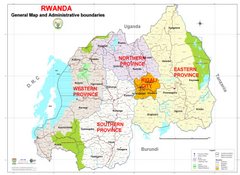
Administrative map