National University of Rwanda
Students’ Association of Genocide Survivors (AERG)
P.O. Box 195 Butare
E-mail: aergunr02@yahoo.fr
HUMURA PROJECT
TO PUT TO LIGHT THE TRAUMA ISSUE AMONG GENOCIDE SURVIVOR PUPILS IN SECONDARY SCHOOLS
CASE STUDY: Secondary School Pupils in former Butare Province
By Pie Eugene RUBAGUMYA
Euthalie NYIRABEGA
Valens BIMENYIMANA
, April 2006
CHAPITRE I: GENERAL INTRODUCTION
1.1. INTRODUCTION
After the 1994 Genocide, Rwanda remained with a lot of physical and mental injuries whose healing will take much time. Thus, since some time, we face a horrifying problem of trauma among many Genocide survivors, especially during commemoration in April. As far as time goes by, that problem gets hardier and it occurs differently in all country’s corners. Anyone who passed through grave events is likely to get trauma. Meanwhile, people manage that problem differently. We realised that children, mainly secondary school pupils, are more attached and sometimes they are obliged to drop studies. It is in that framework that project “Humura” aimed at going deep that issue, giving its evident and latent causes which underlie trauma issue that was crucial in the last two school years (namely 2004 and 2005).
1.1. Statement of the problem
The 1994 Genocide left a lot of people who underwent physical and social damages, directly or indirectly. According to the UNICEF survey, “ thousands of Rwandan children lost their parents or they were separated from them. Almost all children lived traumatising experiences during war, either having seen their family members being tortured or killed in their sight, or being injured or threatened.
Given the fact that many pupils who were still very young in 1994 kept all sad events they have assisted to in their minds, some of them now remember them and get trauma. Other causes underlie trauma among Genocide survivors. First of all, we have environment. Indeed, in some schools, pupils are threatened and ill treated through actions or words by their colleagues, or by some authorities who still keep Genocide ideology. That behaviour affects more those pupils who highly need care and affection in order to overcome the selfless and anxious situation that was caused by the sad and ignominious lose of their beloved family members. In fact, behind the appearance of joy and smile, a deep sorrow is hidden, which, after some time, explodes in trauma. Moreover, in some schools, pupils are refused the right of organizing or participating in commemoration activities, and that raises indignation and frustration which make those children think that they are abandoned to themselves or that their sorrow became commonplace. Let also mention that in some schools, pupils are not authorized to gather in Genocide associations such as AERG that aims at promoting survivors Students’ interests. That association has started in many secondary schools and when pupils meet, they share their experiences and can even find solutions to their problems. When in holydays, those children live in very hard conditions because besides the enormous problems of everyday life, some of them stay in uncertain environment where merchant people threaten or kill them, or they live near places where their relatives are not buried in dignity yet. All those constitute psychological factors that build up and explode in trauma at a small detonation.
Making that issue commonplace or keeping silent with it without tempting to find long term solution would be catastrophic from educators and community in general while we know that that youth is hope and force of the future Rwanda. If this research requires to be carried out, it has also raised two main problems to which we have to find solutions. These are:
1 What are visible and hidden causes that are on basis of trauma among secondary school pupils and what are their consequences?
2 What intervention techniques can educators use to eradicate repeating trauma?
It is in that framework that the Students Association of Genocide Survivors in National University of Rwanda (AERG-UNR), after sad experience of the last two years where many schools had to stop because many pupils had got trauma in April commemoration – and that can even happen again-, undertook a deep research and propose long term solutions to educators and decisions makers in order to face that issue which seems to be repetitive.
1.2. Objectives of the study
As for any research project, our study aims at:
a. Main objective
- Putting to light trauma issue among secondary school survivor pupils by showing its causes and consequences and their negative impact on their life and output. This study will illustrate, through pupils and authorities’ responses, needs in terms of material and psychological help that can diminish that problem.
b. Specific objectives
- Identifying trauma causes and consequences among secondary school pupils
- Gathering views from educators and pupils in order to solve that problem
- Showing the authorities and kind people in charge of people’s well fare needs and measures to be taken in order of achieving effective social integration of survivor pupils
- Proposing long-term solutions about trauma and its underling problems
1.3. Hypothesises
In our research, we will have to verify the following hypotheses:
- Secondary school pupils get trauma because of what they passed through during 1994 Genocide
- Behaviours and environment constitute psychological factors that get increased and finally explode in trauma
- Repeating trauma among pupils has negative impact on their school output
- Knowing basis skills in trauma can be a efficient way of preventing and treating trauma cases in secondary schools
1.4. Interests and limits of the research
A. Interests of the study
First of all, it is the survivor pupils who will benefit from this study, but also the whole community will get aware of their situation and be compassionate. Secondly, decision makers and other people in charge of vulnerable welfare will have credible data from which they can plan actions and strategies for an effective intervention.
B. Limits of the research
First of all, we intend to carry out a pilot test in some secondary schools of former Butare Province. The last ones will be chosen on basis of their location (rural / town). Meanwhile, we hope the outputs to clarify that problem and open ways to durable solutions. The survey will be limited to the 2004 and 2005 school years.
1.5. Methodology
This section deals with the methodology used to gather necessary data that enabled us to answer to our research questions by verifying the above hypotheses in order to reach our objectives.
A. Survey population
As far as the 2004 and 2005 school years served us as reference, our survey population comprises all survivor pupils of former Butare Province who were at school in that period up to now. Indeed, the 6th and 3rd from pupils fulfil the conditions and, given their experience, they will provide credible information about all events of the last two years.
B. Sampling
- At first level, we identified by “descriptive choice” schools which are included in our research. That choice was motivated by the fact that our system is composed of public and private schools on one side, and on other side, we took into account the location of those schools, i.e. in rural areas and in town. The existence of Students’ Association of Genocide Survivors (AERG) in school was also considered as stated in table N 0 1.
- On second level, we identified our sampling by “ simple risky technique” : from a list of students that was made by each school and who get assistance by National Survivors’ Fund, we choose randomly pupils to carry out the survey. Hence, we asked 398 pupils (32.4% of the survey population) as stated in the table below.
- Lastly, in order to complete information provided, we also asked school authorities. We could not ask all proposed candidates (3 persons for each school whose one headmaster, two animators from low and upper classes). Meanwhile, as stated in the table below, we could reach only 19 from 33 who responded to our questionnaire.
Table 1: Recapitulative table of sampling
School
Category
Location
AERG existence
Number of pupils in 2006
Number of pupils asked and (%)
Number of authorities asked
COSTE
Private
Town
101
31 (7.8)
3
Espanya
Private
Town
295
90(22.6)
2
ETN NYANTANGA
Private
Rural
-
50
28 (7.0)
1
GARY SCHEER
Private
Rural
-
87
28(7.0)
2
ETS
Public
Rural
-
14
13(3.3)
2
GSOB
Public
Town
-
82
28(7.0)
2
GSP
Private
Town
340
100(25.1)
1
IMENA COLLEGE OF RINYINYA
Private
Rural
89
25(6.3)
2
IMMACULATE CONCEPTION
Public
Rural
60
19(4.8)
2
PSB Butare
Private
Town
-
45
15(3.8)
2
SANTA MATERI DEI
Public
Town
37
21(5.3)
3
1226
398(32.4)
19
Source: Compilation of statistics of surveyed schools
Notice: (-) Schools having AERG in
() Schools not having AERG in
B. Survey questionnaire
Two questionnaires have been made, one for pupils and another for authorities. Questions that were asked ought to explicate causes, signs and consequences of trauma among survivor pupils, and the remedy to be proposed. Some questions were closed, other were of multiple-choice type with explanations to help respondents. Data have been treated with SPSS Data Editor Software.
CHAPTER II. EXPLANATION OF CONCEPTS USED
2.1. “Humura” Project
The word “Humura” can be translated by “ Be comforted “ Don’t be afraid because I am with you, “ Don’t cry, together we will overcome”.
The word “Humura” was largely used to calm a child in error or who is afraid of something. When an adult told him/her “Humura”, she/he felt comforted by that affection.
“Humura” Project is a response and support to children and to the youth who lived terrible Genocide events as stated in the UNICEF report:
“91.1 of children saw their family members dying, 48% were threatened of being killed, 90% had to hide and protect themselves”.
This study deserves to be carried out given the majority of children who underwent a lot of psychological troubles as stated in the Rwandan Government and UNICEF Reports:
- More than 300.000 Rwandan children, especially teenagers, are traumatised and need psychological support, but only 0.1% gets it appropriately.
Otherwise, Humura Project considers figures as ridiculous because a big number of youth (living at home or in adoptive families) live in precarious conditions that can cause trauma.
Moreover, one of the most damages is the lost of hope by the youth among the adults while they need their care and affection. This project intends at promoting dialogue about how to face hard life. On the other side, as mentioned by many authors, trauma can be treated only in the context that saw it arising and developing. Humura Project intends to put to light the socio economical and cultural context around those young such as family and school. For that reason, the intervention towards them passes by local community that integrates and disintegrates them. This phase will put an emphasis on trauma issue by showing its environmental factors. This project will make suggestions that can stop or attenuate its causes among the youth.
2.2. Trauma issue
We are not able to conceptualise exhaustively trauma issue, but we want to give some orientations that may help in apprehending theoretical dimensions on basis of this research.
a) Trauma
Trauma is a Greco term that means injury, damage or disaster. It is associated to a triggering event that left horror signs in the psyche, “ Sad events that left signs in our mind are likely to affect chronically our life”. This conception associates trauma to a behaviour change resulting from victim’s horrors. That book shows that sad event can cause emotional crisis defined as “ a set of disturbances resulting from a violent emotional chock”.
This research will apprehend how secondary school pupils live trauma with reference to the most cited symptoms as indicated by PARLEAMAN:
- Lack of feelings and emotions
- They tend to retire from the public
- They are aggressive, shameful, anxious and remain depressive
- They no longer trust neither in themselves nor in someone else
- They always feel in insecurity because of violence underwent or to which they assisted
- They speak to themselves (monologue)
- Etc.
b) Trauma causes
In case of trauma, some authors insist on individual internal causes, others on types of responses to external stimuli for emotional appearance. In our case, we have both because on one side, survivor students bear in their hearts what they have seen in Genocide, and on the other side, world realities where they live today affect them and trigger emotional appearance that generates in trauma symptoms among them. Hence, on one side, we will take into account their memory states as direct consequences of the 1994 Genocide, and on the other side, relational situations in family or at school and their life conditions.
c) Trauma consequences among pupils
Trauma has serious negative consequences on pupils and on society in general. At individual level, obsession behaviours such as alcoholism, lack of trust in yourself and in others, soleness, hallucinations, are current consequences of trauma. The result is poverty, lack of commitment to work… all these effects don’t affect only young people, but also the whole community and that situation causes social tissue disintegration, deterioration of education system… That is the reason why people have to think about a better psychosocial care as well as at individual and community levels.
d) Orientations of trauma care among youth
As well as psychosocial dimension is composed of domains, that are psychological and social, we won’t lose our time on those two levels because the first derives from Greco “ psyche” meaning soul and from “logos” which means “ science”. It is therefore the soul science. The second one, “social” deals with people in society. Hence, the psychosocial is a part of psychology that studies human nature and the society influence on psychological functions”.
From the two dimensions, psychosocial care will comprise complete services in favour of victims taking into account of:
- Personality system: taking into account that each person is unique and differs from others in how he/she react to a given situation
- Socio economical environment that comprises social interactions (relations), institutional organisation (family, schools…) financial and material resources at the disposal, political environment, etc. considering those orientations, we will analyse information and views from secondary school survivor pupils, and those from their authorities.
CHAPTER III. DATA PRESENTATION, ANALYSIS AND INTEPRETATION
3.1. INTRODUCTION
Considering the 1994 Genocide atrocious consequences on survivors in general and on youth in particular, this chapter aims at presenting, analysing and interpreting data from interviewees. We want to test if trauma really exists in secondary schools, show its causes and consequences, and its negative impact on pupil’s outcome. After that, we will propose intervention ways to overcome those repeating cases of trauma.
3.2. Data presentation, analysis and interpretation
This section is divided into 4 parties as follows:
- Interviews’ presentation
- Different appearances of trauma
- Trauma causes
- Suggestions made
3.2.1. Interviews’ identification
Table 2: Number of pupils interviewed per form
Form
Number of interviewees
Percentage
3rd form
205
51.5
6th form
193
48.5
Total
398
100.0
We would have taken equal number for 6th and 3rd forms, but in some schools, the number of 6th students is low, for that we used a big number in 3rd form. The low number in 6th form is due to the fact that survivor pupils stay down on one side, and that the number of pupils is bigger in lower class than in upper class.
Table 3: Pupils’ identification per sex
Sex
Number of interviewees
Percentage
Feminine
230
57.8
Masculine
168
42.2
Total
398
100.0
The girls’ rate (57.8) is higher than boys (42.2). This constitutes a contradiction with girls’ rate that is usually lower than boys. This is explained by the fact that during genocide, killers targeted men and boys so that now most of survivors are women and girls.
Table 4: Frequentation period of interviewees in the same school:
Number of years
Number of pupils
Percentage
2
28
7.0
3
269
67.6
4
69
17.3
5
2
0.5
6
19
4.8
7
8
2.0
8
3
0.8
Total
398
100.0
As the frequentation period for many pupils is three years (67.6%) and more, we can assess that they master habits, mood and practices of their schools. This makes the answers more credible because they are based on their own experience.
Table 5: Pupils’ identification per age
Age
Number of interviewees
Percentage
Age group
Percentage
14
5
1.3
15
13
3.3
16
41
10.3
17
49
12.3
18
63
15.8
19
53
13.3
20
58
14.6
21
40
10.1
22
28
7.0
23
23
5.8
24
9
2.3
25
5
1.3
26
5
1.3
27
1
0.3
28
2
0.5
29
1
0.3
32
1
0.3
40
1
0.3
Total
398
100.0
The more represented group age is 15-20 years old, and we have 21-25 years old with 26.9%. Considering the two groups, we can assess that the majority age of interviewees was 3 to 7 years old during the 1994 genocide. The age characteristics is very important to understand their psychological needs that the adult world ignore as stated by the UNICEF report: If it is true that family member’s death can trigger a series of problems to child, psychological needs are less perceived than material ones. If we want those children to develop their necessary capacity in order to face hard life, it is indispensable to pay more attention to their psychological needs.
Table 6: Pupils’ identification per province of residence
Province
Number of interviewees
Percentage
South
297
74.6
East
14
3.5
Ouest
21
5.3
Kigali City
66
16.6
Total
398
100.0
It is clear that a big number of interviewees come from Southern Province. This is due to the fact education policy in Rwanda encourages pupils to go to near schools of their residence. From that, we can ‘t extrapolate our results on national territory and on all survivor students. We based our research on Southern Region to verify our hypothesis, hoping that the outputs will offer us the image of how the problem is, especially among secondary school pupils.
Table 7: Interviewees ‘identification according to the housekeeper’s relation
where they live
Relation with housekeeper
Number of interviewees
Percentage
Having two parents
67
16.8
Having one parent
144
36.2
Living with an aunt
47
11.8
Living with an uncle
13
3.3
Brother or sister
39
9.8
Grand father and mother
16
4
Housekeeper
15
3.8
Others
67
14.2
Total
398
100.0
As far as the number of interviewees with one parent (36.2) plus interviewees with two parents constitutes 53%, we realise that 47% of interviewees are orphans without any parent. Among these, those who live with their direct family member (29.6) while housekeepers held 3.8%. Those who live with different people are 14.2%. That is how their vulnerability is explained.
Meanwhile, let know that survivor students are hope and force of “future Rwanda” as stated by Rwandan saying. That is the reason why we have to protect them and let their rights respected. Nevertheless, the following lines show that those pupils live in precarious conditions so that they wonder about they future without parents’ support.
3.2.2. Existence of trauma cases in secondary schools
Table 8: existence of serious trauma cases in schools during two last years
Answers
Number of authorities
Percentage
Number of pupils who got trauma
Percentage
No
17
89.5
133
65.5
Yes
2
10.5
261
33.4
No response
4
0.1
Total
19
100,0
398
100.0
Trauma cases are found in schools as said by the majority of authorities who responded (89.5). Only one-school authorities accepted not having met trauma in their school. A big number of respondents recognized having got grave trauma (33.4%). Four pupils refused to respond. From two tables above, we see that apart from one school, nine remaining knew trauma cases during the last two school years.
Table 9: Trauma cases by sex: authorities’ observations
More cases with:
Number of authorities interviewed
Percentage
Girls
17
89.4
Boys
1
5.3
Both
1
5.3
Total
19
100
89.4% of respondents show that girls are more attached than boys. As explanation, authorities were unanimous to assess that in Rwandan culture, girls exteriorise their feelings and anxiety more than boys, as stated by this saying “ Amarira y’umugabo atemba ajya mu nda”. In order of not being shameful, boy learns how to overcome internal conflicts and problems for a better adaptation as individual and in his society. For that, the trauma explosion in secondary school is rare, and when it happens, it is very difficult to calm it.
Table 10: Trauma symptoms found during last two years: authorities’
Observations
Symptoms
Number of respondents
Percentage
Fear
17
89.5
Hallucinations
17
89.5
Crying in night
15
78.9
Sleepless
12
63.2
Avoiding persons, places recalling Genocide
11
57.9
Keeping silent
14
73.7
Having revenge will
12
63.2
Going out of school without permission
10
52.2
Others (headache, stomach-ache, gynaecological problems, eye ache)
8
42.1
As stated in table above, trauma symptoms in secondary schools are multiple. Authorities told us that pupils cry in night especially in dormitory and they get hallucinations (89.5), others keep silent (73.3) plus avoiding other people (57.9). Some of them don’t sleep (63.2), and that phenomenon results in bad headache, stomachache and eye ache (42.1). Authorities assess they are sometimes bored and don’t know what to do. It therefore requires increasing the number of trauma counsellors and restore former National Survivors employees because they were very useful.
The animators’ role should also be revised, instead of watching over faulty students, but being cooperative and advisors when they notice abnormal behaviours with those pupils.
Table 11: Period of serious trauma cases
Period when pupils got trauma (2004 & 2005)
Number of schools
Percentage
Before Genocide commemoration (January-March)
5
26.3
During Genocide commemoration (April)
11
57.9
May- July
4
21.1
After Genocide commemoration (August- November)
3
15.3
The table above indicates that in April, trauma cases are more serious (57.9). This is crucial period when a lot of people remember genocide sad events they went through or they watched to. Trauma phenomenon decreases in August- November period because after July, school authorities know vulnerable students and they take care of them. But some of them also pass the whole year with trauma. Here are its causes among the youth in secondary schools.
3.2.3. Trauma causes among secondary school pupils
Table 12: Remembering violence actions underwent
Response
Number
Percentage
Having seen barbarism in their sight
253
63.6
Having seen a family member dying
291
73.1
Unable to bury their relatives in dignity
221
55.5
Other Genocide misdeeds (being orphans)
73
18.3
Table above illustrates that 73.1 % of interviewees have seen at least their family member dying, while 63.3% have undergone barbarism acts such as injuries, rape, insults and laugh, or they were hidden for a certain period. Those who could bury they relatives in dignity can get trauma because, according to Kanyangara: “ lack of last sight to dead or kidnapped member forces an individual to organize his/her mourning and that can cause process of interminable pathological mourning.” . The table below is an example of how people diminished in 1994 Genocide.
Table 13: Pupils’ family composition: Before and after Genocide
Before Genocide
Number of respondents
Percentage
Remaining after Genocide
Number of respondents
Percentage
1-3
80
20.2
1-3
223
56.0
4-6
151
38.1
4-6
148
37.1
7-9
136
34.4
7-9
24
6.0
10-12
24
6.1
10-12
2
0.5
>12
8
2.0
>12
0
0
Total
398
100
398
100
This table shows that the family size which was 20.2 % (1 to 3 family members) rose up to 56.0%. That demographic decrease was not due to family planning, but to genocide that took away theirs, and they are seriously affected, particularly when they meet hard problems.
3.2.3. Causes of school environment
3.3.2.1. Use of bad talks that can trigger trauma by pupils and by educators:
Interviewees’ observations
Table 14: Use of bad word by pupils and educators at school
Existence of bad word
Number of interviewees
Percentage
Yes
169
42.5
No
229
57.5
Total
398
100.0
Pupils confirmed that some animators and their colleagues use bad word towards them, but they are afraid of denouncing them in order of not being punished. In some schools, authorities noticed that and reacted, while in others they kept silent and become suspicious with them.
Table 15: Hierarchy of traumatising words used: Interviewees’ Observations
Identified words by interviewees
Number of interviewees per 169
Percentage
Sorrow words
169
100
Bad words
118
69.8
Insults
29
17.1
Others
59
34.9
The table below shows that sorrow words represent 100%, while insults are 69.8%. the last ones present genocide as logic consequence of what victims deserved; when some pupils say that survivors seek to be seen only. Comrades conclude that survivors are liar and sometimes indict family members who never participated in Genocide. Insults are lees used at schools because perpetrators are afraid to be seriously punished if they are accused. Other way of trauma is genocide denial, the jet of tracts in public places, and even terrorism acts. The main cause of this remains some favours offered to survivor students by National Survivors Fund that seem to be more than material aid given to other students (by the Ministry of Local Administration).
3.2.3.1.2. Trauma cases in relation to authorities’ behaviour
Table 16: Authorities ‘behaviour as trauma causes among pupils at school
Causes
Number of respondents
Percentage
Bad behaviour during Genocide commemoration
310
77.9
Genocide ideology
96
24.1
Bad treatment
69
17.3
To feel alone
102
25.6
Others
130
32.7
Interviewees confirmed that trauma at school is caused by:
On one side, authorities’ negligence, especially some animators, during genocide commemoration (77.9%). on other side, unsafe environment where survivor pupils feel alone, or are ill-treated at school and genocide ideology. all represent 67%. Other causes mentioned deride from physiological crisis such as stomachache, head ache and eye ache that authorities take less care of.
3.3.2. Trauma cases in relation to bad life conditions in family
Table 17: Bad social conditions in relation to home family
Existence of bad social conditions as trauma causes
Number of respondents
Percentage
Yes
343
86.2
No
51
12.8
No response
4
1.0
Total
398
100.0
The majority of respondents assess the survivors’ bad social conditions are the main cause of trauma (86.2%), while only 12.8% said no.
Table 18: Hierarchy of bad social conditions that were identified as trauma
Causes
More cited social conditions
Number of respondents
Percentage
Discrimination within family
185
46.5
Rejection by receiving family
180
45.2
Being always faulty in receiving family
178
44.7
No visit at school
172
43.2
Not having someone to give his/her points paper
136
34.2
Other family conditions
72
18.1
The social conditions above are more relational among the multiple ones. It is clear that those young lack affection that is more important. These conflict situations are due to the fact that the majority of interviewees constitute the group age of 15 up to 20 years old who are self confident and tends to be independent. On other side, receiving families are not prepared to those situations. They think the received children are incorrigibles. The small beginning conflict can get harder if it is not well managed. The country should consider this issue by putting in place social workers and counsellors for all family members. Among other causes cited, we can mention hard jobs comparatively to their physical capacity, and not being free of visiting their comrades and relatives, etc.
Trauma causes in relation to the lack of economical material needs
Table 19: Bad economical material conditions in receiving families
Bad relations due to
Number of respondents
Percentage
Families steal the received child’s property
173
43.5
Lack of school material
227
57.0
Difficult of getting return tickets
242
60.8
Inequity of home material
254
63.8
Deep poverty
243
61.1
Others
38
9.5
The table below shows that pupils lack vital minimum for better study. This is explained by their deep poverty (61.1), difficult to get return tickets and the lack of school material. It is understandable that spend their time in searching how to meet all those needs while they could get solutions from their parents (if they were alive). This is the main cause of their failure in school and psychological trauma follows. The last cause is that receiving family first of all shows interested with the child hiding the ambition of appropriate the child’s legacy (houses, account in banks…).
3.4. Trauma consequences
Table 20: Trauma consequences towards pupils: school authorities’ observations
Consequences
Number of respondents
Percentage
Serious indiscipline cases
1
5.2
Moving from schools
7
36.8
School dropping
5
26.3
Bad note (points)
4
21.0
Others
2
10.5
Moving from school was a the most trauma consequence that was cited by school authorities (36.8%). after that we have school dropping representing 26.3 %, while many of them obtain bad marks (21%) and therefore, they are obliged to resume their studies. Another cause is that these children cannot concentrate in school because of bad souvenirs. Otherwise, Genocide survivor pupils are sent at home or to hospital where they stay many days without studying.
Table 21: Trauma consequences towards school organisation: authorities’
observations
Consequences
Number of schools
Percentage
Small consequences
Serious consequences
Very serious consequences
No visible consequences
Total
4
4
9
2
19
21.1
21.1
47.7
10.5
100.0
3.5. Psychosocial care within schools
3.5.1. Commemoration activities within schools
Table 21: Existence of commemoration activities within schools
Existence of commemoration activities within schools
Number of respondents
Percentage
Yes
56
14.1
No response
340
85.5
2
0.5
The table below illustrates that many schools don’t celebrate Genocide commemoration. Pupils confirmed that they are usually invited by near political institutions such the district and others. This increases their trauma risks because they don’t find counsellors when they come back to schools. It is worth wondering if it should be better to organise internal activities within schools instead of mixing children with adults while we can’t provide them moral and material support after those affecting ceremonies.
Table 22: Satisfaction with regards to Genocide commemoration within schools
Response
Number
Percentage
Yes
48
85.7
No
8
14.3
Total
56
100.0
The majority of respondents assessed to be satisfied with commemoration activities that are organised around their schools. Respondents have also ordered them according to what they prefer and wish to be organised each April given its moral interests
Table 23: The more preferred commemoration activities
Identified activities
Number of respondents
Percentage
Testimonies
47
83.9
Conferences
16
28.5
Prays
23
41.0
Films
19
33.9
Mourning fire
30
53.5
Mourning songs
16
28.5
Others
33
58.9
No response
-
From 56 respondents who confirmed the existence of Genocide commemoration activities in their schools, 83.9 % have appreciated the mourning fire (Igishyito). Songs and conferences are less interesting. Others are related to visits by authorities of Genocide Survivors in crisis such as Students’ Association of Genocide Survivors (AERG).
Most of Genocide survivors develop trauma symptoms that can be chronic or diverse. In all cases people develops a pathological mourning. We should create appropriate environment to manage trauma issue within schools instead of letting pupils live stressing moments alone.
3.5.2. Psychosocial care with regards to traumatised people
Table 24: Pupils ask assistance from school authorities when trauma issue
occurs
Response
Number
Percentage
Yes
274
68.8
No
114
28.6
No response
10
2.5
Total
398
100
Interviewees confirm that they don’t reveal their issue to authorities for two reasons:
First of all, survivor students share most latent trauma cases; therefore, they support each other by group therapy. They only warn authorities in difficult cases and these always respond positively. When we asked them to mention recent cases they remember, they assessed that discipline authorities’ role in 2004 and 2005 was highly appreciable. Secondly, they confirmed that they rely on survivor authorities to which they tell the problem. In lack of these, they prefer to keep silent.
Table 25: How authorities receive traumatised pupils
Reception
Number of respondents
Percentage
Very bad
2
0.5
Bad
16
4.0
Less
163
41.0
Good
150
37.7
Very good
53
13.3
No response
14
3.6
Total
398
100
As far as the above classification is concerned, respondents told us that in 2004& 2005, some discipline authorities did not take into consideration the trauma issue as serious problem and in some cases they rejected patients. In some schools, those bad authorities were even suspended.
Table 26: Hierarchy of trauma care in serious trauma cases
Who helps you more in trauma issue?
Number of respondents
Percentage
Authorities
308
77.4
Teachers
54
13.6
Pupils each other
346
87.4
Counselling agents
93
23.4
Medical doctors
192
48.2
Others
42
10.6
No response
2
0.5
As stated in the table below, teachers are less implicated in the matter. Interviewees told us that many teachers do their job normally and don’t care of pupils’ life. Medical intervention was visible in 2004 and 2005, while counselling agents are resorted to in serious trauma cases. This is the explanation of their small intervention. Pupils wish permanent counselling instead of calling them in urgent situation.
Table 27: Hierarchy of psychosocial trauma care in serious trauma cases
Who helps you more in trauma cases?
Number of respondents out of 133
Percentage
Authorities
32
24.0
Teachers
6
0.4
Pupils
74
55.6
Counsellors
16
12.0
Medical doctors
35
26.3
Parents
28
21.0
Others
35
26.3
No response
2
0.1
The table above indicates that first of all pupils helped each other in last two years. Even in serious trauma cases, they did the same, secondly they were assisted by school authorities and lastly by medical staff and others. Let mention that among the others we have AERG members from National University of Rwanda who intervened usefully in 2004 and 2005.
Table 28: Authorities’ considerations with regards to trauma
Views given
Number of respondents out of 398
Percentage
Grave disease
38
9.5
Serious problem
230
57.8
Don’t mind
25
6.3
Pupils lie
42
10.6
Don’t understand
31
7.8
Others
22
5.5
No response
10
2.6
Total
398
100.0
The majority of respondents confirmed that during the last two years, school authorities took trauma as serious problem (67.3%), while another part said that some authorities are less favourable, either because they don’t understand anything about the issue, or because they make it commonplace (32.2). ten respondents did not provide an answer. While we asked the respondents to clarify their answers, those who told us that school authorities take care of traumatised pupils have appreciated their job, while negligent authorities abandon pupils in dormitory and only their comrades look after them. Some authorities don’t give tickets to traumatised pupils who need to go home. Therefore, pupils do it themselves. The research showed that some authorities try to hide trauma cases in their schools instead of treats them, as it is required. There is also kind of discrimination where some authorities take care more of rich pupils and seem not to mind for poor children.
Table 29: Ways used by authorities to help traumatised pupils
Ways used
Number of respondents
Percentage
To calm students
174
43.7
To take them to hospital
309
77.6
To bring a counsellor to school
23
5.8
To let pupils go back home
148
37.2
Others
36
9.0
No response
2
0.5
It results from the table above that the majority of traumatised pupils are directly brought to hospitals (77.6%). Secondly, many of them stay at school (43.7%) and 37.2 % go home. Among other ways, pupils mentioned soldiers who come to calm them and assure their security. Schools mostly bring pupils to hospital while counselling agents come secondly. Thus, “prevention is better than cure” that is the reason why pupils suggest regular consultation with counsellors who still don’t exist in many schools.
3.6. Solutions made by interviewees
In order to diminish trauma issue in schools, interviewees have made following solutions to major problems:
3.6.1. Propositions to schools authorities
- To set up a permanent counselling service and engage trained agents who can intervene in the neighbouring schools
- To elaborate a civic education program that will eradicate Genocide ideology
- To frequently visit pupils in order to show them sympathy and affection
- To organise counselling trainings in order to equip pupils with basic skills with what they can help their comrades in crisis
3.6.2. Pupils’ propositions
- To meet their basic needs on due time such school material and return tickets
- To organise trauma trainings so that pupils can help their colleagues and learn to live with trauma
- To promote solidarity actions and recreation movies in order to avoid being alone for a long time
- To organise trauma trainings for their receiving family members
- The government should help victims in rehabilitating their damaged property
- To continue commemoration activities where an emphasis should be put on past lessons for a better future
- To sensitise adult people on hear and dialogue with the youth
- To punish severely all bad words in order to eradicate hate
- To set up a judicial advisory system for survivor pupils that could intervene in litigation cases with other people, especially with regards to their property
CONCLUSION AND RECOMMANDATIONS
A) Conclusion
Having realised that trauma phenomenon is serious among many Genocide survivors in general secondary school pupils in particular where some of them are some times obliged to drop their studies, this research aimed at putting to light that problem, its causes and its impact. Information gathered from 398 pupils and 19 school authorities from 11 secondary schools of former Butare Province show that our research hypothesises have been confirmed. Let remind that the last two years (2004 and 2005) served us as reference for hypothesises verification.
First of all, secondary school pupils get trauma due to atrocious actions they met in 1994 Genocide. Therefore, 9 schools out of 11 recognised having known trauma cases in the last two years while 133 pupils accepted that they got serious trauma cases in that period. Among the various symptoms that appeared, we can mention fear, hallucinations, crying in night, keeping silent, sleeplessness, etc. these troubles occur often in April and they are caused by the remind of barbarism acts that were committed in their sight such watching your family members being killed, spending long hours in hiding-place, etc.
Secondly, educators’ behaviours and the environment constitute psychological factors, which accumulate slowly and lastly explode in trauma. The fact was confirmed by interviewees, accepting that some pupils and authorities use bad words and that can cause traumatic troubles among survivors. The bad social relations with receiving families and the lack of basic material also amplify trauma issue.
Thirdly, interviewees showed that repeating trauma has negative impact on survivor pupils’ outcome, especially in schools, where some of them get very bad marks or become indiscipline that sometimes lead to school dropping.
Lastly, we realised that basic skills in trauma and their application can greatly help in case trauma occurs in school before resorting to other people such as medical doctors. Thus, pupils regret the fact that some authorities, in ambiguous situation, hurry in bringing attached pupils at hospital while they could cure even at school by using those basic techniques. Interviewees propose to set up permanent counselling service in neighbouring schools in order to prevent trauma cases instead of intervening when it is declared or later.
B) Recommendations
As far as trauma problems are concerned among secondary schools pupils, we would like to make recommendations to all people in order to think of their better psychosocial care and of effective integration in the evolving Rwandan society. We focused our recommendations to students and their receiving families, schools’ authorities, Genocide Survivors’ Associations, other organisations, and to Rwandan government.
We recommend to Genocide survivor students:
- To envisage excellency and competition because some of them are accused of not committing to studies
- To be more disciplined and keep solidarity spirit
- Not to resign before hard life, but to fight for a bright future
- To remember their tragic past time and work hard because they have no other source
We recommend the receiving families to:
- To know that those teenagers need more affection and avoid loyalty conflicts
- To engage franc dialogue with the youth they look after by using “ Win-Win” method in order to manage together relational conflicts they meet
- To visit pupils at school and enquire about their discipline
We recommend the Genocide Survivors’ Associations to:
As far as counselling benefits are concerned, they should:
- Enlarge operational counselling system to schools
- Intervene in receiving families in order see what goes on there
- To carry out regular follow-up in schools for knowing how survivor students are
- Carry out scientific researches in order to make an inventory of survivors’ problems in general and students ‘problems in particular
- Participate in solving their problems, either materially or at advocacy level
- Participate in decisions-making by administration authorities with regards to survivors’ assistance
- Set up middle and long-term strategic planning according to the objectives set with regards to survivors’ assistance
We recommend schools’ authorities:
- To authorise the formation of solidarity associations because these can enhance mutual support and help group therapy
- To avoid all discriminatory and humiliation actions towards pupils who have psychological troubles in order to facilitate their psychosocial integration.
- To be more affective and compassionate towards pupils, especially those with psychological troubles
- To make advocacy to public institutions and other organisations that can help those pupils
- To reintegrate former National Survivors’ Fund employees and redefine their attributions
- To improve teaching methodology because some schools have a big number failures among their students
We recommend the Rwandan government to:
- Continue total assistance to vulnerable survivors i.e. the payment of school fees and necessary material distribution
- Reintegrate former National Survivors’ Fund employees for better care of survivors’ problems
- Provide trainings to psychosocial interveners and other people who are in contact with pupils
- Assist the receiving families for a better material care
- Maintain and reinforce all kinds of solidarity meetings during holidays because they enable students to share their experience and information and to learn bravery and patriotism
- To promote leisure opportunities and meetings where all youth classes of Rwandan society can learn civic education especially with regards to justice, unity and reconciliation, and other development programs
- Plan deep national research of psychosocial and economical life conditions of survivors in general, with an emphasis put on students and on orphans who are housekeepers.
END
Friday, February 2, 2007


Tourism: an industry to promote
Emmanuel Mungwarakarama
Nyungwe park
Date : Jan 30, 2007
An extensive network of well-maintained walking trails leads through the forest to various waterfalls and viewing points. Well-trained guides, camp sites and specific tours make Nyungwe forest a special income-generating spot.
Can Nyungwe forest welcome more tourists and therefore create more job opportunities to the neighboring locals citizens?
A uniquely rich centre of floral diversity, Nyungwe forest has at least 250 different types of trees and a myriad of flowering plants. The forest hosts 140 types of colorful orchids, 4 groups of primates: 13 species in all, including humankind’s closest living relative, the chimpanzee, blue monkeys, mangabeys, as well as black and white colobus monkeys.
“If maintaining the same prices can protect and facilitate the park conservation, it should be a way of improving this tourism industry in the country,” said Mike Macfadyen, an American environmental researcher from Alaska.
Prices are high, Macfadyen complained.
“This limits access to the forest, but it is also better for park conservation.”
It costs $10 US/1000 Rwf for locals to enter the park and $20 U$/2000 Rwf for foreigners.
Even if prices are high, the number of tourist increases year after year. In 2000, 500 people came, whereas in 2006, the number grew to 3878. Most of them come from Britain, America and Germany.
“Making a choice is so difficult as we have different trails,” said guide Edward Bahizi. “Each is different from another, and as we are taking the pink route, we will meet a waterfall, different types of trees like mahogany and you can even meet birds.”
Bahizi, a trained guide, is healthy, weighing in at 100 kilos. He looks like a young man but he is 35. He speaks 8 different languages.
Nyungwe does, however, deserve more time. Anybody who wants to track chimps and see several varieties of smaller primates will need two days there - and dedicated birdwatchers might never want to leave! Good hours to see chimps are between 6 and 9 in morning.
The Park covers more than 1000 square kilometers of rugged terrain, spanning an altitudinal range from 1600 to 1950 m.
Extending across the majestic hills of southeast Rwanda, Nyungwe National Park is the largest forest in East or Central Africa with 1030 Km2.
Nyungwe’s overall biological diversity has earned it a place on many lists of priority sites for conservation in Africa.
“The uniqueness of this park, and what makes it different from other parks in the world, is here you can find the specified tour sites,” said Macfadyen Adding to this Mike showed that if there was no planned way to provide guides, the conservation would be hard.
Aside from preserving the diverse flora and fauna in Nyungwe, conservation of the forest is important for scientific and sociological reasons, too.
“A French researcher has produced medicine from the trees found in this park,” said Edward.
According to the tourism website, bamboo blankets much of the extreme south-eastern portion of the park. Flooded forests, marshes, and open herbaceous slopes are interspersed throughout. The fauna of Nyungwe reflects this floral diversity.
“Nyungwe Forest acts as the water catchment for about 70 percent of Rwanda,” said Anet Tamale, an ORTPN Public relations office staff. “As such, it protects a major watershed for surrounding communities as well as those further downstream”
People living near the forest experience longer periods of rain each year, supporting their farming activities around the forest. Streams that flow from Nyungwe feed into the Nile and Congo basins.
Tourism in Nyungwe generates some revenue for the national parks and benefits Rwanda’s economy at large.
“A percentage from the income goes to the district level so it can help in building community capacity” confirmed Anet Tamale.
Nyungwe faces several major threats, which stem from the high human pressure around the forest and the need for more land or alternative sources of income.
Nyungwe park
Date : Jan 30, 2007
An extensive network of well-maintained walking trails leads through the forest to various waterfalls and viewing points. Well-trained guides, camp sites and specific tours make Nyungwe forest a special income-generating spot.
Can Nyungwe forest welcome more tourists and therefore create more job opportunities to the neighboring locals citizens?
A uniquely rich centre of floral diversity, Nyungwe forest has at least 250 different types of trees and a myriad of flowering plants. The forest hosts 140 types of colorful orchids, 4 groups of primates: 13 species in all, including humankind’s closest living relative, the chimpanzee, blue monkeys, mangabeys, as well as black and white colobus monkeys.
“If maintaining the same prices can protect and facilitate the park conservation, it should be a way of improving this tourism industry in the country,” said Mike Macfadyen, an American environmental researcher from Alaska.
Prices are high, Macfadyen complained.
“This limits access to the forest, but it is also better for park conservation.”
It costs $10 US/1000 Rwf for locals to enter the park and $20 U$/2000 Rwf for foreigners.
Even if prices are high, the number of tourist increases year after year. In 2000, 500 people came, whereas in 2006, the number grew to 3878. Most of them come from Britain, America and Germany.
“Making a choice is so difficult as we have different trails,” said guide Edward Bahizi. “Each is different from another, and as we are taking the pink route, we will meet a waterfall, different types of trees like mahogany and you can even meet birds.”
Bahizi, a trained guide, is healthy, weighing in at 100 kilos. He looks like a young man but he is 35. He speaks 8 different languages.
Nyungwe does, however, deserve more time. Anybody who wants to track chimps and see several varieties of smaller primates will need two days there - and dedicated birdwatchers might never want to leave! Good hours to see chimps are between 6 and 9 in morning.
The Park covers more than 1000 square kilometers of rugged terrain, spanning an altitudinal range from 1600 to 1950 m.
Extending across the majestic hills of southeast Rwanda, Nyungwe National Park is the largest forest in East or Central Africa with 1030 Km2.
Nyungwe’s overall biological diversity has earned it a place on many lists of priority sites for conservation in Africa.
“The uniqueness of this park, and what makes it different from other parks in the world, is here you can find the specified tour sites,” said Macfadyen Adding to this Mike showed that if there was no planned way to provide guides, the conservation would be hard.
Aside from preserving the diverse flora and fauna in Nyungwe, conservation of the forest is important for scientific and sociological reasons, too.
“A French researcher has produced medicine from the trees found in this park,” said Edward.
According to the tourism website, bamboo blankets much of the extreme south-eastern portion of the park. Flooded forests, marshes, and open herbaceous slopes are interspersed throughout. The fauna of Nyungwe reflects this floral diversity.
“Nyungwe Forest acts as the water catchment for about 70 percent of Rwanda,” said Anet Tamale, an ORTPN Public relations office staff. “As such, it protects a major watershed for surrounding communities as well as those further downstream”
People living near the forest experience longer periods of rain each year, supporting their farming activities around the forest. Streams that flow from Nyungwe feed into the Nile and Congo basins.
Tourism in Nyungwe generates some revenue for the national parks and benefits Rwanda’s economy at large.
“A percentage from the income goes to the district level so it can help in building community capacity” confirmed Anet Tamale.
Nyungwe faces several major threats, which stem from the high human pressure around the forest and the need for more land or alternative sources of income.
Tuesday, October 24, 2006
TVR poised for ‘dynamic’ improvement
By Emmanuel Mungwarakarama
Rwanda Television (TVR) is undergoing a number of transformations, including its recently becoming a round-the-clock station. The new TVR Managing Director, Ms Kije Mugisha, granted an exclusive interview to The Sunday Times’ BERNA NAMATA. Below are excerpts.
ST: Would you please briefly give our readers your background?KM: Before I came to Rwanda Television I worked as a media consultant in Rwanda for various organizations. I have been working in the fields of Radio and sales marketing for almost 10 years. My TV and Radio career started when I first joined college in 1993.
ST: Within a short time you have been in office TVR is already operating 24 hours, and that’s a great improvement. Any reaction from the viewers so far?KM: The reactions have been positive. So that’s an encouraging starting point for us. There is a lot to be done, and I think as media colleagues we will work more together and try to make all our agencies and companies better and more productive. So we have a good start. It’s a challenge, but it’s a very good opportunity. The 24-hour programming is a starting point; there is going to be a few things that will be added to diversify the programmes within the 24-hour clock, and that will come one at a time.
ST: What other innovations do you intend to bring to TVR? Apparently, the word on the street is that TVR is not as relaxed in its editorial line as Radio Rwanda: Do you intend to change the editorial line?KM: Well, I have just to say that the innovation that will come to TVR will certainly be an interesting standard as much as we can do with what we have. So that means with our News and local programmes you will be able to view more dynamic issues being discussed, going in-depth with some of the issues that surround the development of Rwanda here at TVR. This will also go in line with some of the new faces that you see here in Rwanda who do not necessarily speak Kinyarwanda but may have a Rwandan heritage. I think we can just see that automatically, with some of the new things we just see just in Kigali and even outside Kigali. So innovation will come in those two areas. I think sooner rather than later, with interns from Rwanda National University, Butare who are going to start next month, we have some people who will be coming to the Top Ten Rwanda Programme who are specialized in specific media areas – TV, Video production marketing, and public relations. I think we should think outside the box and not talk about censorship or anything in particular that may be perceived as not being relaxed or not being forthcoming because with TV, particularly public TV, there are always objectives and we are determined to make sure we meet the objectives as Television Rwanda and ORINFOR.
ST: Talking of the programmes, Rwanda has three official languages. Is there a balance in the broadcast line? KM: Well, we know there are three major languages that are spoken in the country. For sure our programmes will have to cater to all those people; I can say that is part of the mission in vision. That everybody in Rwanda -- whether Kinyarwanda, English or French speaking -- in one way or another will be satisfied.
ST: What has been your experience since you began your term of office as the director of Rwanda Television?KM: It’s been challenging. The people are co-operative, there is co-operation, and the people are forthcoming. My challenge, however, is to use what I have and teach others. I have vast experience: I have worked with several media organizations around the world. I think what we need are people who are specialized. We need to be patient with each other; people should not be intimidated because I have an American accent.
ST: What challenges have you faced so far?KM: There is a lot of talent and creativity in Rwanda. We have what it takes; what we have to do is to utilize it. We have to work harder. DStv is our competitor. They change their face every six months; we could do that. We have to be more innovative and work harder.
ST: What will be your main focus?KM: My main focus is excellence in content and image perfection. This will need everybody to take their work more seriously than ever. It’s a revolution, an introduction of a complete new way, and everybody has to be prepared.
ST: What message do you have for the public?KM: People should be ready to embrace the new Rwanda Television progress. Rwanda Television is a station for them. My mission is to make sure there is excellence. We have to impact the community. As a media house we have a serious role and we have to take our role seriously. We have to take the goals of excellence and image perfection. It will take time, but we have all it takes. Viewers should be encouraged.
BREAKER:“It will take time, but we have all it takes”
Rwanda Television (TVR) is undergoing a number of transformations, including its recently becoming a round-the-clock station. The new TVR Managing Director, Ms Kije Mugisha, granted an exclusive interview to The Sunday Times’ BERNA NAMATA. Below are excerpts.
ST: Would you please briefly give our readers your background?KM: Before I came to Rwanda Television I worked as a media consultant in Rwanda for various organizations. I have been working in the fields of Radio and sales marketing for almost 10 years. My TV and Radio career started when I first joined college in 1993.
ST: Within a short time you have been in office TVR is already operating 24 hours, and that’s a great improvement. Any reaction from the viewers so far?KM: The reactions have been positive. So that’s an encouraging starting point for us. There is a lot to be done, and I think as media colleagues we will work more together and try to make all our agencies and companies better and more productive. So we have a good start. It’s a challenge, but it’s a very good opportunity. The 24-hour programming is a starting point; there is going to be a few things that will be added to diversify the programmes within the 24-hour clock, and that will come one at a time.
ST: What other innovations do you intend to bring to TVR? Apparently, the word on the street is that TVR is not as relaxed in its editorial line as Radio Rwanda: Do you intend to change the editorial line?KM: Well, I have just to say that the innovation that will come to TVR will certainly be an interesting standard as much as we can do with what we have. So that means with our News and local programmes you will be able to view more dynamic issues being discussed, going in-depth with some of the issues that surround the development of Rwanda here at TVR. This will also go in line with some of the new faces that you see here in Rwanda who do not necessarily speak Kinyarwanda but may have a Rwandan heritage. I think we can just see that automatically, with some of the new things we just see just in Kigali and even outside Kigali. So innovation will come in those two areas. I think sooner rather than later, with interns from Rwanda National University, Butare who are going to start next month, we have some people who will be coming to the Top Ten Rwanda Programme who are specialized in specific media areas – TV, Video production marketing, and public relations. I think we should think outside the box and not talk about censorship or anything in particular that may be perceived as not being relaxed or not being forthcoming because with TV, particularly public TV, there are always objectives and we are determined to make sure we meet the objectives as Television Rwanda and ORINFOR.
ST: Talking of the programmes, Rwanda has three official languages. Is there a balance in the broadcast line? KM: Well, we know there are three major languages that are spoken in the country. For sure our programmes will have to cater to all those people; I can say that is part of the mission in vision. That everybody in Rwanda -- whether Kinyarwanda, English or French speaking -- in one way or another will be satisfied.
ST: What has been your experience since you began your term of office as the director of Rwanda Television?KM: It’s been challenging. The people are co-operative, there is co-operation, and the people are forthcoming. My challenge, however, is to use what I have and teach others. I have vast experience: I have worked with several media organizations around the world. I think what we need are people who are specialized. We need to be patient with each other; people should not be intimidated because I have an American accent.
ST: What challenges have you faced so far?KM: There is a lot of talent and creativity in Rwanda. We have what it takes; what we have to do is to utilize it. We have to work harder. DStv is our competitor. They change their face every six months; we could do that. We have to be more innovative and work harder.
ST: What will be your main focus?KM: My main focus is excellence in content and image perfection. This will need everybody to take their work more seriously than ever. It’s a revolution, an introduction of a complete new way, and everybody has to be prepared.
ST: What message do you have for the public?KM: People should be ready to embrace the new Rwanda Television progress. Rwanda Television is a station for them. My mission is to make sure there is excellence. We have to impact the community. As a media house we have a serious role and we have to take our role seriously. We have to take the goals of excellence and image perfection. It will take time, but we have all it takes. Viewers should be encouraged.
BREAKER:“It will take time, but we have all it takes”
Musician promotes Rwandan culture in a foreign land
By Linda Mbabazi
PEOPLE: After achieving her dream and dancing on top of her world, the renowned Rwandan female musician who resides in Belgium, Cecile Kayirebwa, is said to be spending sleepless nights thinking about how she can transform the Rwandan traditional music
and put it on top of the world. Without hesitating, Rwandans at least believe that Kayirebwa is among the few female musicians who give value to their culture especially when in a foreign land and have even tried to force the nations to love and respect the foreign culture (Rwandan culture), thus winning pride to Rwandans abroad. TNT reporter Linda Mbabazi grabbed a chance with the busy-soft spoken Kayirebwa and captured the autobiography of the celebrity, one hour to her flight back to Belgium which was thought to be important to both her fans and TNT readers. Below is part of the interview. TNT: Can you please introduce yourself to our readers and your fans? My name is Cecile Kayirebwa. I am a daughter to Mrs. Rwabagabo Genevieve and late Rwabagabo Venustus. I was born on 29 September 1946, in Kigali town, Nyarugenge to be precise and I am the second born in the family of twelve children.I started school in 1952 at Rugunga primary school and later joined Notre dame de Citeaux in 1960. I passed with high scores in my senior six final examinations and I was admitted at the School of Social Services in Musha Muruganzu, current Nyanza district. There, I acquired my first diploma in Social Services in 1966 and started working with the Ministry of Civil Services.
TNT: How did you get into the music career?Kayirebwa: My love for music started at age of 5, because my father used to sing and was a choirmaster at Saint Michael Catholic Church. He would bring the choir at home for practices, especially on Tuesday, Friday and Saturday afternoons. None of my siblings inherited dad’s talent, but I did because I was really in love with the music. Though I seemed to be so young by then, I used to keep around every time they came for rehearsals and I would try to imitate them. At the age of 6, I joined Sunday school choir. Sometimes I would be shy because people would stare at me when singing or dancing saying that I had a sweet voice, despite of my age. I remember people would bring me money at the podium and tell my parents how impressed they were with my talent. Many people appreciated the special gift in me and encouraged my parents to help me develop it. During his free time, dad would sit with me at home and teach me some new tones. The desire for music kept growing. I never wasted any single chance; I would spend most of my time singing, trying to improve on my voice. At school, I was chosen to be the leader of our school choir and I would help to compose songs for the choir. The older I grew, the more I got into music. In 1966, I composed two songs, Julianna Muvandimwe wange uragiye?…. (Julian my relative are you leaving? ) and another one was called Rubwiruko, (dedicated to the youth), the two songs became the country’s best hits in 1966. In 1970, the Ministry in charge of Social Affairs hired me for four months to present a programme on social related issues and to advise the masses on the importance of listening to radio. TNT: Your songs were instrumental during the struggle, where were you then?Kayirebwa: I was in Belgium by that time. We fled the country in 1973 when the Hutus were harassing us (Tutsis) calling us Inyenzi (Cockroaches). The first massacre started in 1959 and from then, Tutsis started seeking refugee from different countries of the world, and the unlucky ones who remained in the country were tortured and killed. Though I managed to flee the country, I was traumatized by the horrific acts done in the country, so when I heard of the Rwanda Patriotic Force (RPF), I decided to compose songs of hope and encouraging the strugglers that we were behind them though not at the war front. TNT: After the struggle, Rwandans expected you to return; what stopped you?Kayirebwa: With no doubt, I 100 percent know that (repeating it over and over, as though to make it clear to the reporter). Of course after the struggle we were all expected to return, but I am not the only one who stayed behind. There are many Rwandans all over the world who have not yet returned because of different reasons. My family and I are still behind, not because we don’t want to comeback, but because we have a lot of responsibilities in Belgium. Our families (my children have families there and other relatives) emerged and we don’t wish to separate. Certainly, there is a big community of Rwandans leaving in Belgium and we have kept our culture more than even some who are here in the country. In Belgium, at least each family has tried to teach their children Kinyarwanda as a language, songs and the traditional dance. And I believe this is enough to keep and give value to our culture.TNT: What do you do apart from singing?Kayirebwa: Well, I have a project back in Belgium and I teach especially Rwandans the traditional dance (Amaraba), though even some other people (non Rwandans ) got interested and joined. I am also planning to extend the project here, I want to promote our culture and to support female artistes who are still lagging behind. TNT: Are you married?Kayirebwa: Of course married, with children! (She laughs....wondering why I didn’t know). I got married to Karengera Innocent in 1970, unfortunately he passed away and left me with four children, two girls and two boys. I have four grandchildren.TNT: Do you have any of your children singing or dancing?Kayirebwa: No, certainly none of them adopted my talent, but one girl was in a dancing troupe, but when she got married, she quit. One of my sons is an engineer of sound mix and of recent he was hired in Malawi. TNT: How do you spend your free time? Kayirebwa: In my free time, I go shopping, visit friends, and attend wedding ceremonies, tidy up my house. And I also utilize my free time to teach children Kinyarwanda as our language tell them stories and teach them how to dance. I really love it when children come to my house to teach them, this shows me that even though we are in a foreign country, we still value our culture. What is the time? Oh my God I’m late; I am sorry I have to rush for my flight it was nice talking to you, with a peck on my cheek she runs out of the house.
PEOPLE: After achieving her dream and dancing on top of her world, the renowned Rwandan female musician who resides in Belgium, Cecile Kayirebwa, is said to be spending sleepless nights thinking about how she can transform the Rwandan traditional music
and put it on top of the world. Without hesitating, Rwandans at least believe that Kayirebwa is among the few female musicians who give value to their culture especially when in a foreign land and have even tried to force the nations to love and respect the foreign culture (Rwandan culture), thus winning pride to Rwandans abroad. TNT reporter Linda Mbabazi grabbed a chance with the busy-soft spoken Kayirebwa and captured the autobiography of the celebrity, one hour to her flight back to Belgium which was thought to be important to both her fans and TNT readers. Below is part of the interview. TNT: Can you please introduce yourself to our readers and your fans? My name is Cecile Kayirebwa. I am a daughter to Mrs. Rwabagabo Genevieve and late Rwabagabo Venustus. I was born on 29 September 1946, in Kigali town, Nyarugenge to be precise and I am the second born in the family of twelve children.I started school in 1952 at Rugunga primary school and later joined Notre dame de Citeaux in 1960. I passed with high scores in my senior six final examinations and I was admitted at the School of Social Services in Musha Muruganzu, current Nyanza district. There, I acquired my first diploma in Social Services in 1966 and started working with the Ministry of Civil Services.
TNT: How did you get into the music career?Kayirebwa: My love for music started at age of 5, because my father used to sing and was a choirmaster at Saint Michael Catholic Church. He would bring the choir at home for practices, especially on Tuesday, Friday and Saturday afternoons. None of my siblings inherited dad’s talent, but I did because I was really in love with the music. Though I seemed to be so young by then, I used to keep around every time they came for rehearsals and I would try to imitate them. At the age of 6, I joined Sunday school choir. Sometimes I would be shy because people would stare at me when singing or dancing saying that I had a sweet voice, despite of my age. I remember people would bring me money at the podium and tell my parents how impressed they were with my talent. Many people appreciated the special gift in me and encouraged my parents to help me develop it. During his free time, dad would sit with me at home and teach me some new tones. The desire for music kept growing. I never wasted any single chance; I would spend most of my time singing, trying to improve on my voice. At school, I was chosen to be the leader of our school choir and I would help to compose songs for the choir. The older I grew, the more I got into music. In 1966, I composed two songs, Julianna Muvandimwe wange uragiye?…. (Julian my relative are you leaving? ) and another one was called Rubwiruko, (dedicated to the youth), the two songs became the country’s best hits in 1966. In 1970, the Ministry in charge of Social Affairs hired me for four months to present a programme on social related issues and to advise the masses on the importance of listening to radio. TNT: Your songs were instrumental during the struggle, where were you then?Kayirebwa: I was in Belgium by that time. We fled the country in 1973 when the Hutus were harassing us (Tutsis) calling us Inyenzi (Cockroaches). The first massacre started in 1959 and from then, Tutsis started seeking refugee from different countries of the world, and the unlucky ones who remained in the country were tortured and killed. Though I managed to flee the country, I was traumatized by the horrific acts done in the country, so when I heard of the Rwanda Patriotic Force (RPF), I decided to compose songs of hope and encouraging the strugglers that we were behind them though not at the war front. TNT: After the struggle, Rwandans expected you to return; what stopped you?Kayirebwa: With no doubt, I 100 percent know that (repeating it over and over, as though to make it clear to the reporter). Of course after the struggle we were all expected to return, but I am not the only one who stayed behind. There are many Rwandans all over the world who have not yet returned because of different reasons. My family and I are still behind, not because we don’t want to comeback, but because we have a lot of responsibilities in Belgium. Our families (my children have families there and other relatives) emerged and we don’t wish to separate. Certainly, there is a big community of Rwandans leaving in Belgium and we have kept our culture more than even some who are here in the country. In Belgium, at least each family has tried to teach their children Kinyarwanda as a language, songs and the traditional dance. And I believe this is enough to keep and give value to our culture.TNT: What do you do apart from singing?Kayirebwa: Well, I have a project back in Belgium and I teach especially Rwandans the traditional dance (Amaraba), though even some other people (non Rwandans ) got interested and joined. I am also planning to extend the project here, I want to promote our culture and to support female artistes who are still lagging behind. TNT: Are you married?Kayirebwa: Of course married, with children! (She laughs....wondering why I didn’t know). I got married to Karengera Innocent in 1970, unfortunately he passed away and left me with four children, two girls and two boys. I have four grandchildren.TNT: Do you have any of your children singing or dancing?Kayirebwa: No, certainly none of them adopted my talent, but one girl was in a dancing troupe, but when she got married, she quit. One of my sons is an engineer of sound mix and of recent he was hired in Malawi. TNT: How do you spend your free time? Kayirebwa: In my free time, I go shopping, visit friends, and attend wedding ceremonies, tidy up my house. And I also utilize my free time to teach children Kinyarwanda as our language tell them stories and teach them how to dance. I really love it when children come to my house to teach them, this shows me that even though we are in a foreign country, we still value our culture. What is the time? Oh my God I’m late; I am sorry I have to rush for my flight it was nice talking to you, with a peck on my cheek she runs out of the house.
The Rwandan media has potential to grow into a regional leader
The Rwandan media has potential to grow into a regional leader
By IGNATIUS KABAGAMBE & GASHEGU MURAMILA.
Sunday, 22 October 2006
DAVID APPLEFIELD is the UK-based Financial Times newspaper Project Director for Africa region. He brought his rich expertise to Kigali last week on the invitation of the American Embassy in Rwanda, which also sponsored a five day (October 16 – 20, 2006) training workshop he conducted for private mediapractitioners in the country on how to manage media outlets as profitable businesses. On Thursday October 19, The New Times Managing Editor IGNATIUS KABAGAMBE sounded him out on how he found the media industry here and where he thinks it is headed. Below is the full interview as transcribed by GASHEGU MURAMILA.IK: Today is the fourth and second last day of the workshop: What has your experience with participants so far been like?DAVID: I’m very impressed with the fact that there are some sophisticated, energetic, ambitious and creative players on the private media scene here. I am more impressed by the few that are going forward than those that have not acquired or may never acquire the level of professionalism to become real journalism leaders.IK: During the workshop I noted your strong inclination toward marketing. How effective can that approach be in a situation like here where editorial content is far from being dynamic?DAVID: You have to build a house by erecting all the four walls and the roof at the same time. You have the basis of interesting content but you don’t yet have a media that has proven itself to be sufficiently powerful or has enough impact on society for the commercial world and the political one to take more attention. So I believe that it has to happen at the same time. On the fifth day we are going to be talking about what I call Rwanda’s content. There is a lot of interesting content that exists in the world, in the region and in the country, that isn’t yet being reported on by your newspapers and radio stations. There are a lot of local stories that haven’t been investigated on yet. This could be local stories, human interest stories, and business stories. I agree with you that the content has to become stronger. But strong content without an editorial and marketing strategy won’t help the survival of the newspapers. I believe that the economic health of private media is the key to building a more powerful and impactful independent press.IK: “Something is wrong in a society where every working person cannot have economic access to a daily paper,” is an observation you made in your article published in The New Times last Friday issue. What exactly do you see as wrong?DAVID: A daily newspaper should be on the diet of any responsible citizen. A citizen has to participate in the activities of the society and the economy. So its wrong when the average working man or woman doesn’t have the ability or economic buying power to purchase a newspaper. So I think the cover price of newspapers in Rwanda should come down as more revenues are acquired through advertising, sponsorship of events, etc. That is what I meant by what is wrong. It would be like saying there is something wrong with somebody who can’t afford a loaf of bread every evening or aspirin tablets when you have headache.IK: The daily newspaper in this country is only one and it is just over eight months old. Can our readers benefit from you as a vastly experienced person regarding the media scene on the African continent, to know where Rwanda lies in comparison with other countries?DAVID: Well the good news is that in terms of the production quality, the papers I have seen here are ahead of those in other countries of the same size, especially in West Africa. I think there is not as much suspicion and politicization of content as there is elsewhere. So I think that is positive. Having said that, I think this country could probably use more than one daily and currently your paper is the only English daily. I think that is because of difficulty in production resources. Your paper also doesn’t have the ability to produce enough copies to satisfy its demand. That is good news and bad news. The bad news is that you don’t have enough copies and the good news is that there is more demand and I haven’t seen this in many other countries. The radio scene in Mali is very vibrant and very free. Senegal has a lot of newspapers but there is a lot of political irresponsibility. I think in general what is positive here is that your government seems to be positive and supportive and doesn’t to a great extent meddle into your affairs. I think the climate for the independent free media here is very positive.IK: In the same Friday article I referred to above, you also mentioned the intention by print media practitioners to ask government to exempt from the newsprint and ink the high taxes levied. Which other areas do you suggest the state comes in to enhance the growth of media industry here?DAVID: It’s not the responsibility of the state to be the financial supporter of the private media. However, I think there is the question of legislation. Rwanda still has the Seditious and Libel Act. Only seventeen countries in the world still have this law and I think it has to be reviewed in the press law. There is need for collaboration with some government ministries like health and education in relation with the content you are trying to communicate. I think that people should not look at an independent media that criticizes whatever that is wrong as a media that is anti government or pro-government. These situations are prevalent in African countries like Togo, Niger, Mauritania, and Sierra Leone and highly doubt if Rwanda is happy in this company. Situations of this kind are slowly improving though.TNT: What about other development partners like the US Embassy that sponsored this workshop; Are there other avenues through which they can channel effort and resources to aid media development here?DAVID: What is really fascinating is that many organizations around the world now appreciate the role the media plays in development of their countries. Access to information is much more omnipresent especially with the internet. There are organizations like Intranews in Washington that organizes media training in 47 countries in the world. There is the Night Reader Foundation in the US which sponsors media practitioners around the world. I’m currently with journalists for a human rights organization in Atlanta which sends Canadian young journalists around the world to work with the independent media. The US Embassy believes strongly in helping to train media practitioners. You should feel comfortable by approaching the embassy and any other organization for resources that you need. This doesn’t necessarily mean cash. It could be access to people, other publication, etc.TNT: What was your impression on media freedom in Rwanda before you came and what have you found it to be like now that you have been on the ground?DAVID: Nobody in the few days I have been here has come up to me and said: ‘I can’t get my articles being published or am going to be thrown into jail’. I have seen articles that are pretty balanced and relatively responsible. I haven’t seen any very deep digging investigative journalism, though your colleague at Focus seems to care a lot about writing investigative pieces. I’m more optimistic that the media here is heading for a vibrant developmentTNT: One of the reasons which are constantly advanced as to why the print media industry in Rwanda is terribly under developed is a poor reading culture among the local population. What have you noticed during your short time here that can qualify this assertion?DAVID: Every body says that the people of Rwanda don’t read so much. But I think there is still a lot to be improved. I understand that there is a big library that is being worked on. I hope this will greatly make a step towards this goal. The private press should also launch things like book clubs, excerpts of novels once a week in your daily and short interesting stories for young people. There is need to partner with large publishers in South Africa or North America that could distribute thousands of unsold books that are some times thrown away. Remember that the more educated the public is the more exposed it becomes to issues of development. And the press has an instrumental role to play here.TNT: Would I be wrong if I said you must be eager to say something special about Rwanda’s only daily? If so, what are the areas you think The New Times management should focus on in order to boost the paper’s appeal and credibility?DAVID: An able management should be able to keep in-house talent and develop it. People who are working well should be motivated. My advice is that you identify talent and invest in them because as the paper grows, if such hard working talents aren’t appreciated, when they get a better opportunity they will be tempted to leave. I just had a tour of your offices and I thought you need a lot of re-organization of the jobs and hierarchy of who does what and where they should be seated. There is also the grand corporate feeling one gets seeing your paper on the street, which is not perfectly reflected inside your premises. Otherwise you have the potential to become one of the leading papers in the region.TNT: Lastly David, what has your experience been like; what are the impressions about the Rwandan people and their government? What economic development tip can you give us?DAVID: It’s really an exciting time to be here. There is a lot of potential here and the private sector is growing. There are some special sympathies that the world has for this country that is just walking down the road after the 1994 Genocide. It’s great seeing that the people are working hard together with the government to foster development. Rwanda should convert all the chances it has into tangible development.TNT: Thank you David for your time.DAVID: You are most welcome.LOOK OUT IN OUR WEDNESDAY OCTOBER 25 ISSUE FOR MORE OF DAVID APPLEFIELD VIEWS ON MEDIA AND OTHER ISSUES, EXCLUSIVE TO THE NEW TIMES.
By IGNATIUS KABAGAMBE & GASHEGU MURAMILA.
Sunday, 22 October 2006
DAVID APPLEFIELD is the UK-based Financial Times newspaper Project Director for Africa region. He brought his rich expertise to Kigali last week on the invitation of the American Embassy in Rwanda, which also sponsored a five day (October 16 – 20, 2006) training workshop he conducted for private mediapractitioners in the country on how to manage media outlets as profitable businesses. On Thursday October 19, The New Times Managing Editor IGNATIUS KABAGAMBE sounded him out on how he found the media industry here and where he thinks it is headed. Below is the full interview as transcribed by GASHEGU MURAMILA.IK: Today is the fourth and second last day of the workshop: What has your experience with participants so far been like?DAVID: I’m very impressed with the fact that there are some sophisticated, energetic, ambitious and creative players on the private media scene here. I am more impressed by the few that are going forward than those that have not acquired or may never acquire the level of professionalism to become real journalism leaders.IK: During the workshop I noted your strong inclination toward marketing. How effective can that approach be in a situation like here where editorial content is far from being dynamic?DAVID: You have to build a house by erecting all the four walls and the roof at the same time. You have the basis of interesting content but you don’t yet have a media that has proven itself to be sufficiently powerful or has enough impact on society for the commercial world and the political one to take more attention. So I believe that it has to happen at the same time. On the fifth day we are going to be talking about what I call Rwanda’s content. There is a lot of interesting content that exists in the world, in the region and in the country, that isn’t yet being reported on by your newspapers and radio stations. There are a lot of local stories that haven’t been investigated on yet. This could be local stories, human interest stories, and business stories. I agree with you that the content has to become stronger. But strong content without an editorial and marketing strategy won’t help the survival of the newspapers. I believe that the economic health of private media is the key to building a more powerful and impactful independent press.IK: “Something is wrong in a society where every working person cannot have economic access to a daily paper,” is an observation you made in your article published in The New Times last Friday issue. What exactly do you see as wrong?DAVID: A daily newspaper should be on the diet of any responsible citizen. A citizen has to participate in the activities of the society and the economy. So its wrong when the average working man or woman doesn’t have the ability or economic buying power to purchase a newspaper. So I think the cover price of newspapers in Rwanda should come down as more revenues are acquired through advertising, sponsorship of events, etc. That is what I meant by what is wrong. It would be like saying there is something wrong with somebody who can’t afford a loaf of bread every evening or aspirin tablets when you have headache.IK: The daily newspaper in this country is only one and it is just over eight months old. Can our readers benefit from you as a vastly experienced person regarding the media scene on the African continent, to know where Rwanda lies in comparison with other countries?DAVID: Well the good news is that in terms of the production quality, the papers I have seen here are ahead of those in other countries of the same size, especially in West Africa. I think there is not as much suspicion and politicization of content as there is elsewhere. So I think that is positive. Having said that, I think this country could probably use more than one daily and currently your paper is the only English daily. I think that is because of difficulty in production resources. Your paper also doesn’t have the ability to produce enough copies to satisfy its demand. That is good news and bad news. The bad news is that you don’t have enough copies and the good news is that there is more demand and I haven’t seen this in many other countries. The radio scene in Mali is very vibrant and very free. Senegal has a lot of newspapers but there is a lot of political irresponsibility. I think in general what is positive here is that your government seems to be positive and supportive and doesn’t to a great extent meddle into your affairs. I think the climate for the independent free media here is very positive.IK: In the same Friday article I referred to above, you also mentioned the intention by print media practitioners to ask government to exempt from the newsprint and ink the high taxes levied. Which other areas do you suggest the state comes in to enhance the growth of media industry here?DAVID: It’s not the responsibility of the state to be the financial supporter of the private media. However, I think there is the question of legislation. Rwanda still has the Seditious and Libel Act. Only seventeen countries in the world still have this law and I think it has to be reviewed in the press law. There is need for collaboration with some government ministries like health and education in relation with the content you are trying to communicate. I think that people should not look at an independent media that criticizes whatever that is wrong as a media that is anti government or pro-government. These situations are prevalent in African countries like Togo, Niger, Mauritania, and Sierra Leone and highly doubt if Rwanda is happy in this company. Situations of this kind are slowly improving though.TNT: What about other development partners like the US Embassy that sponsored this workshop; Are there other avenues through which they can channel effort and resources to aid media development here?DAVID: What is really fascinating is that many organizations around the world now appreciate the role the media plays in development of their countries. Access to information is much more omnipresent especially with the internet. There are organizations like Intranews in Washington that organizes media training in 47 countries in the world. There is the Night Reader Foundation in the US which sponsors media practitioners around the world. I’m currently with journalists for a human rights organization in Atlanta which sends Canadian young journalists around the world to work with the independent media. The US Embassy believes strongly in helping to train media practitioners. You should feel comfortable by approaching the embassy and any other organization for resources that you need. This doesn’t necessarily mean cash. It could be access to people, other publication, etc.TNT: What was your impression on media freedom in Rwanda before you came and what have you found it to be like now that you have been on the ground?DAVID: Nobody in the few days I have been here has come up to me and said: ‘I can’t get my articles being published or am going to be thrown into jail’. I have seen articles that are pretty balanced and relatively responsible. I haven’t seen any very deep digging investigative journalism, though your colleague at Focus seems to care a lot about writing investigative pieces. I’m more optimistic that the media here is heading for a vibrant developmentTNT: One of the reasons which are constantly advanced as to why the print media industry in Rwanda is terribly under developed is a poor reading culture among the local population. What have you noticed during your short time here that can qualify this assertion?DAVID: Every body says that the people of Rwanda don’t read so much. But I think there is still a lot to be improved. I understand that there is a big library that is being worked on. I hope this will greatly make a step towards this goal. The private press should also launch things like book clubs, excerpts of novels once a week in your daily and short interesting stories for young people. There is need to partner with large publishers in South Africa or North America that could distribute thousands of unsold books that are some times thrown away. Remember that the more educated the public is the more exposed it becomes to issues of development. And the press has an instrumental role to play here.TNT: Would I be wrong if I said you must be eager to say something special about Rwanda’s only daily? If so, what are the areas you think The New Times management should focus on in order to boost the paper’s appeal and credibility?DAVID: An able management should be able to keep in-house talent and develop it. People who are working well should be motivated. My advice is that you identify talent and invest in them because as the paper grows, if such hard working talents aren’t appreciated, when they get a better opportunity they will be tempted to leave. I just had a tour of your offices and I thought you need a lot of re-organization of the jobs and hierarchy of who does what and where they should be seated. There is also the grand corporate feeling one gets seeing your paper on the street, which is not perfectly reflected inside your premises. Otherwise you have the potential to become one of the leading papers in the region.TNT: Lastly David, what has your experience been like; what are the impressions about the Rwandan people and their government? What economic development tip can you give us?DAVID: It’s really an exciting time to be here. There is a lot of potential here and the private sector is growing. There are some special sympathies that the world has for this country that is just walking down the road after the 1994 Genocide. It’s great seeing that the people are working hard together with the government to foster development. Rwanda should convert all the chances it has into tangible development.TNT: Thank you David for your time.DAVID: You are most welcome.LOOK OUT IN OUR WEDNESDAY OCTOBER 25 ISSUE FOR MORE OF DAVID APPLEFIELD VIEWS ON MEDIA AND OTHER ISSUES, EXCLUSIVE TO THE NEW TIMES.
Why foreign aid has failed to end poverty in Africa
By Emmanuel Mungwarakarama
Tuesday, 24 October 2006
What are the two tragedies of the world’s poor? One of them is, according to Jeffrey Sachs in his book The End of Poverty, 30,000 children die every day from the diseases and malnutrition that go along with extreme poverty. For example, there are nearly 2 million annual child deaths from diarrhea, which could be easily prevented with 10-cent doses of oral rehydration therapy. It is really a tragedy that people are so poor that they cannot afford 10-cent doses of oral rehydration therapy.But there is a second tragedy, which Jeff does not spend any time in his book talking about, and the second tragedy is that the West has already spent $2.3 trillion on foreign aid over five decades, and babies with diarrhea are still not getting the 10-cent doses of oral rehydration therapy. There are still 2 million deaths, and even in what the World Bank calls an aid success story like Ghana, 50 percent of babies with diarrhea never receive oral rehydration care.This is really the scandal of our generation, that all this money has been spent on foreign aid and yet, in any meaningful sense, this money never reached the desperate poor. What is the response to this failure? It is to ask for more aid money, which has been the same answer as in the previous five decades of foreign aid, which does nothing whatsoever to address the second tragedy: that money is spent and yet does not reach the poor.A Grandiose Global PlanSo, the U.N., the World Bank, and the International Monetary Fund have come up with a big plan to solve all the problems of the poor by the year 2015. How exactly would this plan be implemented? Jeff says in his book that the U.N. Secretary General should personally run the plan. He would not have to do much: He would just have to coordinate the actions of thousands of officials in six U.N. agencies, the U.N. country teams, the World Bank, the International Monetary Fund, all consistent with the World Bank and IMF Poverty Reduction Strategy Papers.Just think about the incentives that are created by this grandiose global plan. You have all the aid donors and recipients collectively responsible. They all share responsibility for implementing all of these actions, for meeting 54 different goals, which also depend on lots of other things besides what the donors and recipient governments do. If anything goes wrong, you can blame the other aid donors, you can blame the other factors that affected whether the goals were achieved or not, or you could even just say, “The reason I didn’t achieve that goal was that I was working on this other goal.”That is what happens when you have multiple goals, collective responsibility, and goals depending on things besides what the aid agents themselves do. This is the worst possible incentive system of all time. When you really read the fine print of the very long documents that set out the goals, you reach this conclusion: In this great, grandiose campaign to end world poverty and achieve the Millennium Development Goals, nobody is individually responsible for any one result.Of course, you could set all this in reverse if you did have true accountability and incentives. Then aid agents would want to get customer feedback and try to figure out what works, and then you could get some specific good outcomes from some aid efforts.Just think about the U.N. Millennium Development Goals. How, possibly, could you get customer feedback on which of the 449 interventions are working? Where are the incentives for those implementing the 449 interventions? Who can be held accountable if some of the 449 interventions do not work? And why doesn’t somebody just get held accountable for getting 10-cent medicine to babies?The planners’ favorite answer is to double foreign aid. An interesting iron law of aid advocacy is that whenever anyone starts campaigning for more foreign aid, they always ask for an exact doubling of foreign aid. It is never an 83 percent increase or 117 percent; when in doubt, double foreign aid. Not long ago we had the G-8 summit, in July 2005, where they agreed to double aid to Africa. They have also agreed to double foreign aid as a whole by the year 2010, and the aid campaigners will then ask for doubling aid again after 2010.Unfortunately, the obsession with the amount spent substitutes for customer feedback, incentives, and accountability. It substitutes for focus on whether the money actually reaches the poor, so the second tragedy continues unabated. And it also creates the perverse incentives in aid agencies just to spend money, because if money is the indicator of success, then all the incentives are just to spend aid money and not to try to have the money get results.The World Bank and IMF have their own plans, which they call the Poverty Reduction Strategy Papers. This planning approach is really just a misguided way to approach the problems of world poverty.F. A. Hayek said that “the success of action in society depends on more particular facts than anyone can possibly know.” How can you possibly know enough to implement a big plan? Economics is all about teaching people how little we really know, how little economists really know, about what they imagine they can design. Karl Popper has this great quote, which is really applicable in a lot of circumstances, that any sort of comprehensive plan to remake society in a way that eliminates poverty is just completely unworkable because “it’s not reasonable to assume that a complete reconstruction of our social system would lead at once to a workable system.”Searchers vs. PlannersThe alternative to planners is “searchers.” There are private entrepreneurs who get customer feedback to meet essential needs. They have incentives to get them to you, so there were 9 million copies of the Harry Potter book distributed on the first day of its publication because everyone along the supply chain had the right incentive to get 9 million copies out there. The publisher is held accountable if you are dissatisfied. If you get your Harry Potter book and the words are upside down, you can take it back and get a new one; and if the firm does not give you a new one, then the firm is eventually going to go out of business for mistreating the customers.The other great feedback system that we are all familiar with is democracy. Politicians are subject to voter feedback, so they have the incentives to meet your needs for public services, and they are accountable if they do too lousy a job on delivering public services.Now, we know none of these solutions works perfectly all the time, and they are certainly not an overnight panacea because, as Karl Popper has told us, there is no way that you could transform a whole society overnight from what it is now to a free-market democracy. It is just not within the realm of economists to be able to engineer that. But we know from overwhelming empirical evidence that markets and democracy are the ultimate home-grown source of prosperity. This is how you eliminate world poverty: through markets and democracy. This is what works.I think markets and democracy can be a great model. Since they are such a successful system, they can be a great model to try to make aid more like a successful system, to try to inspire aid efforts to do less planning and more searching, to try to get aid agents thinking in market-like terms, thinking in democracy-like terms; getting customer feedback, having incentives for aid agents to deliver the medicines to the babies, and having accountability if they do not.So we have to ask the question: Why is it that planners are so popular? Why are these big plans more popular than searchers in the whole foreign aid business? There is a fairly clear political economy explanation that the planners offer appealing dreams of ending poverty, which is really good for sound bites and media frenzies, without anyone in the rich countries actually being held responsible for doing anything very costly. All that has to be done is to spend a little more aid money, and then everyone is satisfied, and then you promise grandiose things like the end of poverty for which you will never be held accountable. Politically, it is great to be able to promise big things for which you will never be held accountable.Searchers do not offer big promises like the end of poverty, which aid cannot possibly achieve. Nothing outsiders do can possibly achieve the end of poverty; again, that has to be done by relying on home-grown markets and democracy. So aid right away has a huge rhetorical disadvantage: It is not offering the big promise, and the searchers are insisting on politically risky accountability. Everybody likes accountability for other people, but nobody likes being held accountable themselves, and rich country politicians certainly do not want to be held accountable for taking responsibility for whether their aid dollars accomplish something in helping poor people.The dream of planners is that foreign aid could finance economic growth, and the only reason to think that that can not happen is that it has never happened and every effort to make aid achieve economic growth has failed. The data show that there is a correlation between aid and growth, but, unfortunately, it is negative. Sophisticated econometric analysis finds no evidence that aid raises growth. What does raise growth is markets, so the citizens of India and China, by shifting to more market-oriented economic systems and creating new opportunities for millions of local entrepreneurs to get rich by their own efforts, increased their own incomes by $715 billion last year.This is the true source of long-run development, not foreign aid. The good news about this is that, once you acknowledge that growth is mostly home-grown and comes from home-grown markets and democracy, you could free up aid so that it could maybe accomplish some useful things for poor people to give them new opportunities. You could free aid to do some more specialized tasks that are not so grandiose as ending poverty or achieving economic growth. You could hold aid agencies accountable for achieving specialized tasks.Let me just give you one example of the wrong approach of planners. There is a Canadian/World Bank project in Lesotho that tried to promote farming in a mountainous region of Lesotho, which did not work because, according to the project managers, the local people were defeatists and did not think of themselves as farmers. That was really silly of the local people—except for the fact that they were not farmers; they were migrant workers in South African mines. The only result of the project was that they built a new road on which South African lorries brought grain into the region, which drove the few existing farmers out of business. This is the kind of mess-up on the ground that happens when you try to plan from the top down.Unaccountable planners also keep repeating or even intensifying the same failed approaches. The aid business has been stuck for a long time on trying to work with local governments, which usually means they wind up chasing unachievable goals of transforming poor country governments, which outside aid cannot possibly do. So you have the unaccountable chasing the unchangeable.In the 1960s and ’70s, there was project aid, which assumed that governments had good institutions and policies. And, of course, the aid did not work then because the governments did not have good institutions and policies.In the 1980s, there was some dawning realization that part of the problem was bad economic policies, so then there was the invention of structural adjustment by the World Bank and IMF, which made aid conditional on the bad governments adopting good policies. The only problem with structural adjustment phase one was that it did not work. Aid was not a strong enough incentive to change policies, and the aid donors were not sufficiently selective; they kept giving money to bad governments even when they did not reform.
To be continued
Tuesday, 24 October 2006
What are the two tragedies of the world’s poor? One of them is, according to Jeffrey Sachs in his book The End of Poverty, 30,000 children die every day from the diseases and malnutrition that go along with extreme poverty. For example, there are nearly 2 million annual child deaths from diarrhea, which could be easily prevented with 10-cent doses of oral rehydration therapy. It is really a tragedy that people are so poor that they cannot afford 10-cent doses of oral rehydration therapy.But there is a second tragedy, which Jeff does not spend any time in his book talking about, and the second tragedy is that the West has already spent $2.3 trillion on foreign aid over five decades, and babies with diarrhea are still not getting the 10-cent doses of oral rehydration therapy. There are still 2 million deaths, and even in what the World Bank calls an aid success story like Ghana, 50 percent of babies with diarrhea never receive oral rehydration care.This is really the scandal of our generation, that all this money has been spent on foreign aid and yet, in any meaningful sense, this money never reached the desperate poor. What is the response to this failure? It is to ask for more aid money, which has been the same answer as in the previous five decades of foreign aid, which does nothing whatsoever to address the second tragedy: that money is spent and yet does not reach the poor.A Grandiose Global PlanSo, the U.N., the World Bank, and the International Monetary Fund have come up with a big plan to solve all the problems of the poor by the year 2015. How exactly would this plan be implemented? Jeff says in his book that the U.N. Secretary General should personally run the plan. He would not have to do much: He would just have to coordinate the actions of thousands of officials in six U.N. agencies, the U.N. country teams, the World Bank, the International Monetary Fund, all consistent with the World Bank and IMF Poverty Reduction Strategy Papers.Just think about the incentives that are created by this grandiose global plan. You have all the aid donors and recipients collectively responsible. They all share responsibility for implementing all of these actions, for meeting 54 different goals, which also depend on lots of other things besides what the donors and recipient governments do. If anything goes wrong, you can blame the other aid donors, you can blame the other factors that affected whether the goals were achieved or not, or you could even just say, “The reason I didn’t achieve that goal was that I was working on this other goal.”That is what happens when you have multiple goals, collective responsibility, and goals depending on things besides what the aid agents themselves do. This is the worst possible incentive system of all time. When you really read the fine print of the very long documents that set out the goals, you reach this conclusion: In this great, grandiose campaign to end world poverty and achieve the Millennium Development Goals, nobody is individually responsible for any one result.Of course, you could set all this in reverse if you did have true accountability and incentives. Then aid agents would want to get customer feedback and try to figure out what works, and then you could get some specific good outcomes from some aid efforts.Just think about the U.N. Millennium Development Goals. How, possibly, could you get customer feedback on which of the 449 interventions are working? Where are the incentives for those implementing the 449 interventions? Who can be held accountable if some of the 449 interventions do not work? And why doesn’t somebody just get held accountable for getting 10-cent medicine to babies?The planners’ favorite answer is to double foreign aid. An interesting iron law of aid advocacy is that whenever anyone starts campaigning for more foreign aid, they always ask for an exact doubling of foreign aid. It is never an 83 percent increase or 117 percent; when in doubt, double foreign aid. Not long ago we had the G-8 summit, in July 2005, where they agreed to double aid to Africa. They have also agreed to double foreign aid as a whole by the year 2010, and the aid campaigners will then ask for doubling aid again after 2010.Unfortunately, the obsession with the amount spent substitutes for customer feedback, incentives, and accountability. It substitutes for focus on whether the money actually reaches the poor, so the second tragedy continues unabated. And it also creates the perverse incentives in aid agencies just to spend money, because if money is the indicator of success, then all the incentives are just to spend aid money and not to try to have the money get results.The World Bank and IMF have their own plans, which they call the Poverty Reduction Strategy Papers. This planning approach is really just a misguided way to approach the problems of world poverty.F. A. Hayek said that “the success of action in society depends on more particular facts than anyone can possibly know.” How can you possibly know enough to implement a big plan? Economics is all about teaching people how little we really know, how little economists really know, about what they imagine they can design. Karl Popper has this great quote, which is really applicable in a lot of circumstances, that any sort of comprehensive plan to remake society in a way that eliminates poverty is just completely unworkable because “it’s not reasonable to assume that a complete reconstruction of our social system would lead at once to a workable system.”Searchers vs. PlannersThe alternative to planners is “searchers.” There are private entrepreneurs who get customer feedback to meet essential needs. They have incentives to get them to you, so there were 9 million copies of the Harry Potter book distributed on the first day of its publication because everyone along the supply chain had the right incentive to get 9 million copies out there. The publisher is held accountable if you are dissatisfied. If you get your Harry Potter book and the words are upside down, you can take it back and get a new one; and if the firm does not give you a new one, then the firm is eventually going to go out of business for mistreating the customers.The other great feedback system that we are all familiar with is democracy. Politicians are subject to voter feedback, so they have the incentives to meet your needs for public services, and they are accountable if they do too lousy a job on delivering public services.Now, we know none of these solutions works perfectly all the time, and they are certainly not an overnight panacea because, as Karl Popper has told us, there is no way that you could transform a whole society overnight from what it is now to a free-market democracy. It is just not within the realm of economists to be able to engineer that. But we know from overwhelming empirical evidence that markets and democracy are the ultimate home-grown source of prosperity. This is how you eliminate world poverty: through markets and democracy. This is what works.I think markets and democracy can be a great model. Since they are such a successful system, they can be a great model to try to make aid more like a successful system, to try to inspire aid efforts to do less planning and more searching, to try to get aid agents thinking in market-like terms, thinking in democracy-like terms; getting customer feedback, having incentives for aid agents to deliver the medicines to the babies, and having accountability if they do not.So we have to ask the question: Why is it that planners are so popular? Why are these big plans more popular than searchers in the whole foreign aid business? There is a fairly clear political economy explanation that the planners offer appealing dreams of ending poverty, which is really good for sound bites and media frenzies, without anyone in the rich countries actually being held responsible for doing anything very costly. All that has to be done is to spend a little more aid money, and then everyone is satisfied, and then you promise grandiose things like the end of poverty for which you will never be held accountable. Politically, it is great to be able to promise big things for which you will never be held accountable.Searchers do not offer big promises like the end of poverty, which aid cannot possibly achieve. Nothing outsiders do can possibly achieve the end of poverty; again, that has to be done by relying on home-grown markets and democracy. So aid right away has a huge rhetorical disadvantage: It is not offering the big promise, and the searchers are insisting on politically risky accountability. Everybody likes accountability for other people, but nobody likes being held accountable themselves, and rich country politicians certainly do not want to be held accountable for taking responsibility for whether their aid dollars accomplish something in helping poor people.The dream of planners is that foreign aid could finance economic growth, and the only reason to think that that can not happen is that it has never happened and every effort to make aid achieve economic growth has failed. The data show that there is a correlation between aid and growth, but, unfortunately, it is negative. Sophisticated econometric analysis finds no evidence that aid raises growth. What does raise growth is markets, so the citizens of India and China, by shifting to more market-oriented economic systems and creating new opportunities for millions of local entrepreneurs to get rich by their own efforts, increased their own incomes by $715 billion last year.This is the true source of long-run development, not foreign aid. The good news about this is that, once you acknowledge that growth is mostly home-grown and comes from home-grown markets and democracy, you could free up aid so that it could maybe accomplish some useful things for poor people to give them new opportunities. You could free aid to do some more specialized tasks that are not so grandiose as ending poverty or achieving economic growth. You could hold aid agencies accountable for achieving specialized tasks.Let me just give you one example of the wrong approach of planners. There is a Canadian/World Bank project in Lesotho that tried to promote farming in a mountainous region of Lesotho, which did not work because, according to the project managers, the local people were defeatists and did not think of themselves as farmers. That was really silly of the local people—except for the fact that they were not farmers; they were migrant workers in South African mines. The only result of the project was that they built a new road on which South African lorries brought grain into the region, which drove the few existing farmers out of business. This is the kind of mess-up on the ground that happens when you try to plan from the top down.Unaccountable planners also keep repeating or even intensifying the same failed approaches. The aid business has been stuck for a long time on trying to work with local governments, which usually means they wind up chasing unachievable goals of transforming poor country governments, which outside aid cannot possibly do. So you have the unaccountable chasing the unchangeable.In the 1960s and ’70s, there was project aid, which assumed that governments had good institutions and policies. And, of course, the aid did not work then because the governments did not have good institutions and policies.In the 1980s, there was some dawning realization that part of the problem was bad economic policies, so then there was the invention of structural adjustment by the World Bank and IMF, which made aid conditional on the bad governments adopting good policies. The only problem with structural adjustment phase one was that it did not work. Aid was not a strong enough incentive to change policies, and the aid donors were not sufficiently selective; they kept giving money to bad governments even when they did not reform.
To be continued
Guidance and counselling vital in schools, colleges
By Emmanuel Mungwarakarama
Monday, 16 October 2006
One of the challenges schools and higher institutions of learning are struggling with is indiscipline. In most of these places, students do not give way to a teacher or a lecturer in corridors or pavements. They merely stand in their groups chatting and the teacher has to squeeze his way through.Teachers in many schools have complained about lack of classroom manners. For instance, students walk in and out of classrooms when a lesson is going on without excusing themselves, chew gum in class, murmur to each other, do not take notes and engage in other naughty behaviour. A teacher who took the trouble to find out why this was so was told blankly, by his students, that that is what they were used to. Other serious cases of indiscipline noted in schools include rudeness to teachers and subordinate staff, sneaking out of schools, absenteeism from classes without sound reason (infamously known as ‘dodging’), smoking and use of narcotic drugs, alcohol consumption and promiscuity among many others. Students have been seen in full school uniform frequenting restaurants around their schools where they drink alcohol without shame. The discipline office in most schools has been noted to be the busiest of all offices in schools. If it is not handling a case of misconduct, it is giving permission to students to go home, especially on Fridays, for various reasons, some of which might not even be genuine. Indiscipline is caused by many factors and it is not easy to deal with but yet students need to be shown the right ways of life so that they can grow up into responsible citizens who will be able to steer their countries forward. Besides this, the youth need to be moulded into a people who can go out into the world and fit in it as opposed to being misfits.Teachers and school authorities, beyond offering knowledge and skills, are doing their best, with the available resources, to check the rate of the unruliness in their respective institutions. For instance, most schools have rules and regulations for guiding students and helping authorities in the daily smooth running of school.Students and their guardians normally sign a copy of school rules on admission but it is uncertain whether they really pay any attention to them. In fact, a number of students take the rules for granted leading to pronounced forms of visible delinquency.But even then, imparting discipline in youths cannot be left to schools alone. Without doubt, parents, the government and the general society are all answerable to the youth since they represent a large section of the population. Why for instance should a responsible restaurant attendant serve alcohol to students, who are in full school uniform? One way of addressing indiscipline in schools is through guidance and counselling. These tenets are important at this stage in the students’ lives because it is here that their attitudes, characters and behaviour are formed. Counselling is beneficial since it aims at enabling a person achieve better personal adjustment, growth, and maturity. Psychologists attach emotional difficulties in youth to misbehaviour. Guidance and counselling will help boost the ability of youth to take rational control over their feelings, aid the youth to aim at fulfilling their potentials and achieve an assimilation of past conflicting parts of themselves. Feelings of inadequacies often lead to withdrawal, unhappiness, annoyance, anger, anxiety and hyper-activity in young people. Counselling helps students develop a positive attitude about themselves, enhance their abilities to recognise their areas of proficiency and enables them to make individual choices that become useful in future after their years of formal education. Rwanda, like other African countries, has experienced an infiltration of foreign cultures, political demands/expectations, wars, political instability, poverty and epidemics all of which have weakened the traditional societal structures and led to an increase in moral decay. Guidance and counselling can offer the best approach in amending the arising negative behaviour. Guidance and counselling are age-old practises in many societies. For this reason, they should be institutionalised not only in schools but also communities.
Monday, 16 October 2006
One of the challenges schools and higher institutions of learning are struggling with is indiscipline. In most of these places, students do not give way to a teacher or a lecturer in corridors or pavements. They merely stand in their groups chatting and the teacher has to squeeze his way through.Teachers in many schools have complained about lack of classroom manners. For instance, students walk in and out of classrooms when a lesson is going on without excusing themselves, chew gum in class, murmur to each other, do not take notes and engage in other naughty behaviour. A teacher who took the trouble to find out why this was so was told blankly, by his students, that that is what they were used to. Other serious cases of indiscipline noted in schools include rudeness to teachers and subordinate staff, sneaking out of schools, absenteeism from classes without sound reason (infamously known as ‘dodging’), smoking and use of narcotic drugs, alcohol consumption and promiscuity among many others. Students have been seen in full school uniform frequenting restaurants around their schools where they drink alcohol without shame. The discipline office in most schools has been noted to be the busiest of all offices in schools. If it is not handling a case of misconduct, it is giving permission to students to go home, especially on Fridays, for various reasons, some of which might not even be genuine. Indiscipline is caused by many factors and it is not easy to deal with but yet students need to be shown the right ways of life so that they can grow up into responsible citizens who will be able to steer their countries forward. Besides this, the youth need to be moulded into a people who can go out into the world and fit in it as opposed to being misfits.Teachers and school authorities, beyond offering knowledge and skills, are doing their best, with the available resources, to check the rate of the unruliness in their respective institutions. For instance, most schools have rules and regulations for guiding students and helping authorities in the daily smooth running of school.Students and their guardians normally sign a copy of school rules on admission but it is uncertain whether they really pay any attention to them. In fact, a number of students take the rules for granted leading to pronounced forms of visible delinquency.But even then, imparting discipline in youths cannot be left to schools alone. Without doubt, parents, the government and the general society are all answerable to the youth since they represent a large section of the population. Why for instance should a responsible restaurant attendant serve alcohol to students, who are in full school uniform? One way of addressing indiscipline in schools is through guidance and counselling. These tenets are important at this stage in the students’ lives because it is here that their attitudes, characters and behaviour are formed. Counselling is beneficial since it aims at enabling a person achieve better personal adjustment, growth, and maturity. Psychologists attach emotional difficulties in youth to misbehaviour. Guidance and counselling will help boost the ability of youth to take rational control over their feelings, aid the youth to aim at fulfilling their potentials and achieve an assimilation of past conflicting parts of themselves. Feelings of inadequacies often lead to withdrawal, unhappiness, annoyance, anger, anxiety and hyper-activity in young people. Counselling helps students develop a positive attitude about themselves, enhance their abilities to recognise their areas of proficiency and enables them to make individual choices that become useful in future after their years of formal education. Rwanda, like other African countries, has experienced an infiltration of foreign cultures, political demands/expectations, wars, political instability, poverty and epidemics all of which have weakened the traditional societal structures and led to an increase in moral decay. Guidance and counselling can offer the best approach in amending the arising negative behaviour. Guidance and counselling are age-old practises in many societies. For this reason, they should be institutionalised not only in schools but also communities.
UNR student to head professional exchange studies
By Emmanuel Mungwarakarama IN SOUTHERN PROVINCE
Tuesday, 24 October 2006
JanvierYubahwe, 26, a medical student of the National University of Rwanda (NUR), has been nominated by the International Federation of Medical Students Association (IFMSA) to take charge of the medical students’ professional exchange programmes in the member countries.IFMSA, whose headquarters are based in Amsterdam, Holland, opreates in over 100 countries worldwide and conducts medical students’ professional exchange, involving exchange of students in search of new knowledge especially in human medicine.Yubahwe, who is also the president of medical students association of the National University of Rwanda (MEDSAR), will start work his international duty on January 1, 2007 for a one year tenure when the body elects another person.Medical students at the national university of Rwanda have previously benefited from the professional exchange programme in Germany and Denmark while ten more students are slated to go to Holland next month for a two-month medical teaching practice.The Rwanda medical students association is currently involved in rural and community development activities like teaching and sensitising people on family planning and reproductive health in partnership with the Danish youth Associations. MEDSAR also has working partnership on HIV/Aids prevention, counseling and testing with their Scottish counterparts. The Rwanda village concept project (RVCP) carries out health sensitisation programmes on HIV/Aids, Malaria and Tuberculosis every year under the partnership with the ministry of health and other IFMSA member countries. Sensitization on rabbit rearing and keeping is also another rural development activity being conducted.
Tuesday, 24 October 2006
JanvierYubahwe, 26, a medical student of the National University of Rwanda (NUR), has been nominated by the International Federation of Medical Students Association (IFMSA) to take charge of the medical students’ professional exchange programmes in the member countries.IFMSA, whose headquarters are based in Amsterdam, Holland, opreates in over 100 countries worldwide and conducts medical students’ professional exchange, involving exchange of students in search of new knowledge especially in human medicine.Yubahwe, who is also the president of medical students association of the National University of Rwanda (MEDSAR), will start work his international duty on January 1, 2007 for a one year tenure when the body elects another person.Medical students at the national university of Rwanda have previously benefited from the professional exchange programme in Germany and Denmark while ten more students are slated to go to Holland next month for a two-month medical teaching practice.The Rwanda medical students association is currently involved in rural and community development activities like teaching and sensitising people on family planning and reproductive health in partnership with the Danish youth Associations. MEDSAR also has working partnership on HIV/Aids prevention, counseling and testing with their Scottish counterparts. The Rwanda village concept project (RVCP) carries out health sensitisation programmes on HIV/Aids, Malaria and Tuberculosis every year under the partnership with the ministry of health and other IFMSA member countries. Sensitization on rabbit rearing and keeping is also another rural development activity being conducted.
UK to support Rwanda’s budget
By EUGENE MUTARA
Tuesday, 24 October 2006
The Permanent Secretary of the UK’s Department for International Development (DFID), Sir Suma Chakrabarti has announced the UK’s commitment to support Rwanda by providing direct finance to the national budget.According to a press release from DFID, Sir Chakrabarti announced this on his arrival on Sunday for his four-day official visit to Rwanda.“This is the efficient form of development assistance,” the DFID boss is quoted in the release as saying.He said that UK will also continue to assist Rwanda in key areas like education, agriculture and land reform as well as strengthening public financial management.The support will also extend to the care and treatment of Genocide survivors suffering from HIV/Aids which Chakrabarti said was a key priority to his country.Chakrabarti is slated to meet president Kagame today and he is expected to meet other, high profile government officials to share experience and provide advice on strengthening policy processes and introducing performance budgeting among other objectives for his visit.“I am looking forward to deepening the partnership between our countries by sharing ideas and experience about planning and policy making,” the DFID boss added.He emphasized that getting the best development results requires having the right policies in place.“Policy preparation is a vital part of the development process,” Chakrabarti is quoted as saying.This made it Chakrabarti’s visit to Rwanda after having been here in February where he signed a ten-year partnership agreement between the United Kingdom and the Rwandan government.It is also Rwanda’s major bilateral development partner providing high predictable levels of resources in support of Rwanda’s poverty reduction strategy, according to the release.Through the UK bilateral programme Rwanda has benefited about 200 million pounds to Rwanda for the last 10 years and currently, they provide assistance totaling 46 million pounds of which 31 million pounds goes directly to the national budget.According to this release, the UK committed itself to provide 1.3 billion pounds for development assistance to Africa by 2007/8 to help the continent accomplish the Millennium Development Goals of reducing poverty by half by 2015.
Tuesday, 24 October 2006
The Permanent Secretary of the UK’s Department for International Development (DFID), Sir Suma Chakrabarti has announced the UK’s commitment to support Rwanda by providing direct finance to the national budget.According to a press release from DFID, Sir Chakrabarti announced this on his arrival on Sunday for his four-day official visit to Rwanda.“This is the efficient form of development assistance,” the DFID boss is quoted in the release as saying.He said that UK will also continue to assist Rwanda in key areas like education, agriculture and land reform as well as strengthening public financial management.The support will also extend to the care and treatment of Genocide survivors suffering from HIV/Aids which Chakrabarti said was a key priority to his country.Chakrabarti is slated to meet president Kagame today and he is expected to meet other, high profile government officials to share experience and provide advice on strengthening policy processes and introducing performance budgeting among other objectives for his visit.“I am looking forward to deepening the partnership between our countries by sharing ideas and experience about planning and policy making,” the DFID boss added.He emphasized that getting the best development results requires having the right policies in place.“Policy preparation is a vital part of the development process,” Chakrabarti is quoted as saying.This made it Chakrabarti’s visit to Rwanda after having been here in February where he signed a ten-year partnership agreement between the United Kingdom and the Rwandan government.It is also Rwanda’s major bilateral development partner providing high predictable levels of resources in support of Rwanda’s poverty reduction strategy, according to the release.Through the UK bilateral programme Rwanda has benefited about 200 million pounds to Rwanda for the last 10 years and currently, they provide assistance totaling 46 million pounds of which 31 million pounds goes directly to the national budget.According to this release, the UK committed itself to provide 1.3 billion pounds for development assistance to Africa by 2007/8 to help the continent accomplish the Millennium Development Goals of reducing poverty by half by 2015.
Strive for righteousness - Sheikh Swaleh Habimana
By GASHEEGU MURAMILA
Tuesday, 24 October 2006
As the Muslims from different parts of Kigali yesterday converged at the Nyamirambo regional stadium, the Mufti, Sheikh Swaleh Habimana implored them not to go back to commit sins because the fasting period has ended. “Those who are going back to commit adultery, taking alcohol or drugs and any other unbecoming behaviour are sowing hunger and thirst,” the Mufti told hundreds of believers. He said that every God-fearing person is obliged to speak the truth in a bid of trying to foster unity and development in the country. “If you don’t speak the truth by yourself, you will have betrayed your religion and your country, and when you don’t speak the truth today, someone else will come and tell it which is quite dangerous,” he said. In a message to the congregation, the Imam of Kigali, Sheikh Seleman Byagusetsa also said that the period of Ramadhan was a special time meant to join hands with all the people of Rwanda and the Muslim community in particular in praying and thanking God for having enabled its successful end. “We believe that those thirty days have been fruitful and have brought us closer to God. We should repent and pray to the almighty to continue forgiving us for our wrong deeds,” he said. He added that in a situation where some one commits a crime against the other and repents, there is no need to commit it again because his repentance will have been welcomed. “Even God’s messenger (Nabbi Muhammad) clearly tells us that God welcomes one’s repentance for as long as he doesn’t commit the sin again. This is the reason we are gathered here today to praise and thank God for having protected us,” he said. In his closing remarks, Byagusetsa requested all the Muslims in the country to attend the holy prayers in their designated areas without any excuse. “I therefore humbly request all the people of Rwanda to fully celebrate this day as we also look at helping those in needy situations,” he appealed.Reading a speech on behalf of the Islamic association of Muslims in Rwanda, Alhaji Yussouf Gatikabisi underscored the need for greater unity and love amongst the people as a tool to stop unnecessary bloodshed in the world. “This association is however not happy with innocent lives that are always lost in the world as a result of people who pursue their individual interests in places like Iraq, Palestine and Darfur” he said. Gatikabisi expressed gratitude at the progress so far made by the Islamic association of Rwanda in terms of improving the lives of the people.
Tuesday, 24 October 2006
As the Muslims from different parts of Kigali yesterday converged at the Nyamirambo regional stadium, the Mufti, Sheikh Swaleh Habimana implored them not to go back to commit sins because the fasting period has ended. “Those who are going back to commit adultery, taking alcohol or drugs and any other unbecoming behaviour are sowing hunger and thirst,” the Mufti told hundreds of believers. He said that every God-fearing person is obliged to speak the truth in a bid of trying to foster unity and development in the country. “If you don’t speak the truth by yourself, you will have betrayed your religion and your country, and when you don’t speak the truth today, someone else will come and tell it which is quite dangerous,” he said. In a message to the congregation, the Imam of Kigali, Sheikh Seleman Byagusetsa also said that the period of Ramadhan was a special time meant to join hands with all the people of Rwanda and the Muslim community in particular in praying and thanking God for having enabled its successful end. “We believe that those thirty days have been fruitful and have brought us closer to God. We should repent and pray to the almighty to continue forgiving us for our wrong deeds,” he said. He added that in a situation where some one commits a crime against the other and repents, there is no need to commit it again because his repentance will have been welcomed. “Even God’s messenger (Nabbi Muhammad) clearly tells us that God welcomes one’s repentance for as long as he doesn’t commit the sin again. This is the reason we are gathered here today to praise and thank God for having protected us,” he said. In his closing remarks, Byagusetsa requested all the Muslims in the country to attend the holy prayers in their designated areas without any excuse. “I therefore humbly request all the people of Rwanda to fully celebrate this day as we also look at helping those in needy situations,” he appealed.Reading a speech on behalf of the Islamic association of Muslims in Rwanda, Alhaji Yussouf Gatikabisi underscored the need for greater unity and love amongst the people as a tool to stop unnecessary bloodshed in the world. “This association is however not happy with innocent lives that are always lost in the world as a result of people who pursue their individual interests in places like Iraq, Palestine and Darfur” he said. Gatikabisi expressed gratitude at the progress so far made by the Islamic association of Rwanda in terms of improving the lives of the people.
Subscribe to:
Comments (Atom)
Rwanda
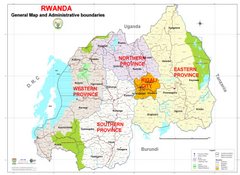
Administrative map