To Orwell Today,
For Jackie Jura:
Press Release Intwari-Partnership CNA-Ubumwe FDLR-CMC PDN Darfour Peace Mission : Beyond Karenzi Karake
from,
Gerard Rusteid
To Gerard Rusteid,
I don't understand some of the terms in the name of your organization or the press release you sent [at bottom of page*] - ie "Intwari, CNA-Ubumwe, CMC, PDN" - but I do recognize the term "FDLR" and in adding "2 + 2" and getting "4" I conclude you are either a genocidaire or a genocidaire sympathiser and so I've foregone the usual "greetings" in the salutation.
I guess you sent me that anti-Karake press-release (which is also anti-Kagame, anti-RPF, anti-Rwanda, anti-Western World) because of the article I posted which exposed the truth about Kibeho and concluded that the Hutu Army and Interahamwe - NOT the RPF - were behind the chaos there that saw 80,000 Rwandans pushed almost beyond endurance of human suffering:
WITNESS KAGAME KIBEHO TRUTH
The RPF were heroes for closing down the IDP camps - including Kibeho - and if General Karake was involved there (although his name was never mentioned) that adds SUPPORT to his being appointed Deputy Commander of the AU/UN peace-making mission in Darfur, on top of all his other accomplishments as an officer in the RPF fighting genocidaires in Rwanda and the Congo, in the past AND in the present.
I can't think of any army I would rather have heading a mission to come to my rescue (if I were from Sudan [or any other nation for that matter]) than Rwanda's, based on their conduct and ability in stopping the Tutsi genocide in their own country. Every other nation in the world - including members of the Organization of African Unity - stood by doing nothing.
The Sudanese government itself has spoken out in defense of Rwanda heading the Darfur mission, as you are no doubt aware:
Sudan defends the controversial Rwandan general. Aug 22, 2007 (The Sudanese government blasted accusations directed at a Rwandan general, nominated as deputy commander for the new U.N.-African Union force in Darfur. Sudan’s envoy to the UN, Abdalhaleem Abdalmahmood, told the daily Al-Sudani that these accusations "are part of a campaign aimed at undermining the credibility of Africans". Last week a Rwandan opposition group accused the newly nominated deputy commander for the Darfur hybrid force of being a "war Criminal"....The Rwandan government has stuck to its choice which is likely to create some delays in setting the structure of the hybrid force...."This will infuriate the Rwandans if Karake is denied a role, and that will make it even more difficult to field adequate African forces, given Rwanda's skill and professionalism, and the sheer size of its contingent and potential to add to it" he added. The Darfur conflict began in 2003 when an ethnic minority rose up against the Arab-dominated government in Khartoum, which then was accused of enlisting the Janjaweed militia group to help crush the rebellion.)
If and when the AU/UN force finally arrives in Darfur (and it's a long way from being a reality) they won't be there to STOP the hell - they'll just be there to help the people (which is better than nothing). They'll have a better mandate than the UN forces that were in Rwanda (ie they'll be allowed to use their weapons) but they won't be allowed to disarm the killers.
Because of fabricated accusations by you genocidaires against Rwanda, the AU/UN mission for Darfur is being TALKED about instead of acted OUT and the suffering of the Sudanese continues unabated.
~ Jackie Jura
*PRESS RELEASE
Partenariat-Intwari
Intwari-Partnership
CNA-Ubumwe FDLR-CMC PDN
------------ --------- --------- --------- --------- --------- --------- ---------
Darfour Peace Mission : Beyond Karenzi Karake
The appointment of Rwandan general Karenzi Karake as Joint Deputy Commander of the UN mission in Darfur seems to have provoked a mini scandal which the media have seized upon rapidly.
By confirming the Rwandan officer for such a strategic post, the African Union has in fact fallen into a trap from which it will have difficulties to free itself. Unless it does not repeat its errors by reiterating the simulacrum of a Neutral Military Observers Group (GOMN) that had been put in place in Rwanda by President Museveni and Dr. Ahmed Salim (then OAU Secretary General), and where 90% of the military elements comprising that group were accomplices of one of the belligerent parties, namely, the RPF.
But the real scandal is to be found in more important, higher decision-making echelons, notably, at the level of the UN Security Council.
In this regard and while waiting to offer more extensive revelations, Intwari-Partnership declares the following in order to inform the national as well as the international opinion:
1. In order to grasp all of its parameters and identify all of its outline, one should place the Darfur conflict in a larger context, one of the famous "Regional Liberation War" so dear to the no less famous "New African Leaders" supported by the United States and the United Kingdom, leaders such as presidents Yoweri Kaguta Museveni of Uganda and Paul Kagame of Rwanda among others.
2. Triggered by the victorious NRA rebellion of Museveni in Uganda against Milton Obote from 1981 to 1986, this "Regional Liberation War" which has known its first success in 1986 through the accession to power of the "African Hitler" Museveni, in reference to his 04/04/1997 speech, was to continue in Rwanda with the tragic offensive of Paul Kagame’s Rwandese Patriotic Front from 1990 to 1994, then spread to the Democratic Republic of the Congo and to Burundi, integrating Tanzania, Kenya, Somalia, Ethiopia, Eritrea and the Sudan. It is in fact a plan for the renaissance of the Great East Africa composed of the ten African countries mentioned above.
3. The immeasurable ambitions of certain African leaders acting in the name of obscure, foreign and/or local interests, often led them into an enterprise of extermination of their own people, of whom they unashamedly self-style "saviors" or "liberators" as it was the case in Rwanda.
4. The sinister project for the edification of a large "Nilotic" empire itself placed under the protection of an Anglo-Saxon empire that will ultimately cover the entire African continent, explains, to a large extent, fratricide conflicts from which Africa mourns daily, conflicts followed by a cohort of crimes against peace, war crimes, crimes against humanity and genocide crimes.
5. In such circumstances as these, it appears urgent and legitimate to ask ourselves questions about the real or hidden intensions about stated or unstated objectives on the side of certain governments such as the government of Rwanda in relation to their multiform contributions to peace missions placed under UN and/or African Union aegis as it is currently the case in Darfur, whereas their collaboration with the SPLA and thus their lack of neutrality vis-à-vis the other Sudanese belligerent was known beforehand.
6. Before pretending to stabilize the Sudan or any other African country, Rwanda should, first, "clean its own house". More than just General Karenzi Karake whose role in massacres is well-known, General Paul Kagame must first of all have the courage to face his very heavy responsibilities in the Rwandan genocide, a genocide whose re-writing appears henceforth inevitable.
7. As for the UN, the African Union and, particularly, the United States and the United Kingdom, whose role in the Rwandan genocide and its seriously devastating consequences in the DRC remain underestimated, their credibility in the framework of the peace efforts currently undertaken in the Sudan may be seriously compromised.
8. Finally, to the Rwandan people in all its constituents and across divisions and wrenches cleverly generated and cynically fostered by a ruthless dictatorship that feeds itself from a permanent state of war, we urgently call upon all of them, our fellow citizens, so that they may, as one and same person, rise and pull down the separation wall erected between them by indignant rulers who knows no scruple.
Done in Brussels, August 21, 2007,
on behalf of Intwari-Partnership,
Déogratias Mushayidi (Signed)
General Secretary and Spokesperson
Saturday, March 6, 2010


Thursday, March 4, 2010
Rwanda flag to start flying at Commonwealth HQ
Kigali: Rwanda’s flag will join other 53 national flags at the Commonwealth Secretariat in London on Monday next week – as the country finalises its entry into the British block, government announced Wednesday.

President Paul Kagame receives the Commonwealth's flag from SG Kamalesh Sharma on January 21 in Kigali (Photo: Commonwealth Secretariat)
The blue-yellow-green-with star flag means Rwanda in London, from March 08, will be a complete member as the 54th member. In January, the Commonwealth Secretary General was in Rwanda and presented the grouping’s flag in Kigali during his visit.
President Paul Kagame received the Commonwealth's flag from SG Kamalesh Sharma in what was billed as a powerful symbolic entry to the association.
Rwanda was allowed into the Commonwealth in November at the Commonwealth Heads of Government summit in Trinidad and Tobago. Incidentally, the occasion happened on the date as Rwanda and France reconciled.
The flag also follows changes that have already taken effect. For example, Rwanda’s envoys to Commonwealth members and those from the block to Kigali are called High Commissioner. The embassies are now referred to as High Commission.

President Paul Kagame receives the Commonwealth's flag from SG Kamalesh Sharma on January 21 in Kigali (Photo: Commonwealth Secretariat)
The blue-yellow-green-with star flag means Rwanda in London, from March 08, will be a complete member as the 54th member. In January, the Commonwealth Secretary General was in Rwanda and presented the grouping’s flag in Kigali during his visit.
President Paul Kagame received the Commonwealth's flag from SG Kamalesh Sharma in what was billed as a powerful symbolic entry to the association.
Rwanda was allowed into the Commonwealth in November at the Commonwealth Heads of Government summit in Trinidad and Tobago. Incidentally, the occasion happened on the date as Rwanda and France reconciled.
The flag also follows changes that have already taken effect. For example, Rwanda’s envoys to Commonwealth members and those from the block to Kigali are called High Commissioner. The embassies are now referred to as High Commission.
‘The East African’ newspaper under fire over Ingabire
Kigali: The Kenyan-based ‘The East African’ newspaper came under scrutiny on Wednesday with President Paul Kagame describing as “insulting” and “offensive” a damning interview it had with the opposition politician Ms. Ingabire Victoire.
Even naming the reporters who conducted the interview for the regional weekly as Mr. Charles Kazooba and Esther Nakazzi, President Kagame wondered why Rwanda is covered by “Ugandan journalists in Uganda…based in Uganda”.
“For me that suggested [that] we are probably less east-African…or the intention was to make Rwanda less east-African” he said, in reference to the five-member East African Community block.
In the lengthy interview published in the weekly’s February 15-20 Issue, Ms. Ingabire heavily criticized government – with most of her attacks directed at President Kagame himself and his Rwanda Patriotic Front (RPF) party.
Mr. Kagame told the Wednesday press conference that the story seemed to portray Rwandan society as a country where people are “tight-lipped”, and Ingabire as their “savoir”. The interview also insinuated Rwanda as a kingdom with Kagame at the helm.
In a seemingly irritated tone, coupled with laughter, Mr. Kagame said the “worst of it…probably something that is equally offensive. Why is it that people would cover Rwanda by Ugandan journalists in Uganda, based in Uganda?”
As the President spoke, the Nation Media correspondent in Kigali Mr. David Kezio interjected, distancing himself from the interview. He said it had been conducted by the Kampala bureau and “probably by email”. Mr. Kezio also said he would check with “my superiors Your Excellence”.
“You tell them that in my own right also…and when I say this you understand it,” said the President, adding, “…in my own right I thought it was offensive”.
He added: “But under freedom of expression, we can take that…but we can also express ourselves”.
The President did not say how that will happen.
The Nation Media Group, the parent company of The East African, is already in Uganda, Kenya and Tanzania, and is now working on entering into the Rwanda market. The media group has several newspapers, radio stations and Nation TV.
Previously, government has had issue with Daily Monitor, a daily in Uganda – also part of the Nation Media Group. Its reporter Mr. Robert Mukombozi was declared persona non grata in 2007. President Kagame at some point personally complained that Mr. Mukombozi had misquoted him.
Meanwhile, the spat with the Nation Media Group’s paper also comes after it was announced recently that it had invited President Kagame to the Pan African Media Conference scheduled for March 18 – 19 in Nairobi.
The major conference will also coincide with Nation Media Group's 50th anniversary.
According to the Group, President Kagame, Kenya’s Mwai Kibaki, as well as Joaquim Alberto Chissano, the former Mozambique leader, and John Agyekum Kufuor, former Ghanaian President, have all confirmed their attendance.
Even naming the reporters who conducted the interview for the regional weekly as Mr. Charles Kazooba and Esther Nakazzi, President Kagame wondered why Rwanda is covered by “Ugandan journalists in Uganda…based in Uganda”.
“For me that suggested [that] we are probably less east-African…or the intention was to make Rwanda less east-African” he said, in reference to the five-member East African Community block.
In the lengthy interview published in the weekly’s February 15-20 Issue, Ms. Ingabire heavily criticized government – with most of her attacks directed at President Kagame himself and his Rwanda Patriotic Front (RPF) party.
Mr. Kagame told the Wednesday press conference that the story seemed to portray Rwandan society as a country where people are “tight-lipped”, and Ingabire as their “savoir”. The interview also insinuated Rwanda as a kingdom with Kagame at the helm.
In a seemingly irritated tone, coupled with laughter, Mr. Kagame said the “worst of it…probably something that is equally offensive. Why is it that people would cover Rwanda by Ugandan journalists in Uganda, based in Uganda?”
As the President spoke, the Nation Media correspondent in Kigali Mr. David Kezio interjected, distancing himself from the interview. He said it had been conducted by the Kampala bureau and “probably by email”. Mr. Kezio also said he would check with “my superiors Your Excellence”.
“You tell them that in my own right also…and when I say this you understand it,” said the President, adding, “…in my own right I thought it was offensive”.
He added: “But under freedom of expression, we can take that…but we can also express ourselves”.
The President did not say how that will happen.
The Nation Media Group, the parent company of The East African, is already in Uganda, Kenya and Tanzania, and is now working on entering into the Rwanda market. The media group has several newspapers, radio stations and Nation TV.
Previously, government has had issue with Daily Monitor, a daily in Uganda – also part of the Nation Media Group. Its reporter Mr. Robert Mukombozi was declared persona non grata in 2007. President Kagame at some point personally complained that Mr. Mukombozi had misquoted him.
Meanwhile, the spat with the Nation Media Group’s paper also comes after it was announced recently that it had invited President Kagame to the Pan African Media Conference scheduled for March 18 – 19 in Nairobi.
The major conference will also coincide with Nation Media Group's 50th anniversary.
According to the Group, President Kagame, Kenya’s Mwai Kibaki, as well as Joaquim Alberto Chissano, the former Mozambique leader, and John Agyekum Kufuor, former Ghanaian President, have all confirmed their attendance.
Saturday, February 27, 2010
Hiddink remplace Vahid
Football - Coupe du monde 2010

Selon nos informations, Vahid Halilhodzic a été démis de ses fonctions de sélectionneur de la Côte d'Ivoire. Une conférence de presse prévue va officialiser la nouvelle. Le Bosniaque paie l'élimination en quarts de finale de la CAN. Le Néerlandais Guus Hiddink le remplacera comme "pigiste".
Il fallait s'y attendre. Quand on vise - légitimement - le titre de la CAN et qu'on s'arrête en quarts de finale, ça fait désordre. Les instances ivoiriennes n'ont pas attendue bien longtemps d'ailleurs, après la compétition, pour annoncer qu'il faudrait sans doute un nouveau sélectionneur aux Eléphants pour briller lors de la Coupe du monde en juin. Cette fois, c'est sûr, ce ne sera pas Vahid Halilhodzic. Le Bosniaque, arrivé en mai 2008 et qui avait qualifié les Ivoiriens pour l'Afrique du Sud, a été officiellement démis de ses fonctions ce samedi par le président Jacques Anouma.
Pour guider les Elephants lors du Mondial, plusieurs noms circulaient. Ceux d'Eric Gerets (ex-OM) et de Guus Hiddink revenaient le plus souvent. Mais c'est le Néerlandais qui a été choisi. L'ex-entraîneur de Chelsea est pourtant sous contrat avec la Fédération russe jusqu'en juin et s'est engagé, pour la suite, avec la Turquie. Mais il a dû trouver un arrangement pour que sa mission sur les rives du Bosphore ne débute qu'en septembre car selon nos informations, c'est une pige qu'il effectuera en Afrique du Sud. Sa mission? Aller le plus loin possible, au moins en 8e de finale, ce qui serait une première pour la Côte d'Ivoire dans l'épreuve.
Sa tâche ne sera pas aisée avec le Brésil et le Portugal comme principaux adversaires mais Hiddink a de l'expérience et ses résultats comme sélectionneur ne sont plus à démontrer: demi-finale de la Coupe du monde avec la Corée du Sud en 2002, 8e de finale avec l'Australie en 2006 et demi-finale de l'Euro 2008 avec la Russie. En outre, le talent (Drogba, Kalou, Koné, Touré, Keita) est présent dans l'équipe. Reste à savoir comment ces joueurs-là auront digéré l'échec de la CAN en Angola et comment, d'ici juin, sans vraiment y être, il pourra préparer au mieux les Eléphants. D'ailleurs, il ne sera sans doute pas sur le banc à Londres mercredi, pour le match amical face à la Corée du Sud.

Selon nos informations, Vahid Halilhodzic a été démis de ses fonctions de sélectionneur de la Côte d'Ivoire. Une conférence de presse prévue va officialiser la nouvelle. Le Bosniaque paie l'élimination en quarts de finale de la CAN. Le Néerlandais Guus Hiddink le remplacera comme "pigiste".
Il fallait s'y attendre. Quand on vise - légitimement - le titre de la CAN et qu'on s'arrête en quarts de finale, ça fait désordre. Les instances ivoiriennes n'ont pas attendue bien longtemps d'ailleurs, après la compétition, pour annoncer qu'il faudrait sans doute un nouveau sélectionneur aux Eléphants pour briller lors de la Coupe du monde en juin. Cette fois, c'est sûr, ce ne sera pas Vahid Halilhodzic. Le Bosniaque, arrivé en mai 2008 et qui avait qualifié les Ivoiriens pour l'Afrique du Sud, a été officiellement démis de ses fonctions ce samedi par le président Jacques Anouma.
Pour guider les Elephants lors du Mondial, plusieurs noms circulaient. Ceux d'Eric Gerets (ex-OM) et de Guus Hiddink revenaient le plus souvent. Mais c'est le Néerlandais qui a été choisi. L'ex-entraîneur de Chelsea est pourtant sous contrat avec la Fédération russe jusqu'en juin et s'est engagé, pour la suite, avec la Turquie. Mais il a dû trouver un arrangement pour que sa mission sur les rives du Bosphore ne débute qu'en septembre car selon nos informations, c'est une pige qu'il effectuera en Afrique du Sud. Sa mission? Aller le plus loin possible, au moins en 8e de finale, ce qui serait une première pour la Côte d'Ivoire dans l'épreuve.
Sa tâche ne sera pas aisée avec le Brésil et le Portugal comme principaux adversaires mais Hiddink a de l'expérience et ses résultats comme sélectionneur ne sont plus à démontrer: demi-finale de la Coupe du monde avec la Corée du Sud en 2002, 8e de finale avec l'Australie en 2006 et demi-finale de l'Euro 2008 avec la Russie. En outre, le talent (Drogba, Kalou, Koné, Touré, Keita) est présent dans l'équipe. Reste à savoir comment ces joueurs-là auront digéré l'échec de la CAN en Angola et comment, d'ici juin, sans vraiment y être, il pourra préparer au mieux les Eléphants. D'ailleurs, il ne sera sans doute pas sur le banc à Londres mercredi, pour le match amical face à la Corée du Sud.
National News Regional News Business News Politics Sports Health Search Contact Us Economy Jobs Administrator Grands Lacs Hebdo CRID Archives Special
Friday, 26 February 2010 20:09
Goma: Attirés par les activités commerciales de Goma, la grande ville du Nord Kivu, de jeunes Rwandais traversent chaque matin la frontière qui sépare leur pays de la RD Congo pour tenter d'y gagner de quoi se nourrir. Ils s’ajoutent ainsi aux enfants de la rue congolais que les autorités et Ong ont bien du mal à prendre en charge.
Très tôt le matin des enfants rwandais se faufilent entre les maisons qui s'enchevêtrent le long de la frontière entre Gisenyi au Rwanda et Goma en RD Congo. Ils évitent ainsi les formalités douanières qui commencent à 7 h et sont de bonne heure dans cette ville, grand carrefour commercial du Nord-Kivu à l'Est de la RDC, où ils viennent chercher de quoi se nourrir.
"Nous avons commencé à constater le passage régulier des enfants de la rue rwandais vers la ville de Goma l’année passée, avec le renforcement des liens entre les deux pays et la libre circulation des biens et des personnes. Il nous est difficile de contrôler leurs mouvements, à l’entrée comme à la sortie, car peu sont ceux qui empruntent les voies autorisées", indique André Masumbuko, agent du service des migrations à la frontière congolaise.
Petits boulots
Commerçants, transporteurs, porteurs et enfants de la rue, tous trouvent leurs comptes dans cette ville. Chaque jour, elle accueille un flux important de véhicules venus du port de Mombasa au Kenya et Dar es Salam en Tanzanie avec des marchandises de divers continents.
C’est aussi là, principalement dans les dépôts du quartier de Birere, que sont déchargés les produits vivriers et manufacturés en provenance du Nord du pays et des villages voisins. Des biens qui seront ensuite acheminés vers les différents marchés du pays, du Rwanda ou du Burundi.
"Ici à Goma au moins nous trouvons à manger et nous rentrons à Gisenyi, au Rwanda, le soir avec un petit quelque chose grâce aux petits boulots que nous faisons. Chez nous il y a moins d’activités commerciales, les porteurs s’arrachent les colis entre eux et nous repoussent. Ils nous disent que ce n’est pas notre boulot", déclare Buregeya, 11 ans, enfant de la rue rwandais. Les plus âgés lavent des voitures et des motos, transportent des colis … "
Après un service, les gens nous donnent 100 ou 200 Fc (de 0,10 $ à 0,22 $). C’est avec ça qu’on se débrouille", affirme Kazungu, âgé de 10 ans. Les plus jeunes, moins forts, abordent les passants, le regard implorant, miné par la faim.
Si vous feignez de ne pas les voir, ils vous poursuivent de leurs jérémiades : "j’ai faim papa, j’ai faim…".
Les enfants rwandais et congolais se confondent, ils sont habillés de la même façon et connaissent bien le swahili (langue la plus parlée à Goma). "Nous les reconnaissons seulement lorsqu’ils parlent entre eux en kinyarwanda (langue rwandaise)", témoigne Alphonsine Masika, commerçante propriétaire d’un dépôt de vivres et produits manufacturés.
Freiner l’afflux
Le Commandant de la Police urbaine souligne que : "l’afflux des enfants rwandais est venu empirer la situation déjà précaire des enfants de la rue de la ville". Deux centres d’hébergement prennent en charge depuis quelques années les enfants de la rue congolais : le centre CAJED (Concert d’Action pour Jeunes et Enfants défavorisés) situé à 5 km du centre-ville et le Centre Don Bosco, proche de Goma, appartenant aux missionnaires Salésiens. Mais faute de moyens suffisants, ceux-ci sont souvent abandonnés à eux-mêmes.
"En 2009, avec nos petits moyens, nous n’avons pu accueillir que 125 locataires", confie frère Mario, Responsable du Centre Don Bosco. La ville y va de ses initiatives aussi comme l’explique son Maire, Rachidi Tumbula : "L’année passée, avec le concours de la police urbaine j’avais déplacé un bon nombre d’enfants de la rue vers un centre que nous avions installé à Mushaki, village situé à 35 km de la ville, mais les Ong et certains organismes internationaux qui nous avaient promis leur concours n’ont pas respecté leurs promesses. Lorsqu’il y a eu coupure brusque de l’assistance en vivres, ces enfants ont regagné Goma".
Pour les associations des droits de l’homme qui oeuvrent dans la province du Nord-Kivu, le gouvernement, avec l’aide des organismes internationaux et les Ong locales, devraient tout d’abord freiner l’arrivée des enfants, en collaboration avec le gouvernement rwandais, et ensuite récupérer ceux de Goma pour les initier à des métiers.
"La tâche n’est pas des moindres mais avec de la bonne volonté et des efforts conjoints, on peut aboutir au résultat escompté", conclut Maundu Djeton, activiste des droits de l’homme et Président urbain de la Socinoki (Société Civile du Nord-Kivu).
Syfia Grands Lacs
Goma: Attirés par les activités commerciales de Goma, la grande ville du Nord Kivu, de jeunes Rwandais traversent chaque matin la frontière qui sépare leur pays de la RD Congo pour tenter d'y gagner de quoi se nourrir. Ils s’ajoutent ainsi aux enfants de la rue congolais que les autorités et Ong ont bien du mal à prendre en charge.
Très tôt le matin des enfants rwandais se faufilent entre les maisons qui s'enchevêtrent le long de la frontière entre Gisenyi au Rwanda et Goma en RD Congo. Ils évitent ainsi les formalités douanières qui commencent à 7 h et sont de bonne heure dans cette ville, grand carrefour commercial du Nord-Kivu à l'Est de la RDC, où ils viennent chercher de quoi se nourrir.
"Nous avons commencé à constater le passage régulier des enfants de la rue rwandais vers la ville de Goma l’année passée, avec le renforcement des liens entre les deux pays et la libre circulation des biens et des personnes. Il nous est difficile de contrôler leurs mouvements, à l’entrée comme à la sortie, car peu sont ceux qui empruntent les voies autorisées", indique André Masumbuko, agent du service des migrations à la frontière congolaise.
Petits boulots
Commerçants, transporteurs, porteurs et enfants de la rue, tous trouvent leurs comptes dans cette ville. Chaque jour, elle accueille un flux important de véhicules venus du port de Mombasa au Kenya et Dar es Salam en Tanzanie avec des marchandises de divers continents.
C’est aussi là, principalement dans les dépôts du quartier de Birere, que sont déchargés les produits vivriers et manufacturés en provenance du Nord du pays et des villages voisins. Des biens qui seront ensuite acheminés vers les différents marchés du pays, du Rwanda ou du Burundi.
"Ici à Goma au moins nous trouvons à manger et nous rentrons à Gisenyi, au Rwanda, le soir avec un petit quelque chose grâce aux petits boulots que nous faisons. Chez nous il y a moins d’activités commerciales, les porteurs s’arrachent les colis entre eux et nous repoussent. Ils nous disent que ce n’est pas notre boulot", déclare Buregeya, 11 ans, enfant de la rue rwandais. Les plus âgés lavent des voitures et des motos, transportent des colis … "
Après un service, les gens nous donnent 100 ou 200 Fc (de 0,10 $ à 0,22 $). C’est avec ça qu’on se débrouille", affirme Kazungu, âgé de 10 ans. Les plus jeunes, moins forts, abordent les passants, le regard implorant, miné par la faim.
Si vous feignez de ne pas les voir, ils vous poursuivent de leurs jérémiades : "j’ai faim papa, j’ai faim…".
Les enfants rwandais et congolais se confondent, ils sont habillés de la même façon et connaissent bien le swahili (langue la plus parlée à Goma). "Nous les reconnaissons seulement lorsqu’ils parlent entre eux en kinyarwanda (langue rwandaise)", témoigne Alphonsine Masika, commerçante propriétaire d’un dépôt de vivres et produits manufacturés.
Freiner l’afflux
Le Commandant de la Police urbaine souligne que : "l’afflux des enfants rwandais est venu empirer la situation déjà précaire des enfants de la rue de la ville". Deux centres d’hébergement prennent en charge depuis quelques années les enfants de la rue congolais : le centre CAJED (Concert d’Action pour Jeunes et Enfants défavorisés) situé à 5 km du centre-ville et le Centre Don Bosco, proche de Goma, appartenant aux missionnaires Salésiens. Mais faute de moyens suffisants, ceux-ci sont souvent abandonnés à eux-mêmes.
"En 2009, avec nos petits moyens, nous n’avons pu accueillir que 125 locataires", confie frère Mario, Responsable du Centre Don Bosco. La ville y va de ses initiatives aussi comme l’explique son Maire, Rachidi Tumbula : "L’année passée, avec le concours de la police urbaine j’avais déplacé un bon nombre d’enfants de la rue vers un centre que nous avions installé à Mushaki, village situé à 35 km de la ville, mais les Ong et certains organismes internationaux qui nous avaient promis leur concours n’ont pas respecté leurs promesses. Lorsqu’il y a eu coupure brusque de l’assistance en vivres, ces enfants ont regagné Goma".
Pour les associations des droits de l’homme qui oeuvrent dans la province du Nord-Kivu, le gouvernement, avec l’aide des organismes internationaux et les Ong locales, devraient tout d’abord freiner l’arrivée des enfants, en collaboration avec le gouvernement rwandais, et ensuite récupérer ceux de Goma pour les initier à des métiers.
"La tâche n’est pas des moindres mais avec de la bonne volonté et des efforts conjoints, on peut aboutir au résultat escompté", conclut Maundu Djeton, activiste des droits de l’homme et Président urbain de la Socinoki (Société Civile du Nord-Kivu).
Syfia Grands Lacs
Linda Melvern: "No apology from Sarkozy was no surprise"

Kigali: The French president's visit is historic but a true reckoning of the role of French policy in the genocide may never be possible. During his whistle-stop visit to Rwanda, Nicolas Sarkozy made no apology for the role of France in the genocide of 1994.
A carefully worded acknowledgement that mistakes had been made, not just by France, was as far as he went. The lack of apology was no surprise. No matter the weight of evidence that has accumulated, no forgiveness is being sought – and none will be offered. The issue is simply off the agenda.
The visit, the first by a French president in 26 years, signifies the resumption of diplomatic relations severed four years ago when a French judge accused the current president of Rwanda, Paul Kagame, of involvement in the assassination of his predecessor – thereby blaming him for triggering the genocide of the Tutsis and moderate Hutus. The judge had issued international arrest warrants for nine Rwandan government officials said to have been responsible. One of those officials, Rose Kabuye, who was subsequently arrested and later released in Germany, has this week been organising the Sarkozy visit. The French judge's work is now largely discredited, with his main witnesses having retracted their testimony.
Sarkozy today visited the national memorial at Gisozi where an estimated 250,000 people are buried. The genocide lasted three months, during which time an estimated 1 million people were murdered; it had been a planned and political campaign intended to eliminate a minority, the Tutsis, to avoid power-sharing and create a "pure Hutu state". France had been the one country that had stood any chance of preventing what happened. For years France had supported Rwanda's Hutu dictatorship; the French military had armed and trained the killers and when the genocide began there were French officers embedded in the elite Rwanda army units whose troops in the first hours had eliminated Rwanda's political opposition. France had given tacit approval to the Hutu Power extremists who had formed a rogue government that would eventually create a society based on genocide.
When the Sarkozy visit was first announced, the French foreign minister, Bernard Kouchner, lost no time in saying it was time to "turn the page". The Rwandan foreign minister, Louise Mushikiwabo, seems to agree. "We have to move on," she said. Kouchner, when asked recently about the prospect of an apology, had said: "More time is needed … to understand every detail … this work is indispensable." But a true reckoning of French policy may never be possible, for the historic visit surely signifies an end to further embarrassment. In all probability, the relevant archives will probably remain firmly under lock and key. French policy was particularly secretive – the preserve of President François Mitterrand and his "Africa Unit" comprising intelligence operatives, mercenaries, businessmen and senior military officers. Its policy was unaccountable to either the French parliament or the press.
President Sarkozy and Bernard Kouchner are familiar with the Rwandan story. In 1994, Kouchner had played the role of intermediary between the French government and the force commander of the UN peacekeepers, Lieutenant General Roméo Dallaire. In one visit to Kigali, Kouchner had negotiated with one of the military leaders, Colonel Théoneste Bagosora, trying to secure the release of Rwandan orphans to fly them to Paris in time for the TV news. Kouchner had promised Bagosora that the release of the children would be an international "public relations coup".
Sarkozy was a government spokesman, and in June 1994 – after two months of widespread massacres – he appeared on French television to explain how France was going to intervene with the military Operation Turquoise in order to establish security zones to protect fleeing refugees. Sarkozy may not have been fully aware of the operation's secondary purpose, for it would ultimately provide an escape route for the Hutu Power killers – the army and the Interahamwe militia – allowing them to establish bases in the neighbouring Democratic Republic of Congo. The hundreds of genocide suspects currently in Europe today have the French military to thank for their freedom.
So far, the only country to have held a credible inquiry into the circumstances of the genocide is Belgium whose troops – the only effective UN contingent in Rwanda – had been hastily withdrawn when the killing began. Ten years ago, the then prime minister Guy Verhofstadt had gone to Kigali and begged the people of Rwanda for forgiveness. "I accept the responsibility of my country," he said.
We are unlikely to ever hear the same from Sarkozy.
Linda Melvern is an investigative journalist and author, who worked for several years at the Evening Standard and at the Sunday Times, including on the latter's Insight team. She is also an honorary professor at the department of international politics, University of Wales, Aberystwyth. An expert on the Rwandan genocide of 1994, she has published several books on the subject, including A People Betrayed: The Role of the West in Rwanda's Genocide (2000) and Conspiracy to Murder: The Rwanda Genocide (2004)
Adapted from The Guardian, Photo from PPU
Gov't searching for fugitive Gen. Kayumba Nyamwasa

Kigali: A career soldier, diplomat and most recently linked to the troubled Green Party, Lt. Gen. Faustin Kayumba Nyamwasa is against back in the news for all the wrong reasons. Government says he is “on the run” in Uganda – a neighbour with which Rwanda almost went to war, RNA reports.
A government communiqué on Friday evening said the embattled Rwandan diplomat to India and renowned ex-army chief no longer represents Rwanda in Delhi with immediate effect. General Kayumba is also sought for crimes committed back home, according to the brief communiqué, also read on state TV and Radio.
The Government says he is in Uganda, but does not say how and why he got there. The statement does not also say which crimes he supposed to answer for.
The Ministry of Foreign Affairs has apparently also started behind-the-scenes maneuvers to have him extradited to Rwanda to answer for the yet unspecified charges, according to the government communiqué.
Last week, the soft-spoken General was in the country along with fellow other envoys for the annual ambassadors’ retreat organised by the Foreign Affairs Ministry. The line-minister Louise Mushikiwabo opened and closed the two-day meeting.
It is not yet clear if he returned to his posting in Delhi before fleeing or simply travelled to Uganda.
Green Party
The General has had his fair share of controversy. Most recently, almost all the local newspapers which brand themselves as ‘independent’ reported that a top secret dossier had been compiled by the intelligence community detailing all people behind the trouble-ridden Green Party of Rwanda.
Among those named also includes Senators, the Police Commissioner General Emmanuel Gasana and several other top former and current government officials. Perhaps the biggest shock was the naming of a senior aide to the Ugandan President Yoweri Museveni, by the names of Dr. John Nagenda.
Among the tens of people named in the controversial dossier – to which government has not commented, or even any of the people named, only Dr. Nagenda, said to be of Rwandan origin, has responded - denying any links to the Green Party.
However, he confirmed that he is an uncle to the Green Party leader Mr. Frank Habineza, for who he even paid tuition at some point.
Army chief
Before the Rwanda Patriotic Front (RPF) rebels captured power in 1994, Colonel Faustin Kayumba Nyamwasa was the Commanding Officer of the Directorate of Military Intelligence (DMI) in the rebel ranks. He would be brought in to battle the ousted government army and interahamwe for several years. Brigade 221 which Nyamwasa headed managed the war-torn northern Rwanda.
In January 1998, then Colonel Kayumba Nyamwasa was appointed army chief of staff replacing then Colonel Samuel Kanyemera. He would become Major General and later Lt. General. Those still in the army ranks describe him as a very strict disciplinarian, but likable officer.
During the dark days after the ex-army and interahamwe militias had been forced out of Rwanda into neighboring Zaire – now DR Congo, General Nyamwasa camped in the heart of the rebel zone in northern Rwanda.
As government struggled to contain the rebel incursions between 1996 to around 1999, General Kayumba was said to have been personally overseeing the war effort. At some point in January 1998, he told the BBC that "We have the means. We have the will. We will kill until they lose their appetite for war.”
And indeed, following the second invasion of DRC by Rwandan forces in 1998 up until now, the interahamwe – now known largely as the FDLR have not been able to strike on Rwandan territory.
President Paul Kagame – then vice president and Defense Minister, up until early 2000, was also a major brain behind the country’s military successes against the rebels.
Sacked
In 2001, General Nyamwasa was relieved of his duties, replaced briefly by exiled General Bem Emmanuel Habyarimana, an ex-FAR officer who was also later replaced by current full General James Kabarebe when Habyarimana become Defense Minister. General Kayumba was sent on training in the UK.
In November 2002, government redeployment returned General Nyamwasa as Head of Security Services – described as coordinating the internal and external security apparatus.
Two years later, the General was posted to India as the country’s envoy – a post he held until Friday.
International indictments
General Kayumba is now not only a fugitive from national justice, he is also sought by the Spanish and French governments over contested indictments.
In November 2006, a French anti-terrorism Judge Jean Louise Bruguiere indicted General Kayumba, along with nine other senior military officers for allegedly being part of the enterprise which assassinated former Rwandan President Juvenal Habyarimana.
The indictments led to Rwanda severing relations with France completely until this Thursday – with the visit of French President Nicholas.
Trouble was not about to end. In February 2008, Spanish judge Andreu Fernando Merrelles also named General Nyamwasa among the 40 people he indicted for the death of Spanish nuns and war crimes.
In both of the indictments, President Kagame is also named but was not indicted owing to presidential immunity under international law. Government has fiercely contested the warrants – but the Spanish indictments have not gone far.
At the time, General Kayumba – a diplomat in India and therefore also protected under international law, angrily dismissed the two indictments.
Majyambere Denies Al-Shabaab Links
The Djibouti Consul to Uganda, Mr. Mohamed Silas Majyambere, a businessman of Rwandan birth has reacted on the story that we recently published to the effect that he was being probed on links to the Al-Shabaab in Somalia.
In an email to 256news.com, the lawyers of the powerful Majyambere’s advocates wrote:
We are writing the present email on behalf of Mr. Majyambere who has been cited in the news article
attached and which can be consulted on www.256news.com.
To Mr. Majyambere’s great surprise and astonishment, he reads his name is linked to Al-Shabaab according to a UN Probe. You can understand that this is shocking news for him and for all of us.
The United Nations have been supporting with all means the Somalia Transitional Federal Government and working towards peace and stability in Somalia; Mr. Majyambere, as the Government and people of the Republic of Djibouti, has helped them according to his means among others in Djibouti where they stayed at Imperial Resort & Red Sea
Hotel where they got full support and help from the hotel staff.
His help was well appreciated during the visit of His Excellency Sheikh Sharif Sheikh Ahmed to the Republic of Burundi where he personally thanked Mr. Majyambere by paying him a personal visit at his Residence in Bujumbura.
In the given circumstances, it is impossible that Mr. Majyambere might have a link whatsoever with Al-Shabaab which stands against all of Mr. Majyambere’s convictions, namely peace and stability in Somalia.
Furthermore Mr. Majyambere has no offices in Nairobi, Mombassa. Also he has no sister-in-law based in the Horn of Africa.
Indeed the Rwandan newspaper Rwanda Rushya published articles on Mr. Bertin Makuza (Rwanda Foam) and Mr. Vedaste Rubangura based on court information respectively
RCA 7886/KIG - 8559/KIG and N°R.Com A0060/08/HCC. The journalist of Rwanda Rushya is Mr. Jean-Gualbert Burasa based in Kigali (Rwanda). It is true that Mr. Majyambere has a private and commercial dispute with Mr. Bertin Makuza (Rwanda Foam) and Mr. Vedaste Rubangura but this should not be the basis of diffusing and circulating baseless
and dangerous information which tarnish the image of the UN and Mr. Majyambere, compromises the reputation of the UN and Mr. Majyambere but which also is a threat to the security, physical integrity and interests of Mr. Majyambere.
On the basis of the above, we hereby would like to request you to let us know whether or not Mr. Majyambere is subject to investigations by the UN Somalia Monitoring Group linking him to Al-Shabaab. Could you please clarify your position as this article is clearly defamatory,
libelous and slanderous for the UN and Mr. Majyambere?
We are looking forward to your response in order to have the opportunity to react accordingly.
Yours sincerely,
On behalf of Mr. Majyambere
MKONO & CO. in association with Denton Wilde Sapte
256news.com appreciates the reaction by Mr. Majyambere and his much-needed input in the Somalia situation.
In an email to 256news.com, the lawyers of the powerful Majyambere’s advocates wrote:
We are writing the present email on behalf of Mr. Majyambere who has been cited in the news article
attached and which can be consulted on www.256news.com.
To Mr. Majyambere’s great surprise and astonishment, he reads his name is linked to Al-Shabaab according to a UN Probe. You can understand that this is shocking news for him and for all of us.
The United Nations have been supporting with all means the Somalia Transitional Federal Government and working towards peace and stability in Somalia; Mr. Majyambere, as the Government and people of the Republic of Djibouti, has helped them according to his means among others in Djibouti where they stayed at Imperial Resort & Red Sea
Hotel where they got full support and help from the hotel staff.
His help was well appreciated during the visit of His Excellency Sheikh Sharif Sheikh Ahmed to the Republic of Burundi where he personally thanked Mr. Majyambere by paying him a personal visit at his Residence in Bujumbura.
In the given circumstances, it is impossible that Mr. Majyambere might have a link whatsoever with Al-Shabaab which stands against all of Mr. Majyambere’s convictions, namely peace and stability in Somalia.
Furthermore Mr. Majyambere has no offices in Nairobi, Mombassa. Also he has no sister-in-law based in the Horn of Africa.
Indeed the Rwandan newspaper Rwanda Rushya published articles on Mr. Bertin Makuza (Rwanda Foam) and Mr. Vedaste Rubangura based on court information respectively
RCA 7886/KIG - 8559/KIG and N°R.Com A0060/08/HCC. The journalist of Rwanda Rushya is Mr. Jean-Gualbert Burasa based in Kigali (Rwanda). It is true that Mr. Majyambere has a private and commercial dispute with Mr. Bertin Makuza (Rwanda Foam) and Mr. Vedaste Rubangura but this should not be the basis of diffusing and circulating baseless
and dangerous information which tarnish the image of the UN and Mr. Majyambere, compromises the reputation of the UN and Mr. Majyambere but which also is a threat to the security, physical integrity and interests of Mr. Majyambere.
On the basis of the above, we hereby would like to request you to let us know whether or not Mr. Majyambere is subject to investigations by the UN Somalia Monitoring Group linking him to Al-Shabaab. Could you please clarify your position as this article is clearly defamatory,
libelous and slanderous for the UN and Mr. Majyambere?
We are looking forward to your response in order to have the opportunity to react accordingly.
Yours sincerely,
On behalf of Mr. Majyambere
MKONO & CO. in association with Denton Wilde Sapte
256news.com appreciates the reaction by Mr. Majyambere and his much-needed input in the Somalia situation.
Sunday, January 24, 2010
My unplanned overthrow of Rwanda!
BY Emmanuel Mungwarakarama
AGE is just a number, perhaps, but it is also felt in the muscles, sinews, and bones: to say nothing of hearts and brains. Your columnist’s mind continually dwells on the happy day, not too many years hence, when Autumn is fully fledged within him and he can concentrate on his First Love, Writing.
Let piece after piece come, if not tumbling out like a new-born lamb, but at least with the measured step that looking back should achieve. But Life never fails to spring surprises when least expected.
On December 23 last year (incidentally my brother Stephen’s entry into the 70s) his son William, living in the United States, agitatedly phoned me that he had come across news that I was among those planning the overthrow of President Kagame of Rwanda.
Reader, I sat down and laughed! 256News.Com had brought out the report and William emailed it rightaway. A certain Godwin Agaba, new name to me, wrote: “It has emerged, following a leak by security sources…a copy…has some of the names…behind the Green Party of Rwanda [who] have been coordinating clandestinely through emails and phone calls to wrestle president Kagame out of power in 2010…It has John Nagenda [256News.Com’s emphasis throughout], a senior adviser to President Museveni to be related to some of the big names behind the Green Party formation.
According to the brief, Nagenda is a maternal uncle to interim Green party Frank Habineza president, and it is Nagenda who paid Habineza’s school fees in his schooldays. Another fact is that Nagenda is a long-time and a close friend to Charles Kabanda who is Green party general secretary and Gen Kayumba Nyamwasa, who is currently Rwandan ambassador to India and a former RDF chief of staff, who is also on the list.
There follows a list of more than a dozen heavy-sounding Rwandans, many of them military. My first and abiding sentiment was one of total incredulity. How preposterous a notion! Many years ago, Uganda and Rwanda used to meet to iron out their differences, laughably chaired by comparative nonentities in the British government. I would have exchanged a joke or two with Nyamwasa. I have never heard of him since. As for Kabanda, his name doesn’t ring a bell, although I might have talked to him without remembering the name. “It was all a long time ago, and in another country…”
Frank Habineza, I know, he worked in my house at Namutamba, on our estate, perhaps 20 years ago. I did help with his school fees. A maternal uncle of his, I have never been. Since he left for Rwanda, I have seen him a few times; the last of which he brought his fiancée for introduction. It is, however, true that from time to time he sent me emails about his life in Rwanda, latterly one or two about the Green Party. I must confess I have not taken his party very seriously. I dimly recall some years ago advising Habineza to stick to work and forget politics. He never struck me as a leader of men, as the saying went!
Funnily enough I was thinking of visiting Rwanda (where I was born in ’38 when my parents were missionaries there). Oh well, another time perhaps.
AGE is just a number, perhaps, but it is also felt in the muscles, sinews, and bones: to say nothing of hearts and brains. Your columnist’s mind continually dwells on the happy day, not too many years hence, when Autumn is fully fledged within him and he can concentrate on his First Love, Writing.
Let piece after piece come, if not tumbling out like a new-born lamb, but at least with the measured step that looking back should achieve. But Life never fails to spring surprises when least expected.
On December 23 last year (incidentally my brother Stephen’s entry into the 70s) his son William, living in the United States, agitatedly phoned me that he had come across news that I was among those planning the overthrow of President Kagame of Rwanda.
Reader, I sat down and laughed! 256News.Com had brought out the report and William emailed it rightaway. A certain Godwin Agaba, new name to me, wrote: “It has emerged, following a leak by security sources…a copy…has some of the names…behind the Green Party of Rwanda [who] have been coordinating clandestinely through emails and phone calls to wrestle president Kagame out of power in 2010…It has John Nagenda [256News.Com’s emphasis throughout], a senior adviser to President Museveni to be related to some of the big names behind the Green Party formation.
According to the brief, Nagenda is a maternal uncle to interim Green party Frank Habineza president, and it is Nagenda who paid Habineza’s school fees in his schooldays. Another fact is that Nagenda is a long-time and a close friend to Charles Kabanda who is Green party general secretary and Gen Kayumba Nyamwasa, who is currently Rwandan ambassador to India and a former RDF chief of staff, who is also on the list.
There follows a list of more than a dozen heavy-sounding Rwandans, many of them military. My first and abiding sentiment was one of total incredulity. How preposterous a notion! Many years ago, Uganda and Rwanda used to meet to iron out their differences, laughably chaired by comparative nonentities in the British government. I would have exchanged a joke or two with Nyamwasa. I have never heard of him since. As for Kabanda, his name doesn’t ring a bell, although I might have talked to him without remembering the name. “It was all a long time ago, and in another country…”
Frank Habineza, I know, he worked in my house at Namutamba, on our estate, perhaps 20 years ago. I did help with his school fees. A maternal uncle of his, I have never been. Since he left for Rwanda, I have seen him a few times; the last of which he brought his fiancée for introduction. It is, however, true that from time to time he sent me emails about his life in Rwanda, latterly one or two about the Green Party. I must confess I have not taken his party very seriously. I dimly recall some years ago advising Habineza to stick to work and forget politics. He never struck me as a leader of men, as the saying went!
Funnily enough I was thinking of visiting Rwanda (where I was born in ’38 when my parents were missionaries there). Oh well, another time perhaps.
Chaos As Rwanda Media Council Elections are Held
By Godwin Agaba
The Director General of Information department in Prime Minister’s office and former Managing Director of The New Times, Ignatius
Kabagambe has stunned journalists in Rwanda when he disregarded his own set guidelines for constituting the Media High Council.
This happened on Tuesday at the chaotic elections for representatives to the Media High Council.
Previously in his letter to all private media houses in Rwanda,
Kabagambe stated that, the representatives would be elected by press house members who are media houses representatives.
In his letter Kabagambe clearly stated that, each media house would have one vote and invitations were sent out in that regard but surprisingly when journalists arrived they found The New Times and Contact FM had bused in their entire staff in (two buses ) including support staff like cleaners , receptionists, tea girls and security guards.
Independent Journalists protested insisting that government directives be followed or the voting adjourned to allow mobilization of genuine journalists to attend, but this was rejected by the president of press house, whose term expired two years ago and has refused to quit, Albert Rudatsimburwa who was a candidate himself.
“How can some one who is a candidate be the one to determine the procedures,” one journalist wondered.
In a u -turn Kabagambe who came expressly to explain his instructions said, he had “over stepped” his cue by stating who would vote, although he thought “it was appropriate since in past dialogue this was agreed by all stake holders.”
It’s here one Managing Editor of the Business Daily, Marcel Museminari said that, “it’s like some body invites you to play basketball but when you arrive at the field he tells you must play soccer without the team and uniform.”
The eventual candidates Albert Rudatsimburwa of Contact FM and Arthur Asiimwe of the RPF owned The New Times were voted for by their own staff members, since all the independent media walked out in protest.
After the walk out, independent journalists condemned the process and vowed to petition cabinet to reject the nominees and force a fair and transparent elections.
Both Rudatsimburwa and Asiimwe are the ones who accompany president Kagame on foreign trips.
Our sources say Rudatsimburwa and Asiimwe have been shuttling on RPF errands in their lobbying International media.
Sources add that the Executive secretary to the Media High Council Mulama Patrice and the president of the Journalists Association Safari Gaspard, both alleged government spies, were the architects of the election rigging.
Last year Rwanda was ranked 158 by Reporters without Borders close to Eritrea and Afghanistan in press freedom.
In this election year Rwanda is likely to go even lower in press
freedom ranking.
The Director General of Information department in Prime Minister’s office and former Managing Director of The New Times, Ignatius
Kabagambe has stunned journalists in Rwanda when he disregarded his own set guidelines for constituting the Media High Council.
This happened on Tuesday at the chaotic elections for representatives to the Media High Council.
Previously in his letter to all private media houses in Rwanda,
Kabagambe stated that, the representatives would be elected by press house members who are media houses representatives.
In his letter Kabagambe clearly stated that, each media house would have one vote and invitations were sent out in that regard but surprisingly when journalists arrived they found The New Times and Contact FM had bused in their entire staff in (two buses ) including support staff like cleaners , receptionists, tea girls and security guards.
Independent Journalists protested insisting that government directives be followed or the voting adjourned to allow mobilization of genuine journalists to attend, but this was rejected by the president of press house, whose term expired two years ago and has refused to quit, Albert Rudatsimburwa who was a candidate himself.
“How can some one who is a candidate be the one to determine the procedures,” one journalist wondered.
In a u -turn Kabagambe who came expressly to explain his instructions said, he had “over stepped” his cue by stating who would vote, although he thought “it was appropriate since in past dialogue this was agreed by all stake holders.”
It’s here one Managing Editor of the Business Daily, Marcel Museminari said that, “it’s like some body invites you to play basketball but when you arrive at the field he tells you must play soccer without the team and uniform.”
The eventual candidates Albert Rudatsimburwa of Contact FM and Arthur Asiimwe of the RPF owned The New Times were voted for by their own staff members, since all the independent media walked out in protest.
After the walk out, independent journalists condemned the process and vowed to petition cabinet to reject the nominees and force a fair and transparent elections.
Both Rudatsimburwa and Asiimwe are the ones who accompany president Kagame on foreign trips.
Our sources say Rudatsimburwa and Asiimwe have been shuttling on RPF errands in their lobbying International media.
Sources add that the Executive secretary to the Media High Council Mulama Patrice and the president of the Journalists Association Safari Gaspard, both alleged government spies, were the architects of the election rigging.
Last year Rwanda was ranked 158 by Reporters without Borders close to Eritrea and Afghanistan in press freedom.
In this election year Rwanda is likely to go even lower in press
freedom ranking.
Wednesday, January 20, 2010
Electoral calendar 2010
* Allotment (sortition)
* By-election
* Electoral fraud
* Show election
* Fixed-term election
* General election
* Primary election
* Indirect election
* Local election
* Referendum
* Criticisms of electoralism
Terminology
* Apportionment
* Crossover voting
* Gerrymandering
* Boundary delimitation (redistricting)
* Majority-minority districts
* Nesting
* Secret ballot
* Suffrage
Subseries
* Political party
* Voting
* Voting systems
Lists
* Elections by country
* Election results by country
* Electoral calendar
Politics portal
v • d • e
This electoral calendar 2010 lists the national/federal direct elections held in 2010 in the de jure and de facto sovereign states and their dependent territories. Referendums are included; it should be noted that they are not elections, however. By-elections are not included.
Contents
[hide]
* 1 January
o 1.1 Upcoming
* 2 February
* 3 March
* 4 April
* 5 May
* 6 June
* 7 July
* 8 August
* 9 September
* 10 October
* 11 November
* 12 December
* 13 Unknown
[edit] January
* 10 January: Croatia, President (2nd Round)
* 17 January: Chile, President (2nd Round)
* 17 January: Ukraine, President (1st Round)
[edit] Upcoming
* 22 January: Netherlands Antilles, Parliament
* 25 January: Saint Kitts and Nevis, Parliament
* 26 January: Sri Lanka, President
[edit] February
* 7 February: Costa Rica, President and Parliament
* 7 February: Ukraine, President (2nd Round)
* 21 February: São Tomé and Príncipe, Parliament
* 21 February: Tajikistan, Parliament
* 28 February: Haiti, Parliament
* 28 February: Togo, President
* February: Greece, President (by the parliament)
[edit] March
* 6 March: Iceland, Debt repayment referendum
* 7 March: Iraq, Parliament and Status of Forces Agreement referendum
* 14 March: Colombia, Parliament
* 16 March: Guinea, Parliament
* 20 March: Madagascar, Parliament
[edit] April
* 5–12 April: Sudan, President and Parliament
* 25 April: Austria, President
* April: Laos, Parliament
* April: Somaliland, President
[edit] May
* 10 May: Philippines, President, House of Representatives and Senate (one half)
* 16 May: Dominican Republic, Parliament
* 22 May: Afghanistan, Parliament
* 23 May: Ethiopia, Parliament
* 25 May: Suriname, Parliament
* 30 May: Colombia, President
[edit] June
* 12 June: Slovakia, Parliament
* 28 June: Burundi, President (1st Round)
* June: Czech Republic, Parliament
* June: Laos, President (by the parliament)
* June: Nagorno-Karabakh, Parliament
[edit] July
* 23 July: Burundi, National Assembly
* 26 July: Burundi, President (2nd Round, if necessary)
* 28 July: Burundi, Senate (indirect)
* July: Mauritius, Parliament
* July: Japan, House of Councillors
* July: Tuvalu, Parliament
* July: Suriname, President (by the parliament)
[edit] August
* 9 August: Rwanda, President
[edit] September
* 19 September: Sweden, General
* 26 September: Venezuela, Parliament
* September: Cook Islands, Parliament
* September: Somaliland, Parliament
[edit] October
* 3 October: Brazil, General (1st round)
* 31 October: Brazil, General (2nd round)
* October: Madagascar, President
* October: Bosnia and Herzegovina, President and Parliament
* October: Egypt, Parliament
* October: Tanzania, President and Parliament
* October: Czech Republic, Senate (a third)
[edit] November
* 2 November: United States, House of Representatives and Senate (one third:"Class III" Senators)
* 28 November: Chad, Parliament
* November: Burkina Faso, President
* November: Bahrain, Parliament
[edit] December
* December: Transnistria, Parliament
[edit] Unknown
* Angola, President (by 2012)
* Australia, Parliament (by 16 April 2011)
* Barbados, republic referendum
* Barbados, Parliament (by January 2013)
* Bonaire, Constitutional referendum
* Burma, Parliament
* Canada, Parliament (by 15 October 2012)
* Central African Republic, President and Parliament
* Côte d'Ivoire, Parliament and President
* Denmark, Parliament and EU opt-out referendum (by 12 November 2011)
* Egypt, President (by 2011)
* Faroe Islands, Constitutional referendum
* Fiji, Parliament (by September 2014)
* Guinea, President (by mid-July 2010)
* Hungary, Parliament (by May 2010)
* Ireland, Parliament (by July 2012)
* Jordan, Parliament (by March 2010)
* Latvia, Parliament (by October 2010)
* Malaysia, Parliament (by 2013)
* Malta, Parliament (by July 2013)
* Moldova, Parliament
* New Zealand, Voting method referendum (by 2011)
* Palestine, President and Parliament
* Poland, President
* Qatar, Parliament (by June 2010)
* Singapore, Parliament (by 2011)
* Spain, Parliament (by March 2012)
* Sri Lanka, Parliament (before 22 April 2010)
* Sudan, Darfur amalgamation referendum (by July 2010)
* Sudan, Southern Sudanese independence referendum (3–5 January 2011)
* Tonga, General
* Ukraine, Parliament (by 2011)
* United Arab Emirates, Parliament
* United Kingdom, General (by 3 June 2010)
* Wales, Devolution referendum (by 5 May 2011)
* By-election
* Electoral fraud
* Show election
* Fixed-term election
* General election
* Primary election
* Indirect election
* Local election
* Referendum
* Criticisms of electoralism
Terminology
* Apportionment
* Crossover voting
* Gerrymandering
* Boundary delimitation (redistricting)
* Majority-minority districts
* Nesting
* Secret ballot
* Suffrage
Subseries
* Political party
* Voting
* Voting systems
Lists
* Elections by country
* Election results by country
* Electoral calendar
Politics portal
v • d • e
This electoral calendar 2010 lists the national/federal direct elections held in 2010 in the de jure and de facto sovereign states and their dependent territories. Referendums are included; it should be noted that they are not elections, however. By-elections are not included.
Contents
[hide]
* 1 January
o 1.1 Upcoming
* 2 February
* 3 March
* 4 April
* 5 May
* 6 June
* 7 July
* 8 August
* 9 September
* 10 October
* 11 November
* 12 December
* 13 Unknown
[edit] January
* 10 January: Croatia, President (2nd Round)
* 17 January: Chile, President (2nd Round)
* 17 January: Ukraine, President (1st Round)
[edit] Upcoming
* 22 January: Netherlands Antilles, Parliament
* 25 January: Saint Kitts and Nevis, Parliament
* 26 January: Sri Lanka, President
[edit] February
* 7 February: Costa Rica, President and Parliament
* 7 February: Ukraine, President (2nd Round)
* 21 February: São Tomé and Príncipe, Parliament
* 21 February: Tajikistan, Parliament
* 28 February: Haiti, Parliament
* 28 February: Togo, President
* February: Greece, President (by the parliament)
[edit] March
* 6 March: Iceland, Debt repayment referendum
* 7 March: Iraq, Parliament and Status of Forces Agreement referendum
* 14 March: Colombia, Parliament
* 16 March: Guinea, Parliament
* 20 March: Madagascar, Parliament
[edit] April
* 5–12 April: Sudan, President and Parliament
* 25 April: Austria, President
* April: Laos, Parliament
* April: Somaliland, President
[edit] May
* 10 May: Philippines, President, House of Representatives and Senate (one half)
* 16 May: Dominican Republic, Parliament
* 22 May: Afghanistan, Parliament
* 23 May: Ethiopia, Parliament
* 25 May: Suriname, Parliament
* 30 May: Colombia, President
[edit] June
* 12 June: Slovakia, Parliament
* 28 June: Burundi, President (1st Round)
* June: Czech Republic, Parliament
* June: Laos, President (by the parliament)
* June: Nagorno-Karabakh, Parliament
[edit] July
* 23 July: Burundi, National Assembly
* 26 July: Burundi, President (2nd Round, if necessary)
* 28 July: Burundi, Senate (indirect)
* July: Mauritius, Parliament
* July: Japan, House of Councillors
* July: Tuvalu, Parliament
* July: Suriname, President (by the parliament)
[edit] August
* 9 August: Rwanda, President
[edit] September
* 19 September: Sweden, General
* 26 September: Venezuela, Parliament
* September: Cook Islands, Parliament
* September: Somaliland, Parliament
[edit] October
* 3 October: Brazil, General (1st round)
* 31 October: Brazil, General (2nd round)
* October: Madagascar, President
* October: Bosnia and Herzegovina, President and Parliament
* October: Egypt, Parliament
* October: Tanzania, President and Parliament
* October: Czech Republic, Senate (a third)
[edit] November
* 2 November: United States, House of Representatives and Senate (one third:"Class III" Senators)
* 28 November: Chad, Parliament
* November: Burkina Faso, President
* November: Bahrain, Parliament
[edit] December
* December: Transnistria, Parliament
[edit] Unknown
* Angola, President (by 2012)
* Australia, Parliament (by 16 April 2011)
* Barbados, republic referendum
* Barbados, Parliament (by January 2013)
* Bonaire, Constitutional referendum
* Burma, Parliament
* Canada, Parliament (by 15 October 2012)
* Central African Republic, President and Parliament
* Côte d'Ivoire, Parliament and President
* Denmark, Parliament and EU opt-out referendum (by 12 November 2011)
* Egypt, President (by 2011)
* Faroe Islands, Constitutional referendum
* Fiji, Parliament (by September 2014)
* Guinea, President (by mid-July 2010)
* Hungary, Parliament (by May 2010)
* Ireland, Parliament (by July 2012)
* Jordan, Parliament (by March 2010)
* Latvia, Parliament (by October 2010)
* Malaysia, Parliament (by 2013)
* Malta, Parliament (by July 2013)
* Moldova, Parliament
* New Zealand, Voting method referendum (by 2011)
* Palestine, President and Parliament
* Poland, President
* Qatar, Parliament (by June 2010)
* Singapore, Parliament (by 2011)
* Spain, Parliament (by March 2012)
* Sri Lanka, Parliament (before 22 April 2010)
* Sudan, Darfur amalgamation referendum (by July 2010)
* Sudan, Southern Sudanese independence referendum (3–5 January 2011)
* Tonga, General
* Ukraine, Parliament (by 2011)
* United Arab Emirates, Parliament
* United Kingdom, General (by 3 June 2010)
* Wales, Devolution referendum (by 5 May 2011)
Victoire Ingabire Umuhoza, Servilien Sebasoni and New Rwanda in the middle

Victoire Ingabire Umuhoza, 42,
Mother and Professional
2010 Controversial Rwandan Presidential Candidate
(Credit)
(The blog Colored Opinions chronicles the intricacies of the current political configurations and the uphill battle of opposition parties of Rwanda. And Ann Garrison of Colored Opinions documents Victoire Ingabire’s rocky return from exile. First-person narrative in French of Victoire Ingabire's life, here. And Wikepedia page in English, here.)
There’s an African country run like North Korea.
It’s not Zimbabwe with its tropical version of Jim Jong-il: Robert Mugabe, the old geezer who refuses to die; a convenient boogey man to showcase what’s wrong with Africa. Robert Mugabe, a ready-made “replacement killer” for Idi Amin.
Well, here’s a headline: Zim is on the right path, with the ever-resilient Morgan Tsvangirai who is fighting toe-to-toe with Mugabe, slowly but surely reversing the economic demise of a once wealthy country. Until the final demise of the walking-dead who is masquerading for the moment as the unbreakable “iron man.”
The African North Korea I’m referring to is Rwanda. In point of fact, and just due north to it, there’s another tropical North Korea: Uganda…
Rwanda and Uganda were once hailed as countries of the “African Renaissance.” Renaissance. Rebirth...
And, Rwanda in particular, is literally being reborn.
The analogy is false, the real North Korea stands out as Mao Zedong’s paper tiger—Rwandans aren’t starving for example. And Kagame—God be with him!—may pass on today but the Rwandan regime will prove to be sustainable and will live on.
There are precedents of stifling dictatorships in Africa. One could argue that Yoweri Museveni is midway on his path to rejoin the lineage of other African strongmen who have lasted or are still lasting a lifetime in power—to name a few, Congo’s Mobutu Sese-Seko (32 years), Gabon’s Omar Bongo (42 years) and Cameroon’s Paul Biya (28 years with the meter running)… Museveni has been the president of Uganda since 1986 (24 years) and shows no sign of relinquishing power.
But these Big Men didn’t have the un je ne sais quoi real stuff. Like the managerial, engineering skills and motivation to devise a biopolitical machine built to last. I should stop right there before I get ensnared into an extended metaphor...
The events unfolding in Kigali prior and after the return of a woman who could have been an Obama for both Rwanda and Congo are mesmerizing. Frightening.
There won’t be an Obama this year in Rwanda called Victoire Ingabire. And tough luck for the Congolese. A breath of fresh air, though, to hear out of the blue a Rwandan politician say the following in a radio interview:
“military expansionism: you know perfectly well that General Kagame’s military had attacked the Congo. Because of that war, Congo's death toll rose to more than 5 million of human lives.”
Moving on... Kagame has been in power since 1994, that is, 16 years. Some could claim he was only vice-president during the 6 years when Pasteur Bizimungu was the president of the country. But any serious observer knows that Bizimungu was a figurehead who was thrown in jail at the first inkling of insubordination. My estimate of the time span Kagame has been in power does stand indeed.
Truth be told: Museveni is but a child compared to Kagame.
We could easily overlook the dictatorial drifts as venial sins and point to economic miracles and good governance. We could likewise turn a blind eye to what F. Reyntjens calls the “privatization and criminalization of public space” in both countries. To put things bluntly, the governments in these two countries operate as criminal enterprises run by the military. They share those attributes with other countries in the region, including the DRC next door.
We could even laud today in hindsight the Pinochet regime as having been a good “free-market fascism” that had positive lasting impact on Chilean economy…
As a semblance of democracy is the “universal” acceptable norm today by donor countries, Rwanda and Uganda subject themselves to the travesty of the cycles of democratic elections.
You could look at Museveni and Kagame as clever players. They’ve both devised backstopping mechanisms to prevent the democratic sham from sliding out of bounds…
Kagame is not Museveni.
Museveni at times devises superficial backstops.
Breaking with the mold, Kagame is taking a stand and drawing a line in the sand. He sneezes and France catches a cold. He gets into the Commonwealth of Nations right under the nose of Nicholas Sarkozy in Trinidad, sending Bernard Kouchner begging for a handshake in Kigali. He could also quit any time he wants to.
In Uganda, credible opposition candidates are just arrested and charged with, say, rape—based on accusations made by government-paid rape victims—and, for good measure, charge them with “terrorism” too. This is what happened to retired Colonel and medical doctor Warren Kizza Besigye Kifefe of the Forum for Democratic Change (FDC) before the 2006 elections. While the opposition candidate is entangled in unending court proceedings, the irremovable Museveni sails to electoral triumph.
In Rwanda, Kagame has 5 more sophisticated backstops. In fact, they are not even backstops. They are something more permanent, the biopolitics of a social formation.
First, ban all reference to tribe and ethnicity while “barely concealed by the ban on ethnic labels, ethnic discrimination has since emerged as the hallmark of the Kagame regime, to an extent unprecedented in the history of Rwanda” (René Lemarchand).
Second, cripple all dissent preemptively with the threat of “revisionism” or “genocide denial.”
Third, line up the opposition with stooges with ridiculous political platform like “full employment, regional security, and progressive taxation”—complete with choreographed pre- and post-electoral accusations by said stooges of attempts by the incumbent to “silence [their] views.” During the 2003 presidential elections, there were two such candidates opposing Kagame that allowed him to get—without any rigging—95.1% of the votes.
And Fourth—and this is Kagame’s masterstroke—let anyone form their political parties but—hold and behold!—according to Ann Garrison, in order to “register and get a ballot line in Rwanda, a party must first convene, and the Democratic Green Party of Rwanda has now tried to convene five times, only to be met with bureaucratic obfuscation and on October 30 [2009], violence.”
The violence meted out against the members of the Democratic Green Party described by Ann Garrison with photographs taken with cellphones was reminiscent of the technique uncovered by Gérard Prunier in his book Africa’s World War:
“songamana: From the [Swahili] verb kusonga, to ‘press together’ [I’d instead translate the verb as to ‘knead’]. A form of crowd control using humiliation practiced by the RPA [Rwandan Patriotic Army] where many people are made to squat tightly together on the ground while being hectored by an officer.”
Nowadays the “hectoring” is preceded by police agents provocateurs masquerading as disgruntled party members resorting to blows to get their points across—prompting the police, lurking by as if by miracle, to suddenly materialize, beat everyone to submission... then “kneading” and “hectoring” them.
No glitches in the perfect setup. Glitches happen on the other side of the border, in the DRC. Not on this side of the border. We are dealing with professionals here.
Kagame’s first 7-year term comes to an end this year. There are presidential elections in August. And the RPF machine suddenly realized that this electoral cycle there are young, determined passionate and iconoclastic opposition candidates who won’t be bullied to play the 2003 script.
So another script has to be written. The script called the final act of the “outing” from the closet. No more playing the clown for “two constituencies” (domestic and foreign). Time to unify the constituencies. To lay these things in the open. To scare Victoire Ingabire into submission while throwing into the dustbin the narrative of “universality” and telling the producers of this discredited narrative—that is, so-called Western “experts” and NGOs—that things have changed once and for all. We're tired of playing the fools. Go ask leaders on the other side of the border, in the DRC, to continue playing this silly game!
And Kagame isn't some mercurial statesman like Museveni who, like a good Congolese politician, at times says things he doesn’t mean. In fact, Kagame has a keen sense of verbal economy. He’s a strategist. He’s got plenty of big guns around: technocrats and intellectuals to do the talking and the doing. And these guys happen to be academic heavy weights.
Way before Victoire Ingabire’s return, the RPF brought out the heavy artillery. In the person of the crafty litterateur, professor, writer, contentious pamphleteer, communication director and spokesperson Servilien M. Sebasoni.
The man was born a wordsmith extraordinaire. A prolific analyst.
He tagged Victoire Ingabire as the “présidente virtuelle du Rwanda” [Rwanda’s virtual president]—a scornful moniker that instantly went viral on Rwandan blogosphere.
By late November, Sebasoni didn’t even think Ingabire would dare to show up at Kigali International Airport.
In the concluding paragraph of the scathing statement he unleashed in Kigali on November 26 with all the flourish of his trademark high-brow French style, Sebasoni scoffs at the pretentions of Ingabire while painting a chilling scenario of the aftermath of elections fraught with controversies:
“the Rwandan presidential election might take place in 2010, if the virtual president, who never ends coming home, decided not to come in Rwanda. On the one end, she has sufficiently prepared her constituents for this eventuality, by tapping into the anthology that her diaspora has made up against Kagame; on the other hand, the alternative that her partisans imagine in the event isn’t enticing for a candidate who is loath to violence. Who would have a stake, in effect, in seeing the upcoming elections lead into a “Kenya” or a “Zimbabwe,” if the results were to be contested by the opposition?”
The pamphlet is even more portentous as it strips the electoral process of any previous pretenses by the regime to appear playing by the rule of a universal canon of democracy—a despicable “IMITATION” (capital in the original) of western standards.
There’s a need to invent the African future of political play, Sebasoni asserts (triggering by association in my mind Mobutu’s maxims of Authenticity: “The African authentic political system isn’t a system of opposition but a system of cohesive juxtaposition”):
“This incapacity to think by oneself, to say something else instead of systematically plundering all the clichés and commonplaces and other acknowledged ‘experts,’ this psittacism is frightening for a generation forced to invent a future, at the moment when Western universalism is leaking at the seams and starts to be contested and put into question as well in Asia as in Africa, even right down on its own turf, in Europe and America in the wake of resounding fiascos. There is in fact a big chunk of books that are coming out to denounce the claims of the Western model to universality. Just read. Jean Ziegler, Hatred of the West (2008); Amin Maalouf, A World Adrift (2009); Immanuel Wallerstein, European Universalism (2008); George Corm, L’Europe et le Mythe de l’Occident [Europe and the Western Myth] (2009). And several more other books. You will discover that the famous ‘international standards’ about which they go on and on are only Western standards to boot. It will soon be permitted to be an honest person without being a Westerner. To take advantage, however, of the insufficiencies of the new Rwanda and to go along with its detractors could be a strategy chosen wisely. The fact remains nonetheless that a political project that would discard individual creativity of the nation is by no means meant to last, even though it is true that the poor have to account to two ‘constituencies,’ the aid donors and the people. Such an anomaly could only be transitory and couldn’t serve as a lasting pact between the politician and the people.”
This guy is brilliant and his prose dense with meaning, let alone this impressive library. I've to give it to him: no one reads anymore in the DRC... The part of "plunder," of "psittacism" ("parotting"): this is heavy stuff lifted from developmental and clinical psychology and applied to cultural theory: that is, "alienation" (again, I stumble upon Mobutu). This is a systematic and chilling exercise in deconstruction. Chilling because this guy might as well tear to pieces “Western standards” of DIPLOMACY and read the riot act to the bickering politicians in Kinshasa as follows: "Hey, guys, this is the 'new normal' in diplomacy in the Great Lakes; our way or the highway!"... Maybe they've done it already!
“Pact between the politician and the people.” Uncanny sentence…
Once again, I’m reminded of Mobutu who kept repeating: “Mobutuism is the complicity between the Guide and his people.” (The man had "bloated" himself to fill up a whole country!) But I know that Mobutu was a “virtual” moron—to borrow a qualifier dear to Sebasoni. Did Mobutu come up independently with all this stuff? I don't think so... And still, I see a a common thread linking Sebasoni and Mobutu as if they tapped into the same well. There’s a genealogy… I also remember the persistent rumor circulating in Zaire at the time that claimed that the ideas of Authenticity were implanted into Mobutu’s mind by Barthélémy Bisengamina Rwema, a Rwandan engineer and intellectual, who served for a long time as Mobutu’s Chief of Staff. And the rumor went on to say that Bisengimana got those ideas from the books authored by Rwandan polymath ALEXIS Kagame… speculation no doubt.
How are the donors going to react to this riot act of new non-Western democracy that doesn't care about "universal standards"? For despite the riot act, Rwanda still needs foreign dollars to bridge the electoral budget deficit:
“The mountainous country faces a huge hike in the cost of holding the election.
The 2010 vote will cost 11 million dollars (7.7 million euros) compared to some 4 million dollars in 2003, according to state radio, which quoted the country's electoral commission.
'The price of voting materials has gone up since 2003 and the number of voters has also risen,' the executive secretary of the electoral commission, Charles Munyaneza, told AFP.
The Rwandan government will bear more than half of the cost of the election, with the rest contributed by donors such as Britain, the European Union and the Netherlands, the radio said.”
We know that Rwandan leadership never backs down… August is just round the corner, let’s wait and see.
Saturday, Victoire Ingabire Umuhoza—“who piles up beautiful names (Victoire, Don, Consolation)” (dixit Sebasoni) — returned to New Rwanda after 16 years of absence and caused an uproar for what she said and angered the powers that be.
New Rwanda may not be the place for her. What a waste with such a beautiful campaign logo: Victore2010… And, BTW, we need brilliant women like her in the Congo.
Madame Victoire, Don:
Please, move to Kinshasa and get Congolese nationality. It’s easy, believe me. It will be your Consolation prize for returning to Africa… Time isn't ripe in New Rwanda for your kind of discourse...Maybe never!... To speak in tongue like Servilien Sebasoni, there's a massive semiotic fraud taking place in New Rwanda, just like under Mobutu's Authenticity in Zaire... It's a waste of time... You belong in the DRC, where no one would ever dare get us back to that sham... Even in the darkest moments when Kisangani was under the boot of Rwandan and Ugandan occupational forces... There's a direct flight from Kigali to Kinshasa, I believe or via Nairobi... Think about it... That’s where you stand the chance of fulfilling your destiny of another kind of Obama of the African Great Lakes region.
Rwanda politician prompts row over genocide memorial

A row has erupted in Rwanda about the genocide memorial not reflecting the plight of Hutus in the 1994 massacres.
During the 100-day genocide, Hutu militias systematically killed about 800,000 Tutsis and moderate Hutus.
But opposition politician Victoire Ingabire, who has returned to Rwanda for the first time since the genocide, says Hutus were also killed by Tutsis.
Genocide survivors group Ibuka says her comments amount to "genocide negation" and she should be prosecuted.

Theodore Simburudari, the head of Ibuka, told the BBC the opposition United Democratic Forces leader should also be tried for "fuelling ethnic hatred".
Victoire Ingabire (Photo from UDF website: www.fdu-rwanda.org/)
People who were massacred in this country cannot simply be forgotten
UDF leader Victoire Ingabire
The BBC's Geoffrey Mutagoma in the capital, Kigali, says Ms Ingabire made the comments during her visit to the Kigali genocide memorial on Saturday.
Following the furore sparked by her remarks, Ms Ingabire told the BBC's Great Lakes Service she was not attempting to belittle the genocide.
"Clearly, reconciliation has a long way to go," she said in an interview conducted in Kinyarwanda.
"People who were massacred in this country cannot simply be forgotten," she said.
"Looking at this memorial, it only stops at the genocide committed to Tutsis; there is still another role that concerns the massacres committed to Hutus.
"Their relatives were also killed and they are asking themselves: 'When will our concerns be discussed?'"
Judicial authorities have so far not commented on the request by the genocide survivors.
But the BBC reporter says considering the sensitivity of the subject, constitutional statutes and other laws regarding the genocide, Ms Ingabire is undoubtedly courting controversy as she moves to register her party to run for the 2010 presidential elections.
Ms Ingabire left Rwanda before the genocide began and has spent the last 16 years in Europe.
The elections due in August will be the second presidential polls held since the genocide.
Ms. Victoire Ingabire Umuhoza’s arrival in Rwanda, an utter reminder of the RTLM!

Indeed, since the vitriolic vocal president of the coalesced nostalgic so-called opposition political parties in exile, a.k.a FDU-Inkingi, announced in September last year the party’s decision to come and compete in the 2010 Presidential elections, we have in this column, informed the public of who they are but also encouraged them to come in the hope that their leader would get an opportunity to erase her totally antiquated image of Rwanda with the sparking reality on the ground.
It was however a shock to me and others in the Rwandan boat of today, when she on arrival proactively continued with her boots of a hardened genocide denier in her characteristic divisionist/hate ideology.
Some among us got the utmost scare of the year when we woke up to her voice and messages on airwaves that sounded identical with that of Ms Bemeriki Valerie on the infamous RTLM during the man-made ‘apocalypse’ of 1994.
She went on to claim that “I am a daughter and a mother, moved by the misery and humiliations of my people…..” Here I got utter consternation, a self-styled presidential contender and sorry to say, munyarwanda mother, agitating and propagating ethnicity, hate and divisionism well knowing where Rwanda was in April 1994?
With Ingabire Victoire’s latest clarity of what her intentions are as testified in her maiden speeches and acts since her arrival in Rwanda on 16 January, we are pretty convinced now than ever that she did not ‘live in the past Rwanda’ while in Holland out of shear ignorance of what Rwanda today stands for but rather behaved as she did out of an ideological conviction that extremism and ethnicity is the route to achieve her political dream and the cherished high office of the land.
A friend intimated when he read the infamous ‘revolutionary’ I mean hate speech of Ingabire, that both the latter and some Rwandans were only lucky that she was out of the country during the 1994 Genocide against the Tutsi, otherwise she might also have participated, and probably would, with the help of Interpol or others, now have been in the gallows.
Aware of the threat that reconciliation and other relevant policies like Gacaca and TIG are a threat to Ms Ingabire’s extremist ethnic ideology which she has as a tool for her political ambitions, the controversial Rwandan lady is out in arms to target these government policies in the hope that she could derail these bonafide Rwandan initiatives that aim at building a Rwandan State that belongs to all Rwandans.
Ingabire should, in this regard, be asked to state in very clear terms her position as regards three crucial issues concerning national security, reconciliation and sustainable stability.
Although in the Imvo n’Imvano programme on BBC of 9 January 2010, Ingabire dismissed her FDU-Inkingi’s roots in the RDR as RPF propaganda, we believe that this fact should not be taken lightly.
We find it necessary to remind the public what RDR really is and what it stands for so that whatever Ingabire pretends, she together with her party are seen in their true context….
“RDR is the first criminal organization to acquire international recognition through Genocide laundering. It was officially launched on 3 April 1995, with offices in France, Belgium, Netherlands and Canada,” according to Jean Kambanda’s testimony at the ICTR.
Ex-FAR military leaders, including Col. Bagosora, orchestrated the creation of RDR and, from the outset, sought to control it. As a matter of fact, on 29 April 1995, the High Command of FAR (Ex-Rwandan Army) issued a statement in Bukavu, divorcing itself from the Hutu ‘government in exile’, the group of Hutu extremists that had been its partner in the genocide.
FAR believed that the exiled government had become ineffective in serving the interests of refugees in Zaire and extremist Hutu everywhere and instead declared its unswerving support for the RDR.
In 1998, the RDR admitted that it was created to bypass or circumvent the embargo imposed on the genocidaire government in exile. Since then, there was a ploy by the group to — through the concepts and language used in the RDR’s numerous press releases and discourse — depict the 1994 Genocide against the Tutsi as a “civil war”, “tragedy”, and “crisis”, or even as Ingabire has lately endeavored, insinuate a double Genocide.
In the same strategy, the RDR, and lately the FDU-Inkingi, have relentlessly accused the RPF of “sensationalizing the Genocide and using their version of the facts” as political capital, in an attempt to win international sympathy and donor aid, “using, for political benefits, the tragedy which has plunged into mourning the Rwandan people…” (Quoted from RDR Political Platform)
Most recently, the November 23, 2009 report of a UN Group of Experts confirmed with evidence that, being an emanation of genocidal forces, FDU Inkingi and thus RDR, is still in close collaboration with FDLR in a strategy of overthrowing the current government.
The Group of Experts has gathered substantial evidence about existing collaboration between FDLR and FDU-Inkingi. It disclosed that the FDLR military leaders are in close contact with Diaspora members of the FDU-Inkingi political group in Belgium, including J.B Mberabahizi (FDU Inkingi’s Secretary General), and Naomi Mukakinani, wife to FDU’s Commissioner for Social Affairs, Michel Niyibizi.
The Experts report also affirms that Victoire Ingabire has attended the so-called “Inter-Rwandese Dialogue” meetings along with FDLR supporters which they both strongly advocate for.
Though unsurprising, given the common ideology and background, this collaboration between the FDLR and FDU Inkingi is rather disturbing and Ingabire Victoire had better come clear of these accusations if she is to earn any trust of Rwandans. She must also account for her role in her original party, the RDR, as it is the one ideologically leading the FDU-Inkingi coalition.
In her end of the year 2009 propaganda speech, Ingabire Victoire stated that “Gacaca courts and even Interpol have become tools to harass or get rid of individuals on behalf of the Kigali regime!” She has several times vowed to close all the Gacaca courts once she gets into power.
She seems to know that actually most of the said courts have already closed after they, more successfully than not, tried over a million cases of suspected genocidaires.
The underlying issue here is that she is obviously a Genocide denier, and yet those tried by these courts are birds of the same feathers in ideology, thus her defense for them, including those warranted by the ICTR through Interpol as genocide suspects.
This is indeed neither surprising as one of her RDR mission was to constitute defense support to ICTR prisoners prosecuted for the crime of Genocide.
Ingabire should substantiate to the Rwandan public and the international community at large, her characteristic allegations against both the Gacaca and Interpol and come clear as to why she stands aside and advocates for the Genocide suspects who are the very people targeted by the two institutions.
Another very sensitive issue that Ingabire must also come clear about is her unrelenting undermining of the concept of “Genocide ideology” as defined in the Rwandan Constitution.
In the mentioned BBC program and her other numerous propaganda speeches, she shamelessly sustains that “the Genocide ideology is an RPF invention to deny those opposed to it …”
For an uprightly thinking Rwandan, except when he/she is still committed to pursuing the “unfinished genocide”, to state that there is no Genocide ideology in a country that has just experienced the very Genocide, is simply tantamount to genocide denial, an expression of that genocide ideology itself, a crime in the Rwandan law and I dare add, even under the International law given the gravity of the crime of Genocide.
The Rwandan public and peace lovers in the International Community should educate themselves on the true intentions of the likes of Ingabire, listen to their discourses and double-edged sword talk in order to appropriately get an informed opinion on what would happen if any of them was to, God forbid, rise to the highest office in Rwanda.
After this long silence that was premised on the hope that Ingabire would be the ‘Prodigal daughter of Rwanda’ once she physically got the realities of the Rwanda of today, we are now motivated than ever to keep this column active and continue contributing as other peace loving people of the World, to the Never Again principle.
muhetofe@gmail.com
Tuesday, January 12, 2010
Habyarimana tué par les siens
12/01/2010 15:33:42
Jeune Afrique
Par : Tshitenge Lubabu M. K.
Un rapport d’enquête rwandais sur l’assassinat de l’ancien chef de l’État conclut à la responsabilité des extrémistes hutus de son propre camp.
Certains croyaient pouvoir affirmer que l’attentat perpétré dans la nuit du 6 avril 1994 contre l’avion du président Juvénal Habyarimana, alors qu’il se préparait à atterrir à l’aéroport de Kigali, était l’œuvre du Front patriotique rwandais (FPR, actuellement au pouvoir). Telle est du moins la conviction du juge français Jean-Louis Bruguière, qui a délivré des mandats d’arrêt contre neuf hauts responsables rwandais soupçonnés d’être impliqués dans cet attentat. Cette thèse vient d’être contredite par le rapport publié par le « Comité indépendant d’experts », créé par le gouvernement rwandais en avril 2007 pour « établir la vérité sur les circonstances du crash de l’avion Falcon 50 immatriculé 9XR-NN ». Selon cette équipe de sept membres – tous Rwandais – dirigée par Jean Mutsinzi, président de la Cour africaine des droits de l’homme et des peuples, et ancien président de la Cour suprême du Rwanda, l’attentat (c’est le terme utilisé) a été perpétré par des extrémistes du camp de Habyarimana. Pour arriver à cette conclusion, le Comité Mutsinzi a enquêté pendant deux ans, consulté de nombreux documents inédits et interrogé plus de 500 personnes.
Expertise britannique
Mais qui a donc tiré ces fameux missiles Sam 16 ? Et d’où ? Un commando du FPR, à partir des locaux du Conseil national de développement (CND), sur la colline de Masaka ? Non, répondent les membres du Comité Mutsinzi, confortés par une enquête menée sur le terrain par deux experts de l’université de Cranfield et de l’Académie militaire du Royaume-Uni. D’après cette expertise, basée notamment sur l’audition de plusieurs témoins et l’analyse d’éléments matériels disponibles, les missiles ont vraisemblablement été tirés du camp militaire de Kanombe, dans la zone de l’aéroport. Au moment des faits, ce camp était sous le contrôle des Forces armées rwandaises (FAR). Plusieurs témoins – militaires, agents en poste à l’aéroport, voisins, etc. – ont déclaré aux enquêteurs que les tirs ne pouvaient provenir d’ailleurs que du camp de Kanombe. Et que, après l’attentat, l’attitude de beaucoup de membres des forces armées et d’hommes du sérail prouvait qu’un plan venait d’être exécuté.
Pour les auteurs de l’enquête, c’est la décision prise par Juvénal Habyarimana de procéder à l’installation des institutions de la transition conformément aux Accords d’Arusha qui a scellé son destin. Il devait passer à l’acte juste après son retour de Dar es-Saalam. Cette initiative, qui devait se concrétiser par un partage du pouvoir avec l’opposition et, par conséquent, la perte des privilèges pour beaucoup de ses proches et alliés, n’a pas plu aux faucons. À la tête de ceux-ci, un homme, le colonel Théoneste Bagosora, ancien commandant du camp de Kanombe et, à l’époque des faits, tout-puissant directeur de cabinet du ministre de la Défense. C’est lui qui aurait préparé une partie du plan : l’élimination physique de Habyarimana, la confiscation du pouvoir par les militaires et le génocide.
Depuis 1994, c’est la première fois qu’une enquête qui ne se base pas que sur des témoignages, le plus souvent aléatoires, aboutit. Pendant quinze ans, malgré l’existence de preuves, personne n’a voulu, à commencer par l’Organisation des Nations unies (ONU), chercher à comprendre ce qui s’était vraiment passé le 6 avril 1994. Et qui a déclenché le génocide. Même si le Comité Mutsinzi estime que, attentat ou pas, le projet de massacrer les Tutsis et les Hutus opposés à la politique de Habyarimana aurait de toute façon été mis à exécution.
Jeune Afrique
Par : Tshitenge Lubabu M. K.
Un rapport d’enquête rwandais sur l’assassinat de l’ancien chef de l’État conclut à la responsabilité des extrémistes hutus de son propre camp.
Certains croyaient pouvoir affirmer que l’attentat perpétré dans la nuit du 6 avril 1994 contre l’avion du président Juvénal Habyarimana, alors qu’il se préparait à atterrir à l’aéroport de Kigali, était l’œuvre du Front patriotique rwandais (FPR, actuellement au pouvoir). Telle est du moins la conviction du juge français Jean-Louis Bruguière, qui a délivré des mandats d’arrêt contre neuf hauts responsables rwandais soupçonnés d’être impliqués dans cet attentat. Cette thèse vient d’être contredite par le rapport publié par le « Comité indépendant d’experts », créé par le gouvernement rwandais en avril 2007 pour « établir la vérité sur les circonstances du crash de l’avion Falcon 50 immatriculé 9XR-NN ». Selon cette équipe de sept membres – tous Rwandais – dirigée par Jean Mutsinzi, président de la Cour africaine des droits de l’homme et des peuples, et ancien président de la Cour suprême du Rwanda, l’attentat (c’est le terme utilisé) a été perpétré par des extrémistes du camp de Habyarimana. Pour arriver à cette conclusion, le Comité Mutsinzi a enquêté pendant deux ans, consulté de nombreux documents inédits et interrogé plus de 500 personnes.
Expertise britannique
Mais qui a donc tiré ces fameux missiles Sam 16 ? Et d’où ? Un commando du FPR, à partir des locaux du Conseil national de développement (CND), sur la colline de Masaka ? Non, répondent les membres du Comité Mutsinzi, confortés par une enquête menée sur le terrain par deux experts de l’université de Cranfield et de l’Académie militaire du Royaume-Uni. D’après cette expertise, basée notamment sur l’audition de plusieurs témoins et l’analyse d’éléments matériels disponibles, les missiles ont vraisemblablement été tirés du camp militaire de Kanombe, dans la zone de l’aéroport. Au moment des faits, ce camp était sous le contrôle des Forces armées rwandaises (FAR). Plusieurs témoins – militaires, agents en poste à l’aéroport, voisins, etc. – ont déclaré aux enquêteurs que les tirs ne pouvaient provenir d’ailleurs que du camp de Kanombe. Et que, après l’attentat, l’attitude de beaucoup de membres des forces armées et d’hommes du sérail prouvait qu’un plan venait d’être exécuté.
Pour les auteurs de l’enquête, c’est la décision prise par Juvénal Habyarimana de procéder à l’installation des institutions de la transition conformément aux Accords d’Arusha qui a scellé son destin. Il devait passer à l’acte juste après son retour de Dar es-Saalam. Cette initiative, qui devait se concrétiser par un partage du pouvoir avec l’opposition et, par conséquent, la perte des privilèges pour beaucoup de ses proches et alliés, n’a pas plu aux faucons. À la tête de ceux-ci, un homme, le colonel Théoneste Bagosora, ancien commandant du camp de Kanombe et, à l’époque des faits, tout-puissant directeur de cabinet du ministre de la Défense. C’est lui qui aurait préparé une partie du plan : l’élimination physique de Habyarimana, la confiscation du pouvoir par les militaires et le génocide.
Depuis 1994, c’est la première fois qu’une enquête qui ne se base pas que sur des témoignages, le plus souvent aléatoires, aboutit. Pendant quinze ans, malgré l’existence de preuves, personne n’a voulu, à commencer par l’Organisation des Nations unies (ONU), chercher à comprendre ce qui s’était vraiment passé le 6 avril 1994. Et qui a déclenché le génocide. Même si le Comité Mutsinzi estime que, attentat ou pas, le projet de massacrer les Tutsis et les Hutus opposés à la politique de Habyarimana aurait de toute façon été mis à exécution.
Monday, November 9, 2009
Woman passes 950th driving test
Cha Sa-soon holds her successful test
Cha Sa-soon says she needs a licence for a vegetable-selling business
A South Korean woman is celebrating after passing the written exam for a driving licence - on her 950th attempt.
After four years of trying, 68-year-old Cha Sa-soon finally managed to secure the 60 out of 100 points needed to pass the test.
The grandmother has spent more than 5m won ($4,200, £2,600) on application fees for the test.
Now Mrs Cha, who lives in Jeonju, 130 miles (210km) south of Seoul, must pass the practical test to get on the road.
'Don't give up'
According to the Korean Driver's Licence Agency, the 50-minute written test consists of 50 multiple-choice questions on road regulations and car maintenance.
Mrs Cha had been trying to pass it since 13 April 2005, the Korea Times reported.
She wanted a licence so that she could use a vehicle to sell vegetables and other goods, the newspaper said.
And her determination to pass the test has made her well-known at the Jeonju centre.
"She is really famous here. Not only agency employees but even some test-takers know her. Her challenging spirit is really amazing," one official was quoted as saying.
Speaking in February - after her 775th failure - Mrs Cha had appeared undaunted.
"I believe you can achieve your goal if you persistently pursue it," she told Reuters news agency.
"So don't give up your dream, like me. Be strong and do your best."
Cha Sa-soon says she needs a licence for a vegetable-selling business
A South Korean woman is celebrating after passing the written exam for a driving licence - on her 950th attempt.
After four years of trying, 68-year-old Cha Sa-soon finally managed to secure the 60 out of 100 points needed to pass the test.
The grandmother has spent more than 5m won ($4,200, £2,600) on application fees for the test.
Now Mrs Cha, who lives in Jeonju, 130 miles (210km) south of Seoul, must pass the practical test to get on the road.
'Don't give up'
According to the Korean Driver's Licence Agency, the 50-minute written test consists of 50 multiple-choice questions on road regulations and car maintenance.
Mrs Cha had been trying to pass it since 13 April 2005, the Korea Times reported.
She wanted a licence so that she could use a vehicle to sell vegetables and other goods, the newspaper said.
And her determination to pass the test has made her well-known at the Jeonju centre.
"She is really famous here. Not only agency employees but even some test-takers know her. Her challenging spirit is really amazing," one official was quoted as saying.
Speaking in February - after her 775th failure - Mrs Cha had appeared undaunted.
"I believe you can achieve your goal if you persistently pursue it," she told Reuters news agency.
"So don't give up your dream, like me. Be strong and do your best."
The Africans who fought in WWII

A photo of three African soldiers taken during the Second World War
Jagamo Kello, middle, left home at just 15 to fight Italian invaders
By Martin Plaut
BBC Africa analyst
The 70th anniversary of World War II is being commemorated around the world, but the contribution of one group of soldiers is almost universally ignored. How many now recall the role of more than one million African troops?
Yet they fought in the deserts of North Africa, the jungles of Burma and over the skies of Burma. A shrinking band of veterans, many now living in poverty, bitterly resent being written out of history.
For Africa, World War II began not in 1939, but in 1935.
I greeted Gandhi with a military salute and asked him: 'What are you going to do for Africa now that India is going to be free?'
Marshal Kebby
Nigerian soldier
Italian Fascist troops, backed by thousands of Eritrean colonial forces, invaded Ethiopia.
Emperor Haile Selassie was forced to flee to the UK, but others, known as Patriots, fought on. Among them was Jagama Kello. Fifteen years old at the time, he left home and raised a guerrilla force that struck at the Italian invaders.
Mein Kampf
Other Africans learnt what Fascism could mean for them. Among them was John Henry Smythe of Sierra Leone. His teacher gave him Adolf Hitler's book, Mein Kampf.
"We read what this man was going to do to the blacks if he gets into power. And he attacked the British and Americans for encouraging the blacks to become doctors and lawyers," Mr Smythe said.
A black and white picture of John Henry Smythe looking through a camera.
John Henry Smythe, left, read Hitler's Mein Kampf before joining the RAF
"It was a book which would put any black man's back up and it put mine up."
He volunteered to join the Royal Air Force, becoming a navigator, flying bombers over Germany. Others took a similar view.
Joe Culverwell, who went on to fight for the liberation of Zimbabwe, volunteered the day war was declared in 1939.
"Don't forget in those days we were very loyal Brits - stupid as that may sound now," Mr Culverwell says. "We were brainwashed into being little brown Britishers."
Others were conscripted. They were picked up when they went to visit a local market or on the orders of a local chief.
And many found that once they enlisted they were badly treated. The reality of military life for African soldiers like Nigerian Marshall Kebby was very different from the propaganda.
"As a colonial soldier I had very rough treatment. At that time we hadn't even a single Nigerian officer, all were British. And many of us revolted against injustice, what I might call man's inhumanity to man."
'Hell'
But once the fighting began there was little time for protest. For men like Mr Culverwell, serving in Somalia, being bombed by the Italians was a terrifying experience.
We, the ex-servicemen, gave this country the freedom it's enjoying today.
Marshall Kebby
"Boy that was hell. We all had foxholes. I never felt so frightened in my life. They were bombing 100 yards away. We daren't even look up, you see."
Mr Smythe took part in air-raids over enemy territory.
But on the night of 18 November 1943 his plane was shot down over the German city of Mannheim. He spent 18 months in a prisoner of war camp, where the Germans tried to extract intelligence from him.
"You must use some special instruments to navigate your way here," his interrogator told Mr Smythe.
"He said: 'I want you to co-operate to get you out of this place.' I said: 'I will give you my name and number'. He started to scream at me; became a real Nazi officer.
"He said: 'You know they are talking about whether to execute you tomorrow or not. Because you, as a black man, should not involve in white man's war.'"
Meeting Gandhi
On the other side of the world, Mr Kebby was meeting Indians.
Among them was the leader of India's independence movement, Mahatma Gandhi, who was addressing a crowd of one million people in Madras. Mr Kebby worked his way to the front.
"It was one of the greatest things I did as a soldier. I greeted Gandhi with a military salute and asked him: 'What are you going to do for Africa now that India is going to be free?'
"He said: 'India will not do anything for you. But India will give you moral support on condition you fight the British non-violently'."
By 1945 the war was over, African troops had helped the allied powers defeat Germany, Italy and Japan.
Graphic, showing the numbers of African soldiers involved in WWII
Mr Culverwell remembers talking to other black soldiers he met about what would happen to them now.
"We used to have long chats about the colour problem and we were determined that we were not going to be treated that way any more."
Freedom fighters
But for most Africans independence was still 15 years away.
In the meantime, the veterans had to get home and find a job.
BBC WORLD SERVICE
You can listen to Africa's Forgotten Soldiers on BBC World Service at 10:05am on Friday 13 November.
More BBC World Service documentaries
Many found little gratitude for their years of service and no work.
In February 1948 veterans from Ghana, among them Kalimu Glover went to petition the governor.
But instead of receiving them, police opened fire. It sparked off an outpouring of anger on the streets of Accra.
"After the shooting, we said we should damage all British things in the city. We got stones, sticks to break down shops. We broke them all down. Those were wonderful days: February 1948, Saturday to Sunday."
Mr Kebby is convinced that he and others like him helped end colonial rule.
"Every soldier who went to India got new ideas and learnt new things. We came back with improved ideas about life. We, the ex-servicemen, gave this country the freedom it's enjoying today. We gave this freedom and handed it over to our country."
Pasteur Bizimungu
From Wikipedia, the free encyclopedia
Jump to: navigation, search
Pasteur Bizimungu (born 1950) was the President of Rwanda from July 19, 1994 until March 23, 2000. He is an ethnic Hutu born in the Gisenyi prefecture of Rwanda. Bizimungu worked within the Hutu MRND regime which ruled Rwanda (until 1994), including as director general of the national electricity company. In 1990 he joined the primarily Tutsi Rwandese Patriotic Front when his brother, a colonel in the Rwandan Armed Forces, was assassinated, possibly on the orders of the government.
The Rwandan Patriotic Front was dissatisfied with the Hutu government of Juvénal Habyarimana, who Pasteur Bizimungu was reportedly close to in the 1980s. After Habyarimana's death in a plane crash April 6, 1994 decades of complex ethnic, social and political hatreds were ignited and led to the Rwandan Genocide.
Eventually in July 1994 the Rwandan Patriotic Front gained control of the country and established a national unity government. The RPF leader, Tutsi Paul Kagame, was chosen vice-president, and Bizimungu was chosen President so that the majority Hutus would still be highly represented in the government. Bizimungu was chosen largely for his harsh criticisms of Hutu hardliners. Bizimungu frequently reported that the hardliners assassinated his close friend Juvénal Habyarimana and reportedly supplied information to the MI6 demonstrating the involvement of Hutu hardliners and French intelligence in the assassination.
During Bizimungu's administration, many believed that Kagame had true control of the government. Bizimungu, as deputy leader of the RPF, eventually came into a conflict with Kagame amid growing differences with the government over its policies and what he saw as an unwarranted crackdown on dissent. He resigned in March 2000, and Kagame became president.
In May 2001, Bizimungu founded an opposition movement, the Party for Democratic Renewal (PDR), known as Ubuyanja in the Kinyarwanda language. It was almost immediately banned by the government, which accused it of being a radical Hutu party. Critics claim that the government is simply crushing opposition figures under the pretext of inciting racial tensions. Bizimungu was placed under house arrest for continuing the operations of the party on April 19, 2002 and charged with endangering the state. On June 7, 2004 he was sentenced to 15 years in prison for attempting to form a militia, inciting violence and embezzlement. He received a five-year sentence for each of these convictions, which were to run consecutively.[1] On 17 February 2006, represented by a team of attorneys including Peter Zaduk[2], Bizimungu's appeal, based on the fact that he was convicted of crimes different from those with which he was initially charged, was denied by the Supreme Court.[3]
He was released on 6 April 2007, having been pardoned by Kagame.[4]
Jump to: navigation, search
Pasteur Bizimungu (born 1950) was the President of Rwanda from July 19, 1994 until March 23, 2000. He is an ethnic Hutu born in the Gisenyi prefecture of Rwanda. Bizimungu worked within the Hutu MRND regime which ruled Rwanda (until 1994), including as director general of the national electricity company. In 1990 he joined the primarily Tutsi Rwandese Patriotic Front when his brother, a colonel in the Rwandan Armed Forces, was assassinated, possibly on the orders of the government.
The Rwandan Patriotic Front was dissatisfied with the Hutu government of Juvénal Habyarimana, who Pasteur Bizimungu was reportedly close to in the 1980s. After Habyarimana's death in a plane crash April 6, 1994 decades of complex ethnic, social and political hatreds were ignited and led to the Rwandan Genocide.
Eventually in July 1994 the Rwandan Patriotic Front gained control of the country and established a national unity government. The RPF leader, Tutsi Paul Kagame, was chosen vice-president, and Bizimungu was chosen President so that the majority Hutus would still be highly represented in the government. Bizimungu was chosen largely for his harsh criticisms of Hutu hardliners. Bizimungu frequently reported that the hardliners assassinated his close friend Juvénal Habyarimana and reportedly supplied information to the MI6 demonstrating the involvement of Hutu hardliners and French intelligence in the assassination.
During Bizimungu's administration, many believed that Kagame had true control of the government. Bizimungu, as deputy leader of the RPF, eventually came into a conflict with Kagame amid growing differences with the government over its policies and what he saw as an unwarranted crackdown on dissent. He resigned in March 2000, and Kagame became president.
In May 2001, Bizimungu founded an opposition movement, the Party for Democratic Renewal (PDR), known as Ubuyanja in the Kinyarwanda language. It was almost immediately banned by the government, which accused it of being a radical Hutu party. Critics claim that the government is simply crushing opposition figures under the pretext of inciting racial tensions. Bizimungu was placed under house arrest for continuing the operations of the party on April 19, 2002 and charged with endangering the state. On June 7, 2004 he was sentenced to 15 years in prison for attempting to form a militia, inciting violence and embezzlement. He received a five-year sentence for each of these convictions, which were to run consecutively.[1] On 17 February 2006, represented by a team of attorneys including Peter Zaduk[2], Bizimungu's appeal, based on the fact that he was convicted of crimes different from those with which he was initially charged, was denied by the Supreme Court.[3]
He was released on 6 April 2007, having been pardoned by Kagame.[4]
Théodore Sindikubwabo
From Wikipedia, the free encyclopedia
Jump to: navigation, search
Théodore Sindikubwabo (born 1928 – died late 1990s) was President of the National Development Council (Parliament of Rwanda) 1988–1994 and the interim president of Rwanda from April 9 to July 19, 1994, during the Rwandan genocide.
Born in the town of Butare in the south of Rwanda, Sindikubwabo was educated as a physician, and was Minister of Health in the administration of President Kayibanda. Following the takeover by Juvénal Habyarimana, Sindikubwabo became a practising pediatrician in Kigali Central Hospital. He later returned to politics as a deputy in parliament.
Immediately following Habyarimana's assassination on April 6, 1994, Sindikubwabo was installed as interim President by the Crisis Committee controlled by Colonel Théoneste Bagosora, and was the head of government during the genocide. Many scholars and the British MI6 report that Sindikubwabo and Hutu hardliners organized Habyarimana's assassination due to concerns over the Arusha Accords with the aid of French intelligence. .[citation needed] Sindikubwabo is widely believed to have been a puppet of the group of military officers who held the real power. On 19 April 1994, he made a now infamous speech at the ceremony appointing a new Préfet (Governor) of Butare that was broadcast on national radio, in which he insulted those who were not "working", a euphemism for killing Tutsis, and told them to "get out of the way and let us work". On 29 April, he returned to Butare and told the populace that he was there to supervise the killing of Tutsi. On an 18 May visit to Kibuye Prefecture, he congratulated the people on how well they had done their "work".[citation needed]
Following the invasion of the Rwandese Patriotic Front that took control of the country and ended the genocide, Sindikubwabo fled to Zaire (now the Democratic Republic of the Congo), where he lived in exile in Bukavu. He was interviewed there for the book We Wish to Inform You That Tomorrow We Will Be Killed With Our Families and quoted as saying: "The moment has not yet come to say who is guilty and who is not guilty."[citation needed] He was initially reported to have been killed in the Rwandan government attack on Bukavu in November 1996 at the beginning of the First Congo War, but subsequent reports put him in Kinshasa. He died in exile in Democratic Republic of the Congo in the late 1990s of natural causes and was never charged by the International Criminal Tribunal for Rwanda.
Jump to: navigation, search
Théodore Sindikubwabo (born 1928 – died late 1990s) was President of the National Development Council (Parliament of Rwanda) 1988–1994 and the interim president of Rwanda from April 9 to July 19, 1994, during the Rwandan genocide.
Born in the town of Butare in the south of Rwanda, Sindikubwabo was educated as a physician, and was Minister of Health in the administration of President Kayibanda. Following the takeover by Juvénal Habyarimana, Sindikubwabo became a practising pediatrician in Kigali Central Hospital. He later returned to politics as a deputy in parliament.
Immediately following Habyarimana's assassination on April 6, 1994, Sindikubwabo was installed as interim President by the Crisis Committee controlled by Colonel Théoneste Bagosora, and was the head of government during the genocide. Many scholars and the British MI6 report that Sindikubwabo and Hutu hardliners organized Habyarimana's assassination due to concerns over the Arusha Accords with the aid of French intelligence. .[citation needed] Sindikubwabo is widely believed to have been a puppet of the group of military officers who held the real power. On 19 April 1994, he made a now infamous speech at the ceremony appointing a new Préfet (Governor) of Butare that was broadcast on national radio, in which he insulted those who were not "working", a euphemism for killing Tutsis, and told them to "get out of the way and let us work". On 29 April, he returned to Butare and told the populace that he was there to supervise the killing of Tutsi. On an 18 May visit to Kibuye Prefecture, he congratulated the people on how well they had done their "work".[citation needed]
Following the invasion of the Rwandese Patriotic Front that took control of the country and ended the genocide, Sindikubwabo fled to Zaire (now the Democratic Republic of the Congo), where he lived in exile in Bukavu. He was interviewed there for the book We Wish to Inform You That Tomorrow We Will Be Killed With Our Families and quoted as saying: "The moment has not yet come to say who is guilty and who is not guilty."[citation needed] He was initially reported to have been killed in the Rwandan government attack on Bukavu in November 1996 at the beginning of the First Congo War, but subsequent reports put him in Kinshasa. He died in exile in Democratic Republic of the Congo in the late 1990s of natural causes and was never charged by the International Criminal Tribunal for Rwanda.
Juvénal Habyarimana
Juvénal Habyarimana (8 mars 1937 - 6 avril 1994) fut le président du Rwanda de 1973 jusqu'à son assassinat en 1994. Juvénal Habyarimana a épousé Agathe Kanziga[1].
Biographie
Ministre de la Défense pendant la présidence de Grégoire Kayibanda, dont le fils était son filleul, Juvénal Habyarimana dirige un coup d'État et prend le pouvoir le 5 juillet 1973. Ce coup d'État intervient dans un contexte très troublé : le président Kayibanda est de plus en plus contesté, cependant que le massacre des élites hutues au Burundi, en 1972, réveille des angoisses au Rwanda. Le gouvernement de Kayibanda tente de renforcer son assise dans la population en lançant de violentes campagnes contre les Tutsis dans les établissements scolaires et l'administration. Selon Bernard Lugan, « le coup d'État militaire de juillet 1973 a stoppé un processus qui aurait pu évoluer vers des massacres généralisés et une guerre civile interne aux Hutu[2]. » Selon l'ancien ministre de la Défense (1992-1993) James Gasana[3], « l'élite tutsi va se solidariser avec le coup du 5 juillet 1973 », car se sent « vengée » par le renversement et l'incarcération de son oppresseur[4].
Juvénal Habyarimana laissa mourir en prison Grégoire Kayibanda et plusieurs membres de son gouvernement renversé.
Juvénal Habyarimana est originaire du nord-ouest du Rwanda et Grégoire Kayibanda du sud. Même si ces deux présidents se reconnaissaient comme Hutu, les populations des deux régions avaient peu de sympathies mutuelles.
Marqué, comme son prédécesseur, par l'institutionalisation des catégories administratives ethnistes lors de la colonisation belge, il favorisera les Hutus, dont il était issu, pendant les vingt années de sa présidence, et soutiendra la majorité hutue du Burundi contre le gouvernement tutsi, avant que le pouvoir ne revienne, dans ce pays voisin du sud, aux partis hutus en 1993. Habyarimana, introduit des quotas ethniques dans l'administration et l'enseignement pour limiter le poids des Tutsis. L'historien Jean-Pierre Chrétien va jusqu'à parler de « nazisme tropical » pour caractériser le régime Habyarimana[5]. Certains auteurs[réf. nécessaire] ont repris cette expression, d'autres ont jugé qu'elle n'avait « guère de sens »[6], ou qu'elle relevait de la manipulation pro-FPR[7].
Au contraire, l'ancien premier ministre (juillet 1994-août 1995) rwandais Faustin Twagiramungu a indiqué que « jamais le président Habyarimana n’avait été accusé [par l'opposition démocratique dont Twagiramungu était l'un des meneurs] d’être l’ennemi des Tutsis. On disait même au contraire que le coup d’État qu’il avait fait les avait favorisés, et qu’en tout état de cause, il leur avait ouvert le secteur privé où ils étaient devenus prospères[8] ». James Gasana, le ministre de la Défense de J. Habyarimana, désormais installé en Suisse[9], nuance et précise que les quotas régionaux et ethniques ont en tout cas favorisé les Tutsis par rapport aux Hutus du sud, soutiens du président Kayinbanda jusqu'à la fin des années 1960 - alors que Habyarimana est du nord[10].
Quoi qu'il en soit, le juriste et politologue belge Filip Reyntjens note quant à lui qu'« entre la prise de pouvoir par le général Habyarimana et le début de la guerre en octobre 1990, aucune violence à caractère ethnique n'a été déplorée » et que « même si elle était loin d'être parfaite, la situation des droits de l'homme contrastait favorablement avec celle prévalant ailleurs en Afrique »[11] dans les années 1970 et 1980. Dès la première édition de son ouvrage sur le génocide au Rwanda, Gérard Prunier fait des analyses comparables : « L'un dans l'autre, les Tutsis n'avaient pas la vie facile étant donné qu'ils étaient victimes d'une discrimination institutionnelle, mais dans la vie quotidienne, la situation restait tolérable. En comparaison avec les années Kayibanda, les choses s'étaient améliorées au point même que certains hommes d'affaires tutsis réputés avaient fait fortune et étaient en très bons termes avec le régime. L'accord tacite était “Ne vous mêlez pas de politique, c'est la prérogative des Hutus”. Tant que les Tutsis respectaient ce principe, on les laissait généralement en paix. [...] Le système, bien qu'autoritaire, était quelque peu débonnaire et il fonctionnait sur le plan économique[12]. »
Un des arguments qui rendirent le régime Habyarimana très populaire auprès des organisations non gouvernementales, jusqu'en 1990, étaient en effet sa stabilité et sa relative prospérité.
Au début des années 1990, la rébellion armée tutsie du Front patriotique rwandais, intégrant dans ses rangs les démocrates hutus opposants à Juvénal Habyarimana, mène des actions militaires contre le gouvernement rwandais. Après avoir franchi la frontière ougando-rwandaise en masse le 1er octobre 1990, l'avancée se poursuit jusqu'à Gabiro (à 90 km de Kigali), mais suite aux contre-attaques meurtrières de l'armée rwandaise et à l'engagement des forces françaises de l'opération Noroït, le FPR ne peut progresser plus loin. Il poursuit des actions de guérilla pour maintenir son contrôle sur une partie du territoire rwandais. Au moins le Zaïre et la Belgique ont en 90 et jusqu'en 91 (pour les Belges) eux aussi aidé l'armée d'Habyarimana contre le FPR.
Suite au discours de La Baule du président François Mitterrand en 1990, Habyarimana annonce une libéralisation et une démocratisation du régime. En 1991, une nouvelle constitution, garantissant le multipartisme et les libertés publiques, est adoptée. À partir de 1992, le gouvernement est dirigé par un membre de l'opposition.
Selon Colette Braekmann, Pascal Krop et Gérard Prunier, le président François Mitterrand entretint une relation particulière avec Habyarimana, de même que leurs fils respectifs Jean-Pierre Habyarimana et Jean-Christophe Mitterrand, responsable de la cellule africaine à l'Elysée, que les Rwandais, comme d'autres Africains, appelaient « papa m'a dit» . L'ancien premier ministre Faustin Twagiramungu, a pour sa part jugé que ces relations n'avaient jamais été particulières[13]. Selon les notes rédigées par J.-Ch. Mitterrand et consultées par Pierre Péan, le conseiller et fils du président était réservé et dénué d'enthousiasme sur l'intervention française au Rwanda. Dans une note du 16 octobre 1990, il juge « impossible » une intervention directe, se prononce pour « des livraisons minimum » de munitions et d'armes, et juge que cette aide « permettrait à la France de demander avec force le respect des droits de l'homme et une ouverture démocratique, une fois le calme revenu »[14].
Assassinat du président Habyarimana
Article détaillé : Attentat du 6 avril 1994 (Rwanda).
Dans la soirée du 6 avril 1994, le président Habyarimana, le président Cyprien Ntaryamira du Burundi, ainsi que plusieurs hauts responsables du Rwanda et du Burundi, sont tués à bord de l'avion qui les ramène de Tanzanie, où ils avaient participé à un sommet consacré aux crises burundaise et rwandaise. Leur Falcon 50 avait amorcé sa phase d'atterrissage sur l'aéroport de Kigali, lorsqu'il a été frappé par un tir de missile sol-air. Le lendemain, les extrémistes hutu ont éliminé les éléments modérés du gouvernement, avant d'exterminer les populations civiles tutsi ainsi que les hutu qui s'opposaient au génocide.
Les circonstances exactes et les responsabilités de cet attentat n'ont pas été élucidées ; certains allèguent que l'attentat a eu lieu sur ordre de Paul Kagamé, chef du FPR, d'autres que ce sont les extrémistes hutu voulant faire capoter les accords d'Arusha, éventuellement aidés par des militaires et/ou mercenaires français.
Enquête en France
La pertinence du contenu de cet article est remise en cause. (Merci d'indiquer la date de pose grâce au paramètre date)
Considérez le contenu de cet article avec précaution. Discutez-en ou améliorez-le !
Une enquête est ouverte en France sur l'attentat contre le président Juvénal Habyarimana en avril 1994. En 1998, les familles des trois membres d'équipage français de l'avion présidentiel abattu ont porté plainte pour "assassinats en relation avec une entreprise terroriste".
Selon des témoignages d'anciens membres du FPR, cette décision aurait été prise fin 1993 et début 1994 par les chefs de l'Armée patriotique rwandaise, dont Paul Kagame.
Le juge Jean-Louis Bruguière a rendu, au terme de son enquête, une ordonnance de soit-communiqué concluant à la responsabilité de Paul Kagame et de plusieurs de ses principaux collaborateurs. Le 21 novembre 2006, le parquet de Paris a donné son accord au juge Bruguière pour qu'il délivre des mandats d'arrêts internationaux contre neuf proches du président rwandais Paul Kagame, dont James Kabarebe, chef d'État-major général des Forces rwandaises de défense et Charles Kayonga, chef d'État-major de l'armée de terre[15]. Le juge d'instruction ne peut pas engager de poursuites contre Paul Kagame en raison de l'immunité accordée en France aux chefs d'État en exercice. Il a demandé à l'ONU de saisir le Tribunal pénal international pour le Rwanda (TPIR) en Tanzanie pour engager contre Paul Kagame une procédure judiciaire.
Le principal témoin du juge Bruguière, Emmanuel Ruzigana est ensuite revenu sur son témoignage après la publication de l'ordonnance[16]. Le second témoin du juge, qui affirme pourtant avoir participé à l'attentat, n'est pas concerné par les mandats d'arrêts[17].
Notes
1. ↑ Extrait d'un Document législatif du Sénat de Belgique [archive] : « le président Habyarimana avait un problème. La Seconde République qu'il créa en 1973 était au départ une revanche des Rwandais du nord sur les Rwandais du sud du Parmehutu (104). Mais une fois qu'il fut clair que les portefeuilles ministériels, les opportunités économiques et les bourses d'études à l'étranger allaient avant tout aux Rwandais du nord, ceux-ci commencèrent à s'entre-déchirer pour savoir qui se taillerait la part du lion. Le président et son épouse favorisaient les gens de la préfecture de Gisenyi par rapport au groupe de la préfecture de Ruhengeri, dirigé par le ministre des Affaires étrangères Casimir Bizimungu et le ministre des Travaux publics Joseph Nzirorera. Ceux du clan de Ruhengeri furent donc contraints de jouer les seconds couteaux derrière ceux du clan de Gisenyi. Mais cela ne s'arrêtait pas là. Les faveurs étaient accordées en fonction de la commune d'origine et à ce niveau, le président avait une faiblesse. Le président Habyarimana était né dans la commune de Karago, mais il n'était pas « quelqu'un », il n'était pas issu d'un lignage respectable. En fait, des rumeurs persistantes rapportaient que son grand-père aurait été un immigrant provenant soit de la province ougandaise de Kigezi, soit de la province zaïroise du Kivu. Il était à plusieurs égards un homme seul, qui s'était forgé lui-même. Bien qu'étant devenu le mwami des Hutus, le shebuja à la tête du pays, il n'avait pas de véritables abagaragu qui soient dévoués entièrement à sa personne.
Enfin, le cas de la femme du président était différent. Agathe Kanziga provenait de Bushiru et était la fille d'un de ces petits lignages Abahinza du nord qui dirigèrent de petites principautés indépendantes jusqu'à la fin du XIXe siècle et, dans certains cas même, jusque dans les années 1920. Elle et sa famille étaient très fières de leur lignage qui était vaste et bien connu. Le président s'en remettait donc au clan de sa femme et à ses abagaragu pour être ses yeux et ses oreilles. Elle devint si puissante qu'on lui donna le surnom « Kanjogera », en mémoire de la terrible mère du roi Musinga, qui tenait les rênes du pouvoir dans l'ombre du trône. Son époux se reposait sur elle et sur sa famille, mais peu à peu, il devint leur prisonnier et finalement leur victime. (105) Dans le climat de la fin des années 1980, alors que la compétition politique pour arracher le contrôle d'une économie en net recul s'intensifiait, les projets de succession que le président Habyarimana nourrissait pour le colonel Mayuya constituaient une grave menace pour le Clan de Madame qui risquait de perdre le contrôle du pouvoir à un moment où ce contrôle était plus vital que jamais car Mayuya était l'homme du président (l'un des rares! (106)). Le colonel Serubuga, un des akazu les plus puissants, organisa le meurtre de Mayuya. Le sergent qui appuya sur la détente fut par la suite assassiné en prison et le magistrat du ministère public en charge du dossier fut assassiné pendant l'instruction. »
2. ↑ Bernard Lugan, Rwanda : le génocide, l'Église et la démocratie, éd. du Rocher, 2004, p. 98, note 3.
3. ↑ Parti socialiste vaudois - Candidature de M. James Gasana au Conseil communal de Bussigny. Mise au point [archive]
4. ↑ James Gasana, Rwanda : du parti-État à l'État-garnison, éd. de L'Harmattan, 2002, p. 26
5. ↑ Un « nazisme tropical » au Rwanda? [archive], Vingtième Siècle. Revue d'histoire, 1995 (48) pp. 131-142]
6. ↑ Gauthier de Villers, « L'africanisme belge face aux problèmes d'interprétation de la tragédie rwandaise » [archive], Politique africaine, décembre 1995, p. 2
7. ↑ Pierre Péan, Noires fureurs, blancs menteurs, éd. Fayard/Mille et une nuits, Introduction, chapitre 5, « Les vains efforts d'Habyarimana » et chapitre 20, « Jean-Pierre Chrétien, ou le cachet universitaire des sornettes du FPR »
8. ↑ Audition de M. Faustin Twagiramungu [archive] devant la mission d'information parlementaire française. M. Twagiramungu a, depuis son passage à la primature après le génocide, renié ses acquointances et amitiés au FPR, et il fait figurer le Manifeste des Bahutu sur son site : http://www.twagiramungu.net/histoire.htm [archive]
9. ↑ Parti socialiste vaudois - Candidature de M. James Gasana au Conseil communal de Bussigny. Mise au point [archive]
10. ↑ James Gasana, op. cit., p. 39
11. ↑ Filip Reyntjens, L'Afrique des grands lacs en crise. Rwanda, Burundi, 1988-1994, éd. Karthala, 1994, p. 35
12. ↑ Cité dans le rapport [archive] remis par la commission d'enquête du Sénat belge
13. ↑ Audition de M. Faustin Twagiramungu [archive] devant la mission d'information parlementaire française : « Il a estimé que les rapports entre le président François Mitterrand et le président Habyarimana n’étaient pas privilégiés, mais qu’ils résultaient, à son avis, d’une coopération qui s’était tissée au fil du temps. »
14. ↑ Pierre Péan, Noires fureurs, blancs menteurs, éd. Fayard/Mille et une nuits, 2005, p. 53
15. ↑ Mandats d'arrêt contre des proches de Kagame [archive], Nouvelobs.fr, 4 décembre 2006
16. ↑ Le juge Bruguière démenti par l'un de ses témoins-clés [archive], Radio France Internationale, 4 décembre 2006
17. ↑ Attentat du 6 avril 1994: Bruguière accuse Kagame [archive], Libération, 21 novembre 2006
Biographie
Ministre de la Défense pendant la présidence de Grégoire Kayibanda, dont le fils était son filleul, Juvénal Habyarimana dirige un coup d'État et prend le pouvoir le 5 juillet 1973. Ce coup d'État intervient dans un contexte très troublé : le président Kayibanda est de plus en plus contesté, cependant que le massacre des élites hutues au Burundi, en 1972, réveille des angoisses au Rwanda. Le gouvernement de Kayibanda tente de renforcer son assise dans la population en lançant de violentes campagnes contre les Tutsis dans les établissements scolaires et l'administration. Selon Bernard Lugan, « le coup d'État militaire de juillet 1973 a stoppé un processus qui aurait pu évoluer vers des massacres généralisés et une guerre civile interne aux Hutu[2]. » Selon l'ancien ministre de la Défense (1992-1993) James Gasana[3], « l'élite tutsi va se solidariser avec le coup du 5 juillet 1973 », car se sent « vengée » par le renversement et l'incarcération de son oppresseur[4].
Juvénal Habyarimana laissa mourir en prison Grégoire Kayibanda et plusieurs membres de son gouvernement renversé.
Juvénal Habyarimana est originaire du nord-ouest du Rwanda et Grégoire Kayibanda du sud. Même si ces deux présidents se reconnaissaient comme Hutu, les populations des deux régions avaient peu de sympathies mutuelles.
Marqué, comme son prédécesseur, par l'institutionalisation des catégories administratives ethnistes lors de la colonisation belge, il favorisera les Hutus, dont il était issu, pendant les vingt années de sa présidence, et soutiendra la majorité hutue du Burundi contre le gouvernement tutsi, avant que le pouvoir ne revienne, dans ce pays voisin du sud, aux partis hutus en 1993. Habyarimana, introduit des quotas ethniques dans l'administration et l'enseignement pour limiter le poids des Tutsis. L'historien Jean-Pierre Chrétien va jusqu'à parler de « nazisme tropical » pour caractériser le régime Habyarimana[5]. Certains auteurs[réf. nécessaire] ont repris cette expression, d'autres ont jugé qu'elle n'avait « guère de sens »[6], ou qu'elle relevait de la manipulation pro-FPR[7].
Au contraire, l'ancien premier ministre (juillet 1994-août 1995) rwandais Faustin Twagiramungu a indiqué que « jamais le président Habyarimana n’avait été accusé [par l'opposition démocratique dont Twagiramungu était l'un des meneurs] d’être l’ennemi des Tutsis. On disait même au contraire que le coup d’État qu’il avait fait les avait favorisés, et qu’en tout état de cause, il leur avait ouvert le secteur privé où ils étaient devenus prospères[8] ». James Gasana, le ministre de la Défense de J. Habyarimana, désormais installé en Suisse[9], nuance et précise que les quotas régionaux et ethniques ont en tout cas favorisé les Tutsis par rapport aux Hutus du sud, soutiens du président Kayinbanda jusqu'à la fin des années 1960 - alors que Habyarimana est du nord[10].
Quoi qu'il en soit, le juriste et politologue belge Filip Reyntjens note quant à lui qu'« entre la prise de pouvoir par le général Habyarimana et le début de la guerre en octobre 1990, aucune violence à caractère ethnique n'a été déplorée » et que « même si elle était loin d'être parfaite, la situation des droits de l'homme contrastait favorablement avec celle prévalant ailleurs en Afrique »[11] dans les années 1970 et 1980. Dès la première édition de son ouvrage sur le génocide au Rwanda, Gérard Prunier fait des analyses comparables : « L'un dans l'autre, les Tutsis n'avaient pas la vie facile étant donné qu'ils étaient victimes d'une discrimination institutionnelle, mais dans la vie quotidienne, la situation restait tolérable. En comparaison avec les années Kayibanda, les choses s'étaient améliorées au point même que certains hommes d'affaires tutsis réputés avaient fait fortune et étaient en très bons termes avec le régime. L'accord tacite était “Ne vous mêlez pas de politique, c'est la prérogative des Hutus”. Tant que les Tutsis respectaient ce principe, on les laissait généralement en paix. [...] Le système, bien qu'autoritaire, était quelque peu débonnaire et il fonctionnait sur le plan économique[12]. »
Un des arguments qui rendirent le régime Habyarimana très populaire auprès des organisations non gouvernementales, jusqu'en 1990, étaient en effet sa stabilité et sa relative prospérité.
Au début des années 1990, la rébellion armée tutsie du Front patriotique rwandais, intégrant dans ses rangs les démocrates hutus opposants à Juvénal Habyarimana, mène des actions militaires contre le gouvernement rwandais. Après avoir franchi la frontière ougando-rwandaise en masse le 1er octobre 1990, l'avancée se poursuit jusqu'à Gabiro (à 90 km de Kigali), mais suite aux contre-attaques meurtrières de l'armée rwandaise et à l'engagement des forces françaises de l'opération Noroït, le FPR ne peut progresser plus loin. Il poursuit des actions de guérilla pour maintenir son contrôle sur une partie du territoire rwandais. Au moins le Zaïre et la Belgique ont en 90 et jusqu'en 91 (pour les Belges) eux aussi aidé l'armée d'Habyarimana contre le FPR.
Suite au discours de La Baule du président François Mitterrand en 1990, Habyarimana annonce une libéralisation et une démocratisation du régime. En 1991, une nouvelle constitution, garantissant le multipartisme et les libertés publiques, est adoptée. À partir de 1992, le gouvernement est dirigé par un membre de l'opposition.
Selon Colette Braekmann, Pascal Krop et Gérard Prunier, le président François Mitterrand entretint une relation particulière avec Habyarimana, de même que leurs fils respectifs Jean-Pierre Habyarimana et Jean-Christophe Mitterrand, responsable de la cellule africaine à l'Elysée, que les Rwandais, comme d'autres Africains, appelaient « papa m'a dit» . L'ancien premier ministre Faustin Twagiramungu, a pour sa part jugé que ces relations n'avaient jamais été particulières[13]. Selon les notes rédigées par J.-Ch. Mitterrand et consultées par Pierre Péan, le conseiller et fils du président était réservé et dénué d'enthousiasme sur l'intervention française au Rwanda. Dans une note du 16 octobre 1990, il juge « impossible » une intervention directe, se prononce pour « des livraisons minimum » de munitions et d'armes, et juge que cette aide « permettrait à la France de demander avec force le respect des droits de l'homme et une ouverture démocratique, une fois le calme revenu »[14].
Assassinat du président Habyarimana
Article détaillé : Attentat du 6 avril 1994 (Rwanda).
Dans la soirée du 6 avril 1994, le président Habyarimana, le président Cyprien Ntaryamira du Burundi, ainsi que plusieurs hauts responsables du Rwanda et du Burundi, sont tués à bord de l'avion qui les ramène de Tanzanie, où ils avaient participé à un sommet consacré aux crises burundaise et rwandaise. Leur Falcon 50 avait amorcé sa phase d'atterrissage sur l'aéroport de Kigali, lorsqu'il a été frappé par un tir de missile sol-air. Le lendemain, les extrémistes hutu ont éliminé les éléments modérés du gouvernement, avant d'exterminer les populations civiles tutsi ainsi que les hutu qui s'opposaient au génocide.
Les circonstances exactes et les responsabilités de cet attentat n'ont pas été élucidées ; certains allèguent que l'attentat a eu lieu sur ordre de Paul Kagamé, chef du FPR, d'autres que ce sont les extrémistes hutu voulant faire capoter les accords d'Arusha, éventuellement aidés par des militaires et/ou mercenaires français.
Enquête en France
La pertinence du contenu de cet article est remise en cause. (Merci d'indiquer la date de pose grâce au paramètre date)
Considérez le contenu de cet article avec précaution. Discutez-en ou améliorez-le !
Une enquête est ouverte en France sur l'attentat contre le président Juvénal Habyarimana en avril 1994. En 1998, les familles des trois membres d'équipage français de l'avion présidentiel abattu ont porté plainte pour "assassinats en relation avec une entreprise terroriste".
Selon des témoignages d'anciens membres du FPR, cette décision aurait été prise fin 1993 et début 1994 par les chefs de l'Armée patriotique rwandaise, dont Paul Kagame.
Le juge Jean-Louis Bruguière a rendu, au terme de son enquête, une ordonnance de soit-communiqué concluant à la responsabilité de Paul Kagame et de plusieurs de ses principaux collaborateurs. Le 21 novembre 2006, le parquet de Paris a donné son accord au juge Bruguière pour qu'il délivre des mandats d'arrêts internationaux contre neuf proches du président rwandais Paul Kagame, dont James Kabarebe, chef d'État-major général des Forces rwandaises de défense et Charles Kayonga, chef d'État-major de l'armée de terre[15]. Le juge d'instruction ne peut pas engager de poursuites contre Paul Kagame en raison de l'immunité accordée en France aux chefs d'État en exercice. Il a demandé à l'ONU de saisir le Tribunal pénal international pour le Rwanda (TPIR) en Tanzanie pour engager contre Paul Kagame une procédure judiciaire.
Le principal témoin du juge Bruguière, Emmanuel Ruzigana est ensuite revenu sur son témoignage après la publication de l'ordonnance[16]. Le second témoin du juge, qui affirme pourtant avoir participé à l'attentat, n'est pas concerné par les mandats d'arrêts[17].
Notes
1. ↑ Extrait d'un Document législatif du Sénat de Belgique [archive] : « le président Habyarimana avait un problème. La Seconde République qu'il créa en 1973 était au départ une revanche des Rwandais du nord sur les Rwandais du sud du Parmehutu (104). Mais une fois qu'il fut clair que les portefeuilles ministériels, les opportunités économiques et les bourses d'études à l'étranger allaient avant tout aux Rwandais du nord, ceux-ci commencèrent à s'entre-déchirer pour savoir qui se taillerait la part du lion. Le président et son épouse favorisaient les gens de la préfecture de Gisenyi par rapport au groupe de la préfecture de Ruhengeri, dirigé par le ministre des Affaires étrangères Casimir Bizimungu et le ministre des Travaux publics Joseph Nzirorera. Ceux du clan de Ruhengeri furent donc contraints de jouer les seconds couteaux derrière ceux du clan de Gisenyi. Mais cela ne s'arrêtait pas là. Les faveurs étaient accordées en fonction de la commune d'origine et à ce niveau, le président avait une faiblesse. Le président Habyarimana était né dans la commune de Karago, mais il n'était pas « quelqu'un », il n'était pas issu d'un lignage respectable. En fait, des rumeurs persistantes rapportaient que son grand-père aurait été un immigrant provenant soit de la province ougandaise de Kigezi, soit de la province zaïroise du Kivu. Il était à plusieurs égards un homme seul, qui s'était forgé lui-même. Bien qu'étant devenu le mwami des Hutus, le shebuja à la tête du pays, il n'avait pas de véritables abagaragu qui soient dévoués entièrement à sa personne.
Enfin, le cas de la femme du président était différent. Agathe Kanziga provenait de Bushiru et était la fille d'un de ces petits lignages Abahinza du nord qui dirigèrent de petites principautés indépendantes jusqu'à la fin du XIXe siècle et, dans certains cas même, jusque dans les années 1920. Elle et sa famille étaient très fières de leur lignage qui était vaste et bien connu. Le président s'en remettait donc au clan de sa femme et à ses abagaragu pour être ses yeux et ses oreilles. Elle devint si puissante qu'on lui donna le surnom « Kanjogera », en mémoire de la terrible mère du roi Musinga, qui tenait les rênes du pouvoir dans l'ombre du trône. Son époux se reposait sur elle et sur sa famille, mais peu à peu, il devint leur prisonnier et finalement leur victime. (105) Dans le climat de la fin des années 1980, alors que la compétition politique pour arracher le contrôle d'une économie en net recul s'intensifiait, les projets de succession que le président Habyarimana nourrissait pour le colonel Mayuya constituaient une grave menace pour le Clan de Madame qui risquait de perdre le contrôle du pouvoir à un moment où ce contrôle était plus vital que jamais car Mayuya était l'homme du président (l'un des rares! (106)). Le colonel Serubuga, un des akazu les plus puissants, organisa le meurtre de Mayuya. Le sergent qui appuya sur la détente fut par la suite assassiné en prison et le magistrat du ministère public en charge du dossier fut assassiné pendant l'instruction. »
2. ↑ Bernard Lugan, Rwanda : le génocide, l'Église et la démocratie, éd. du Rocher, 2004, p. 98, note 3.
3. ↑ Parti socialiste vaudois - Candidature de M. James Gasana au Conseil communal de Bussigny. Mise au point [archive]
4. ↑ James Gasana, Rwanda : du parti-État à l'État-garnison, éd. de L'Harmattan, 2002, p. 26
5. ↑ Un « nazisme tropical » au Rwanda? [archive], Vingtième Siècle. Revue d'histoire, 1995 (48) pp. 131-142]
6. ↑ Gauthier de Villers, « L'africanisme belge face aux problèmes d'interprétation de la tragédie rwandaise » [archive], Politique africaine, décembre 1995, p. 2
7. ↑ Pierre Péan, Noires fureurs, blancs menteurs, éd. Fayard/Mille et une nuits, Introduction, chapitre 5, « Les vains efforts d'Habyarimana » et chapitre 20, « Jean-Pierre Chrétien, ou le cachet universitaire des sornettes du FPR »
8. ↑ Audition de M. Faustin Twagiramungu [archive] devant la mission d'information parlementaire française. M. Twagiramungu a, depuis son passage à la primature après le génocide, renié ses acquointances et amitiés au FPR, et il fait figurer le Manifeste des Bahutu sur son site : http://www.twagiramungu.net/histoire.htm [archive]
9. ↑ Parti socialiste vaudois - Candidature de M. James Gasana au Conseil communal de Bussigny. Mise au point [archive]
10. ↑ James Gasana, op. cit., p. 39
11. ↑ Filip Reyntjens, L'Afrique des grands lacs en crise. Rwanda, Burundi, 1988-1994, éd. Karthala, 1994, p. 35
12. ↑ Cité dans le rapport [archive] remis par la commission d'enquête du Sénat belge
13. ↑ Audition de M. Faustin Twagiramungu [archive] devant la mission d'information parlementaire française : « Il a estimé que les rapports entre le président François Mitterrand et le président Habyarimana n’étaient pas privilégiés, mais qu’ils résultaient, à son avis, d’une coopération qui s’était tissée au fil du temps. »
14. ↑ Pierre Péan, Noires fureurs, blancs menteurs, éd. Fayard/Mille et une nuits, 2005, p. 53
15. ↑ Mandats d'arrêt contre des proches de Kagame [archive], Nouvelobs.fr, 4 décembre 2006
16. ↑ Le juge Bruguière démenti par l'un de ses témoins-clés [archive], Radio France Internationale, 4 décembre 2006
17. ↑ Attentat du 6 avril 1994: Bruguière accuse Kagame [archive], Libération, 21 novembre 2006
Subscribe to:
Posts (Atom)
Rwanda
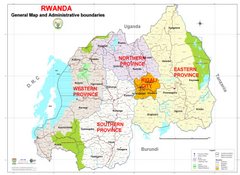
Administrative map